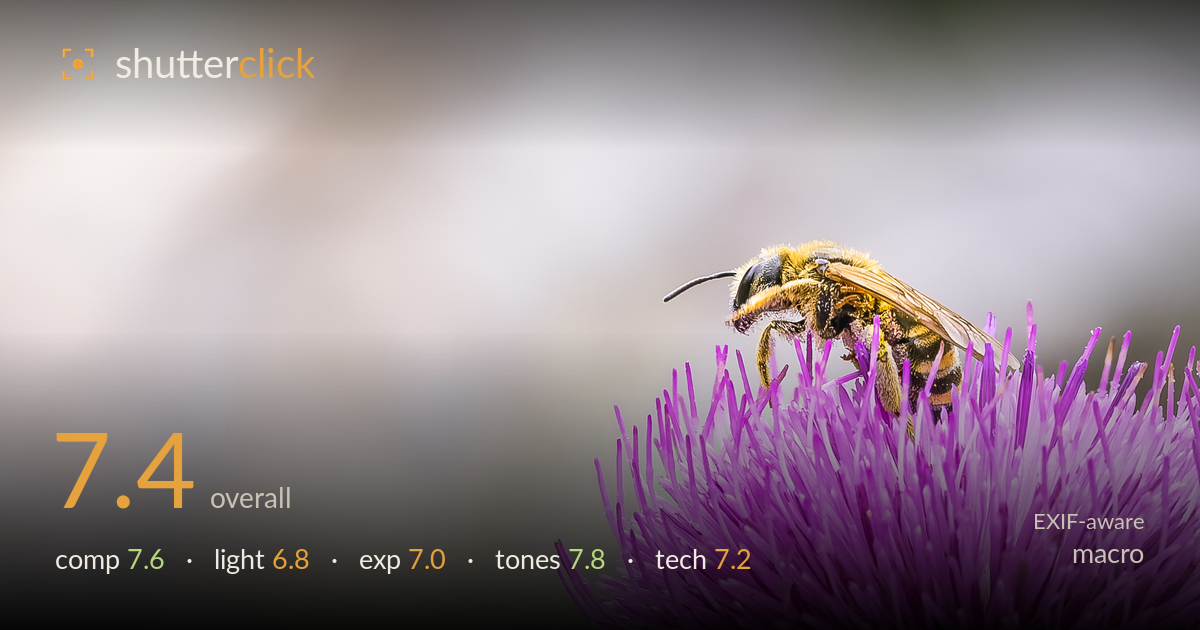
A bee on a magenta thistle
Photo by Kresimir Jukic

| Focal length | 250 mm |
| Aperture | f / 9.0 |
| Shutter | 1/400 s |
| ISO | ISO 800 |
| Exp. comp. | 0.0 EV |
| Shot at | 08:42 · Jun 9, 2024 |
A clean, well-timed macro of a bee working a thistle, carried by a strong colour relationship between the magenta bloom and the golden insect. The generous negative space to the left gives the subject room to breathe and reads as deliberate. What most holds it back is the focus plane: the near wing and thorax carry sharpness but the eye and head sit slightly soft, and in this genre the eye is where the shot lives or dies. The flat, diffuse light also limits texture on the bee's fur. Both are addressable with a touched-up focus point and better light angle.
The placement works well — the bee and bloom anchored to the right third with a broad sweep of soft negative space opening to the left, giving the subject a natural direction to face into. The thistle's radiating spikes form a pleasing base, and the diagonal of the flower head leads the eye up to the insect. The subject sits a little high and tight against the top edge; a fraction more headroom would relieve that crowding. Overall a confident, uncluttered arrangement that lets the subject dominate.
The light is soft and even, likely open shade or overcast, which keeps highlights on the bee's body from blowing and renders the magenta petals cleanly. That softness is also the limitation: it flattens the fine hairs on the thorax and abdomen that a more raking, directional light would separate and sculpt. There is no strong catchlight in the eye, which mutes the sense of a living subject. A low side light would add dimensionality and texture across the bee's surface.
Exposure is well judged for a high-key treatment. The bright, near-white background holds without clipping to pure paper across most of the frame, and the bee's midtones sit at a readable brightness. Shadow detail in the darker abdomen bands is retained. The overall high-key balance is airy rather than accidental, which suits the subject. A touch more exposure on the bee itself, or a subtle local lift, would open the shaded underside where detail edges toward murky.
The colour is the standout — the saturated magenta of the thistle plays against the warm gold and amber of the bee for a vivid complementary pairing, and neither channel tips into oversaturation or clipping. White balance is neutral and the background greys and creams stay clean. Contrast is gentle, matching the high-key mood without going flat. The magenta is pushed near its limit; a slight pull in saturation would protect the finest petal-tip gradations from blocking up.
At 250mm, f/9, 1/400s and ISO 800, the settings are sensible for a hand-held reach macro. The shutter froze the bee cleanly with no motion blur, and ISO 800 keeps noise negligible in the smooth background. f/9 was a reasonable compromise for depth at this magnification, but at this distance the plane of focus still lands on the near wing and thorax rather than the eye and head, which read slightly soft — the critical failure point for an insect portrait. Focus stacking is impractical on a live subject, so the fix is placing the single focus point precisely on the eye and, if the light allows, stopping to f/11–f/13 to extend the plane forward. The zoom lens delivers acceptable sharpness where focus lands but lacks the bite of a dedicated macro; a tripod or monopod would also steady framing at this focal length. Solid execution overall, undone mainly by focus placement.
What would elevate it
Tags
Shot something like this?
Expert photo critique, on demand — scored across six categories, EXIF-aware. Start with 3 free critiques, no credit card.
critique my photo — free