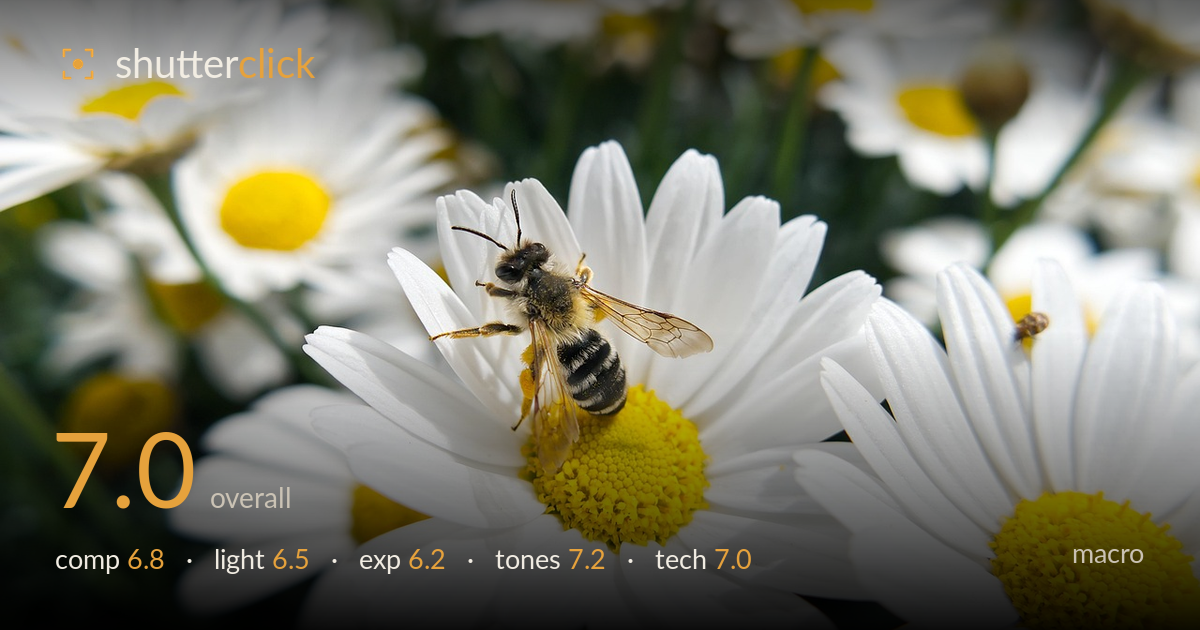
A bee resting on a daisy
Photo by ProsaClouds

No EXIF metadata in this file
Technical analysis based on visual assessment only.
A clean, well-timed capture of a bee on a daisy, with the striped abdomen and translucent wing venation rendered crisply enough to hold attention. The main flower's yellow disc anchors the frame and the surrounding blooms build depth. What most holds it back is exposure on the white petals — the brightest highlights push toward clipping in the direct sun, flattening some petal detail. The bee also sits slightly high in the flower, and the busy field of competing daisies pulls the eye. A moment of softer light and a touch of exposure restraint would let the delicate insect texture carry the shot fully.
The bee reads clearly against the white petals, and the yellow disc directly beneath it forms a natural pedestal. The surrounding daisies build layered depth and context. The subject placement, however, sits marginally high and left of the central flower, leaving the lower disc dominant while the bee competes for attention. The frame is also busy — multiple daisies at varying focus draw the eye outward. A tighter framing that isolates the bee-and-flower pairing, with the disc lower in the frame, would concentrate the visual weight where it belongs.
Bright, direct midday sun lights the scene, giving strong separation between the dark bee and the white petals and lighting the wing to reveal its venation. But hard overhead light is unforgiving on white subjects — the petals catch specular hotspots and the shadows fall harshly across the bloom. The fine fuzz on the bee's thorax would show more dimension under softer, more raking light. Diffused light, or an overcast moment, would tame the highlights and let the delicate textures read with more gradation.
Exposure is generally close, holding the bee's midtones and the yellow disc well. The white petals, however, sit at the edge of clipping under direct sun, and the brightest areas in the upper flowers lose subtle petal structure. Bringing exposure down roughly a third to half a stop would preserve highlight detail while keeping the bee readable. The darker background greenery retains adequate shadow information. Overall the balance leans slightly bright, sacrificing the finer tonal steps in the whites that macro rewards.
The white-yellow-green palette is clean and naturally cheerful, with accurate white balance and no obvious cast. The yellow disc is saturated but believable, and the green background provides a calm contrast to the bright blooms. Contrast is a touch high from the hard light, which crushes some petal gradation at the extremes. The bee's tonal separation — dark thorax, striped abdomen, amber legs — reads well. A gentler tone curve would recover subtlety in the highlights without dulling the overall brightness.
Focus lands accurately on the bee, with the striped abdomen, thorax fuzz, and wing venation resolved sharply — the critical plane for a macro of this kind. Depth of field is shallow enough to soften the background daisies into pleasant context while keeping the insect crisp, a sensible balance for the subject size. The near petals and disc hold acceptable sharpness, though the plane of focus is narrow, so parts of the flower drift soft. Noise is not a factor in this bright light, and there is no visible motion blur, suggesting a shutter speed fast enough to freeze the subject. The main technical limitation is not the capture but the light interacting with exposure — the whites carry little margin. A slightly smaller aperture would have extended the sharp zone across the bee and the flower head together, and focus stacking would let both the insect and the full bloom render crisply. As executed, the focus discipline is the standout strength.
What would elevate it
Tags
Shot something like this?
Expert photo critique, on demand — scored across six categories, EXIF-aware. Start with 3 free critiques, no credit card.
critique my photo — free