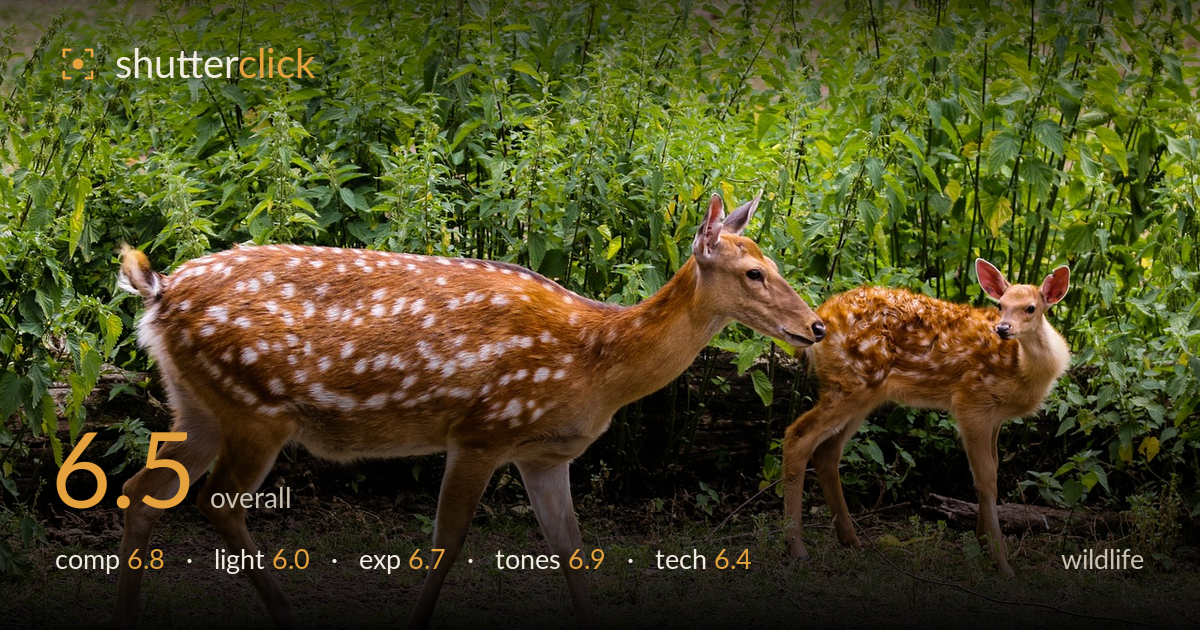
A doe and her fawn
Photo by garten-gg

No EXIF metadata in this file
Technical analysis based on visual assessment only.
A tender pairing of a doe and fawn that reads clearly and tells a small story of maternal proximity. The two animals face each other across the frame, and the spotted coats stand out well against the green backdrop. What most holds the image back is the busy, near-uniform vegetation behind the subjects, which flattens depth and competes with the fine spotting. The light is flat overcast, so the coats lack modeling and the eyes have no catchlights. The fawn's head is the strongest element; the doe's face is slightly soft. A cleaner background and lower angle would lift this from record shot to a genuinely compelling wildlife frame.
The two animals are well placed, the doe filling the left half and the fawn anchoring the right, with their facing heads creating a connecting line across the frame. Both stand fully within the frame with adequate room. The hedge of nettles runs as an unbroken band, giving little separation and no sky or depth cue. The foreground of trampled grass is dead space. A lower shooting position and a gap in the background would have given the subjects more air and dimensionality.
Flat, diffused overcast light dominates. It renders the spotted coats evenly and avoids harsh clipping, which suits the delicate white markings, but it gives no directionality to model the forms and leaves the eyes without catchlights. The fawn's face and the doe's flank sit in the same tonal register as everything else, so nothing pops forward. Softer light is forgiving for detail but here it robs the scene of drama. Early or late side light would have carved shape into the coats.
Exposure is handled competently for the flat conditions. The white spots retain detail rather than blowing out, and shadow areas under the bellies and in the vegetation hold information. Midtones on the coats are placed well and read naturally. The overcast sky keeps dynamic range compressed, so there is little risk of clipping, and the histogram would sit comfortably in the middle. Nothing is dramatically off; the image simply lacks the tonal punch that stronger light would allow it to hold.
White balance is neutral and believable, with the warm tan of the coats reading true against saturated greens. Contrast is on the low side, a direct product of the flat light, which keeps the overall look a touch muted. The greens are lush without oversaturation, and the reddish tones in the fawn's ears and the doe's face are pleasant. A modest contrast lift and a small clarity boost on the coats would separate the subjects from the green wall behind them and add bite.
Focus lands most convincingly on the fawn's head, where the eye and ear detail are crisp, while the doe's face appears a fraction soft, suggesting the plane of focus favored the closer or better-lit animal. Depth of field looks moderate: both animals are acceptably sharp but the background nettles remain busy rather than melting away, so subject separation is weak. A wider aperture or longer focal length would have thrown that hedge into softer blur. Noise is not a concern in this daylight exposure, and there is no visible motion blur, so shutter speed was sufficient for the slow-moving subjects. The framing is at the animals' own height, which flattens perspective; a lower stance would have added intimacy. Overall the execution is clean and technically sound, but the choices err toward documentation rather than isolation. Prioritizing sharp focus on the doe's eye and using depth of field to suppress the background would elevate the result.
What would elevate it
Tags
Shot something like this?
Expert photo critique, on demand — scored across six categories, EXIF-aware. Start with 3 free critiques, no credit card.
critique my photo — free