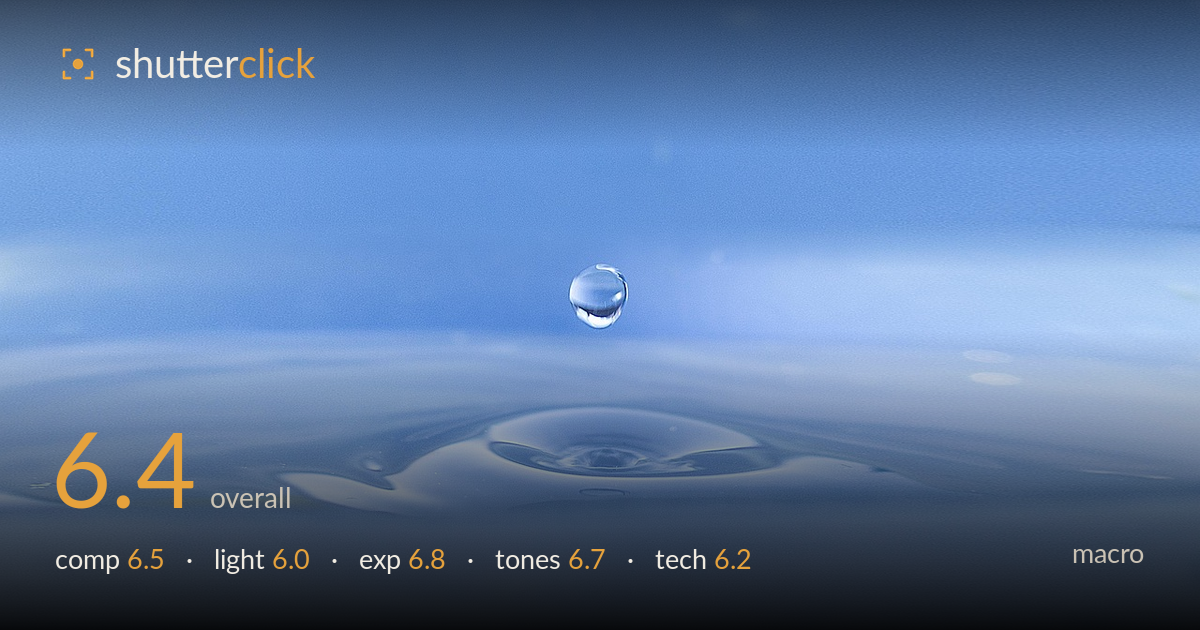
A droplet above still water
Photo by fernandozhiminaicela

No EXIF metadata in this file
Technical analysis based on visual assessment only.
A cleanly captured water-drop moment, with the suspended droplet frozen above the disturbed surface and the concentric rings reading clearly. What holds it back most is timing and focus precision: the droplet, the real subject, sits slightly soft while the surface impact carries some of the sharpest detail, splitting the eye between two focal points. The composition places the drop near the upper centre with a lot of quiet water below, which reads calm but leaves the frame slightly bottom-heavy. The monochromatic blue is pleasant but flat. A crisper drop and warmer or more directional light would lift this from competent to striking.
The droplet sits high and near centre, with the impact crater directly below forming a vertical relationship that works. The concentric ripples add rhythm and lead the eye outward. However, the lower third is largely empty, undifferentiated water, making the frame feel bottom-heavy and the negative space passive rather than purposeful. Placing the droplet on a stronger intersection, or cropping some dead water from the bottom, would tighten the balance. The horizontal ripple bands running across create pleasant layering that partly redeems the emptiness.
The light is soft and diffuse, giving even, gentle rendering across the surface and a smooth gradient in the background. That softness keeps the scene clean but also flattens the droplet, which needs a small hard specular highlight to read as glassy and dimensional. Right now the drop shows only a faint tonal shift rather than a crisp catchlight. A single directional light or a bright window reflection placed to glint off the sphere would give it sparkle and separate it from the similarly toned background.
Exposure is well controlled for a high-key subject. Highlights on the ripple crests stay bright without clipping to pure white, and the mid-tones hold the subtle surface modelling. Nothing is buried in shadow, which suits the airy blue mood. The droplet itself sits at a sensible brightness, though it competes tonally with the background rather than standing apart. Overall the histogram appears to sit high but safely, a deliberate and appropriate reading for this bright, minimal water study.
The image is essentially monochromatic blue, cool and consistent, which lends a calm, clinical feel appropriate to a water study. White balance leans distinctly cold; a touch more neutrality or a subtle warm accent would add interest. Tonal separation is the weak point: the droplet, the ripples, and the background all share such close blue values that contrast is low and the subject struggles to pop. A faint colour or tonal contrast between drop and surface would give the frame more depth and dimension.
The frozen droplet suggests a fast shutter or flash was used effectively, and motion is well arrested with no smearing on the suspended sphere or the moving surface. The main technical shortfall is focus placement: the sharpest detail appears to fall on the impact crater and near ripples, while the airborne droplet, the intended hero, reads slightly soft. In macro water work the plane of focus is razor-thin, so pre-focusing on the exact drop position is critical. Depth of field looks reasonably shallow, which is fine, but it means the drop and surface can't both be crisp at once, making focus choice decisive. Image quality is clean with no obvious noise, and the sensor handled the bright tones without artefacts. A slightly smaller aperture would extend depth of field to cover both the drop and the crater, or careful timing so the drop sits exactly in the focal plane would resolve the split. Sharpness on the ripples confirms the optics are capable.
What would elevate it
Tags
Shot something like this?
Expert photo critique, on demand — scored across six categories, EXIF-aware. Start with 3 free critiques, no credit card.
critique my photo — free