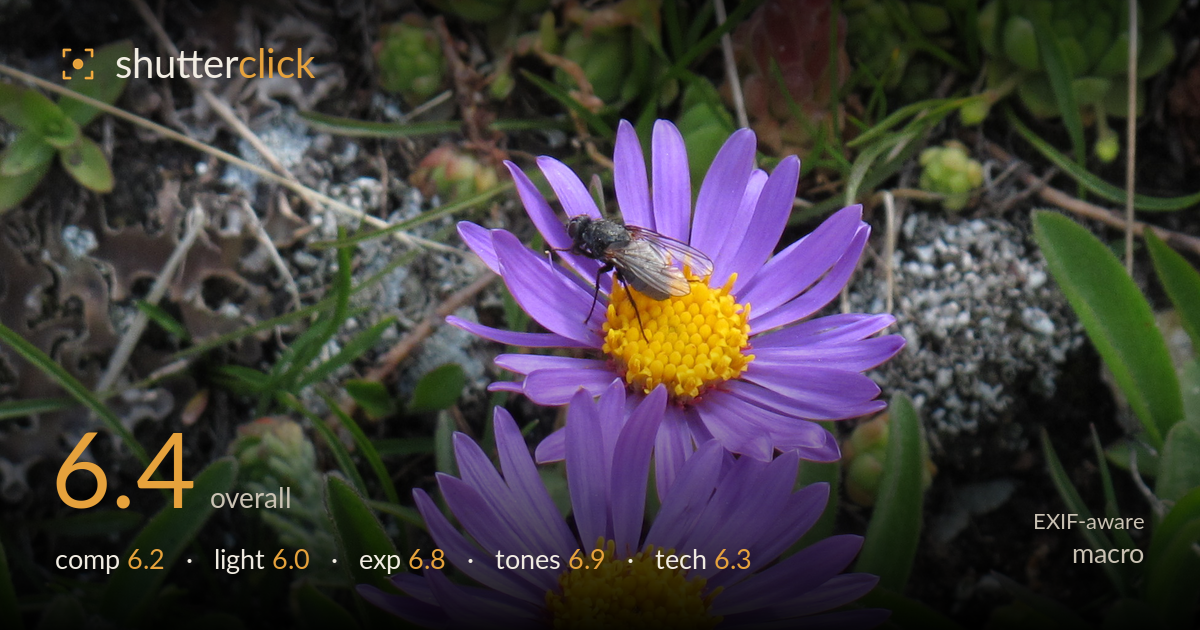
A fly on an alpine aster
Photo by Robert Flogaus-Faust

| Focal length | 31 mm |
| Aperture | f / 6.3 |
| Shutter | 1/200 s |
| ISO | ISO 200 |
| Exp. comp. | -0.67 EV |
| Shot at | 11:58 · Aug 10, 2010 |
Two alpine asters with a fly perched on the upper bloom's disc make a serviceable field record with genuine appeal in the colour and the small moment the insect provides. What most holds the frame back is that neither the fly nor the flower centres sit crisply sharp — the plane of focus lands loosely across the blooms, and the busy tangle of grass, lichen and soil competes hard for attention. The vertical stacking of the two flowers reads more as a snapshot alignment than a deliberate arrangement. Cleaner focus on the fly and a simpler background would lift this considerably.
The two flowers stacked vertically create a reasonable diagonal pull, and the fly on the upper bloom gives the eye a natural entry point. But the lower flower dominates centre-frame while the top one is partly cut, leaving the balance uneven. The background is a restless mix of grass, lichen and bare soil that pulls attention from the subjects. The small purple bud lower centre adds a nice secondary note. A framing that isolated one flower with its visitor, against calmer surroundings, would carry far more force.
Flat, overcast light keeps the petals evenly lit and avoids blown highlights on the pale purple, which suits the delicate hue. The trade-off is a lack of modelling — the flowers and the fly sit without much dimensional shaping, and the yellow disc florets never get the raking light that would reveal their fine texture. Shadows are soft and open, which reads as gentle but also a little lifeless. A touch of directional side light, or shooting when a break in cloud gave low-angle sun, would add depth.
The -0.67 EV compensation was a sound call — it protects the bright yellow centres and the pale purple petals from clipping, and the histogram sits comfortably without crushed shadows in the darker soil patches. Overall brightness reads accurate for the overcast conditions. The petals retain gradation rather than washing out. If anything the darker background areas swallow some detail, but that helps rather than hurts subject separation. A deliberate, well-judged exposure that leaves the important tones intact.
The purple-yellow complementary pairing is the strongest asset here, and white balance renders both convincingly under flat light without a colour cast. Greens in the foliage stay natural rather than oversaturated. Contrast is a little muted, which is faithful to the conditions but leaves the image feeling slightly soft overall. The petal purples hold subtle tonal variation. A modest contrast and clarity lift in post would give the blooms more presence against the background without pushing the colours into artificiality.
At f/6.3, 1/200s and ISO 200 on the G11, the settings are reasonable for the conditions, but the small sensor and moderate aperture leave depth of field spread thinly across two flowers on different planes — the result is that neither the fly nor the disc centres land tack-sharp, and macro work lives or dies on that precision. The fly, the most compelling element, is the very thing that needed critical focus and doesn't quite have it. A narrower aperture would have deepened the plane, though diffraction on this sensor sets a practical limit, making focus stacking the better route for two blooms at different distances. 1/200s was fast enough to freeze both the flowers and the fly. ISO 200 keeps noise well controlled. Focus accuracy, not exposure or motion, is the limiting factor. Placing the focus point deliberately on the insect's eye, and stopping down or stacking to hold both discs, would transform the sharpness.
What would elevate it
Tags
Shot something like this?
Expert photo critique, on demand — scored across six categories, EXIF-aware. Start with 3 free critiques, no credit card.
critique my photo — free