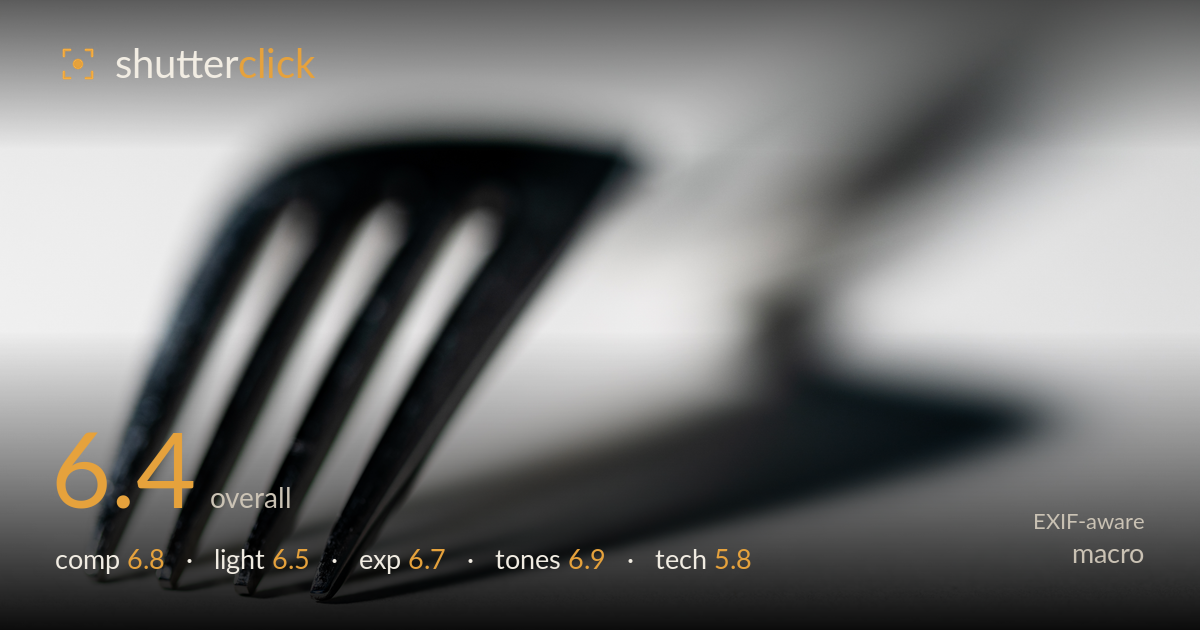
A fork standing on its tines
Photo by Dietmar Rabich

| Focal length | 105 mm |
| Aperture | f / 2.8 |
| Shutter | 1/15 s |
| ISO | ISO 100 |
| Exp. comp. | 0.0 EV |
| Shot at | 09:13 · Apr 11, 2021 |
A clean, minimal study of a fork standing on its tines, carried by strong negative space and a graphic silhouette against pale grey. The concept is sound and the restraint reads as deliberate. What holds it back is focus placement: the sharp plane sits on the front two tine tips rather than the fuller face of the fork, so the strongest graphic element — the tines and their curved bowl — dissolves into softness. For a macro at f/2.8 and 105mm, the depth of field is razor-thin and the image needs its plane of focus decided with more intent. A touch more of the fork rendered crisp would elevate this considerably.
The lone fork standing upright is a strong minimalist idea, and the generous negative space to the upper right gives the shape room to breathe. The tines fan out as a natural set of leading lines toward the lower-left corner. Placement leans a little low and left, crowding the bottom edge where tine tips nearly touch the frame. A hair more breathing room beneath the tips, and pulling the fork marginally toward centre, would balance the heavy empty field above. The diagonal footprint of the shadow adds welcome anchoring weight.
Soft, diffuse light keeps the mood quiet and the grey ground even, appropriate for a minimal still life. The single soft shadow trailing to the right grounds the object and adds a graphic secondary shape. However, the lighting is flat on the fork itself — the metal reads mostly as a dark silhouette with little of the specular highlight that gives cutlery its character. A raking side light would catch the tine edges and reveal the brushed or polished surface, turning a flat shape into something with dimension and material presence.
Exposure is well judged for the high-key intent. The grey background holds clean, gradated tone without clipping, and the shadow beneath the fork retains detail rather than crushing to black. The dark metal sits deep but never blocks up completely — some structure survives in the tines. The overall placement reads deliberate rather than accidental. If anything, a slight lift could brighten the ground to near-white for a cleaner high-key look, but the current balance is safe and controlled. Histogram sits comfortably without either extreme in danger.
The near-monochrome grey palette suits the subject and reinforces the minimal, quiet mood. White balance is neutral and clean, with no unwanted colour cast in the background. Contrast between the dark fork and pale field is strong and reads graphically. The tonal gradation across the background is smooth and pleasing. The metal itself could use a little more tonal separation — right now it flattens into near-black, losing the mid-tone modeling that would show it as metal rather than shadow. Otherwise the restraint here works well.
This is where the image struggles most. At 105mm and f/2.8 on full frame, the depth of field is extremely shallow for a subject this close, and the plane of focus has landed on the two front tine tips rather than the broader body of the fork. The result is that most of the graphic shape — the curved bowl and the fuller run of tines — falls into soft blur, undercutting the very structure the composition relies on. Stopping down to f/8 or f/11, or better, a focus stack of several frames, would carry the whole fork sharp while keeping the background soft. The 1/15s shutter at ISO 100 is fine on a tripod for a static subject, and the low ISO keeps the file clean and noise-free, which is exactly right. The lens choice is appropriate for macro. The core fix is depth-of-field management: this subject needs its focus plane deliberately placed and enough aperture to render the key form crisp.
What would elevate it
Tags
Shot something like this?
Expert photo critique, on demand — scored across six categories, EXIF-aware. Start with 3 free critiques, no credit card.
critique my photo — free