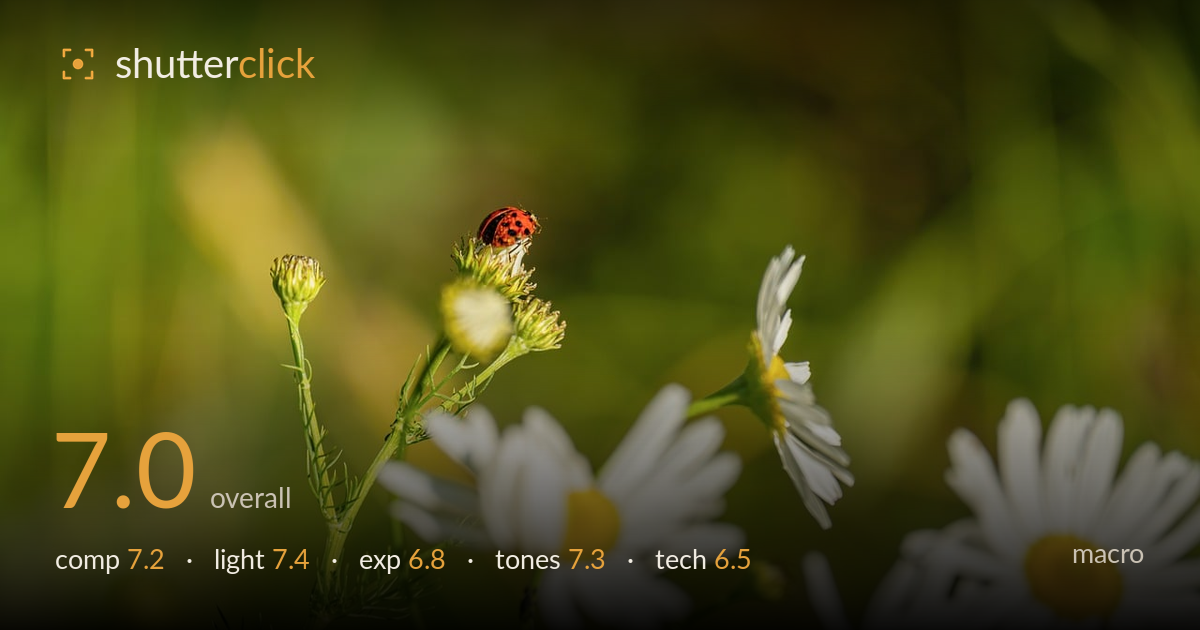
A ladybird on a wildflower bud
Photo by Couleur

No EXIF metadata in this file
Technical analysis based on visual assessment only.
A ladybird perched atop an unopened bud carries this frame, and its placement in the upper-left third gives the eye a clear entry point against a soft green field. The bud-and-insect cluster is the strongest element, but focus lands more convincingly on the surrounding buds than on the ladybird itself, which softens the payoff of the whole shot. The daisies at right add colour balance yet compete for attention and sit largely out of the plane of focus. Beautiful ambient light and clean bokeh do a lot of work here; sharper placement of the focal plane on the beetle would elevate it.
The ladybird on the bud is well positioned near an upper-left intersection, and the diagonal green stems create pleasing structure and lead the eye upward. The white daisies at right add colour contrast and balance the weight of the frame. However, the composition is slightly split between two competing subjects — the insect cluster and the daisy grouping — which dilutes focus. Tightening in on the ladybird, or letting the daisies fall further into soft suggestion, would give the frame a single clear anchor rather than two.
Soft, warm side light rakes across the scene, giving the buds and stems gentle dimensional modelling without harsh shadows. The backlighting through the daisy petals lends a delicate translucence, and the diffused quality keeps the green background luminous rather than muddy. The ladybird's shell catches just enough light to register its gloss. The overall direction works well for the botanical subject; a touch more light striking the ladybird directly would have made it pop against the bud instead of sitting in comparative shade.
Exposure is generally well judged, holding detail in the bright white petals without significant clipping — impressive given how easily daisies blow out. Midtones in the green foliage sit comfortably and the ladybird retains its red saturation. The brightest daisy edges push close to the highlight ceiling but stay recoverable. Shadow areas within the flower centres remain readable. The balance leans slightly bright overall, which suits the airy meadow feel, though a hair more restraint on the highlights would preserve extra petal texture.
The green-and-white palette is fresh and cohesive, with warm golden hints in the background adding depth without turning garish. White balance reads accurate — the whites are clean and the greens natural rather than yellow-cast. Contrast is gentle and appropriate for the soft, high-key mood. The yellow daisy centres provide a welcome accent that echoes the warm background. Saturation is restrained and believable. A slightly cooler treatment in the shadows could add separation, but the current grade suits the subject well.
Depth of field is very shallow, which produces the creamy background that makes this image work, but it also exposes the central weakness: the sharpest plane appears to fall on the lower buds and stems rather than on the ladybird, the intended star. The insect's shell and legs read soft where crisp detail would reward the viewer most. For macro, focus precision on the key subject is everything, and here it lands just short. The daisies are almost entirely out of focus, which is fine as supporting elements but leaves the frame without a truly tack-sharp anchor. Noise is well controlled and the rendering is clean. The lens delivers attractive bokeh with smooth transitions and no distracting outlining. A narrower aperture, or focus stacking a few frames, would have brought the ladybird fully sharp while retaining enough background softness. Careful manual focus on the beetle's eyes and pronotum, or a focus rail for fine adjustment, would close the gap between a pleasant shot and a compelling one.
What would elevate it
Tags
Shot something like this?
Expert photo critique, on demand — scored across six categories, EXIF-aware. Start with 3 free critiques, no credit card.
critique my photo — free