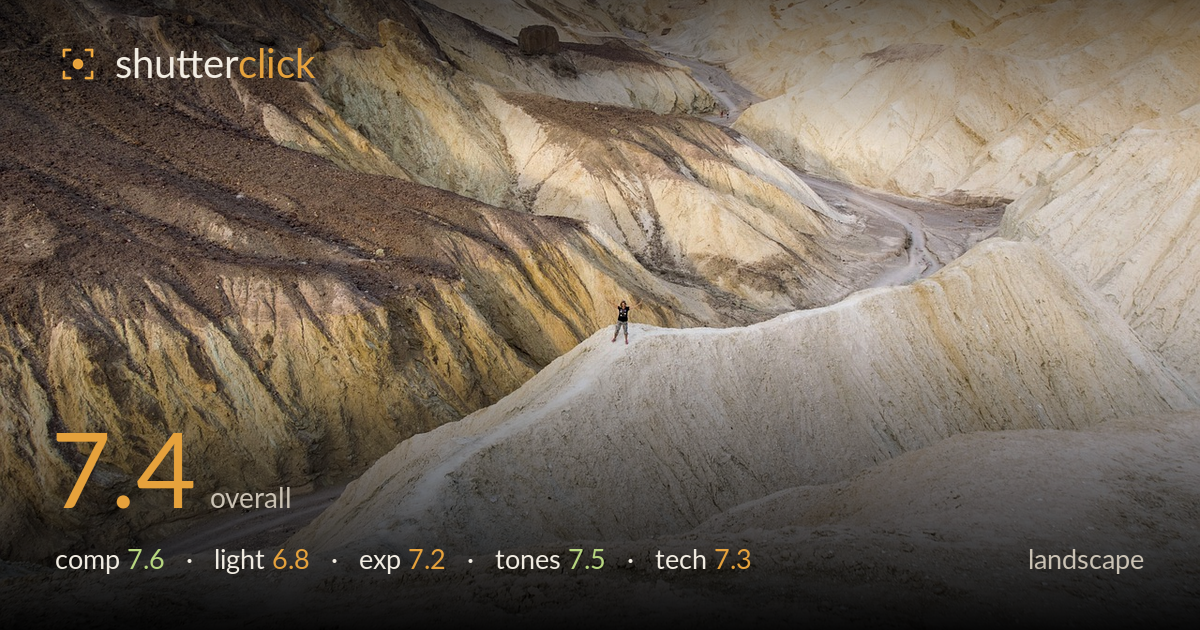
A lone figure in the badlands
Photo by peterperhac

No EXIF metadata in this file
Technical analysis based on visual assessment only.
A strong sense of scale anchors this Death Valley badlands scene — the small human figure arms-raised on the ridge instantly communicates the vastness of the eroded terrain around it, which is the frame's biggest win. The undulating ridgelines and channels create natural depth and movement. What most holds it back is the light: flat, fairly even illumination that leaves the sculpted folds without the raking side light that would carve them into three dimensions. The figure, while a clever scale device, sits a touch small and could read as an accident rather than intent. The colour palette of ochres, greys, and mauves is handled well.
The eroded ridgelines snake through the frame and pull the eye across the terrain, and placing the tiny figure on the central ridge gives the whole scene its sense of scale. The high vantage layers foreground gullies against distant peaks effectively. The figure sits near centre, though, which slightly stalls the dynamism the diagonal ridges set up; positioning it on a thirds intersection would let the lines lead toward it. The soft valley floor visible top-centre adds welcome atmospheric depth to the composition.
The light is the weakest element here. It reads as diffuse and fairly directionless — the badlands folds and channels are visible but not sculpted, missing the low, raking angle that would throw shadows into every crease and reveal the corrugated texture these formations are known for. The warm patch on the upper-right ridge hints at what side light could do across the whole scene. Shooting closer to sunrise or sunset, with the sun grazing across the ridges, would transform the depth and drama dramatically.
Exposure is well controlled across a tricky range. The bright, pale ridges hold detail without clipping, and the darker mauve slopes on the left retain texture rather than blocking up. The distant valley floor stays legible. Midtones sit comfortably and the overall brightness feels natural for the conditions. There is a slight flatness that stems more from the light than the exposure itself, but the tonal information is all present and would respond well to a modest contrast lift in post.
The colour palette is the scene's quiet strength — soft ochres, creams, dusty mauves, and greenish-grey seams in the rock all read cleanly, and white balance sits neutral without an unwanted cast. The gradation between the pale sun-facing ridges and the shadowed slopes is smooth. Saturation is restrained and believable for desert badlands. A touch more separation between the warm and cool tones, or a gentle contrast boost, would give the mineral banding more presence without tipping into artificiality.
The image appears sharp across the frame, with the near foreground detail and the distant ridges both well resolved, suggesting a sensible aperture for landscape depth of field and accurate focus. Noise is not an issue in the shadow areas, indicating a low ISO and good light-gathering. The wide focal length suits the sweeping terrain and captures the layering from foreground gullies to background peaks without obvious distortion. The tiny figure on the ridge, while intentional as a scale device, is small enough that a longer look is needed to register it — a slightly tighter framing or a moment when the figure is more prominently silhouetted against a lighter background would help it read instantly. Overall execution is clean and technically assured; nothing here undermines the image on a craft level, and the main gains lie in timing the light rather than adjusting settings.
What would elevate it
Tags
Shot something like this?
Expert photo critique, on demand — scored across six categories, EXIF-aware. Start with 3 free critiques, no credit card.
critique my photo — free