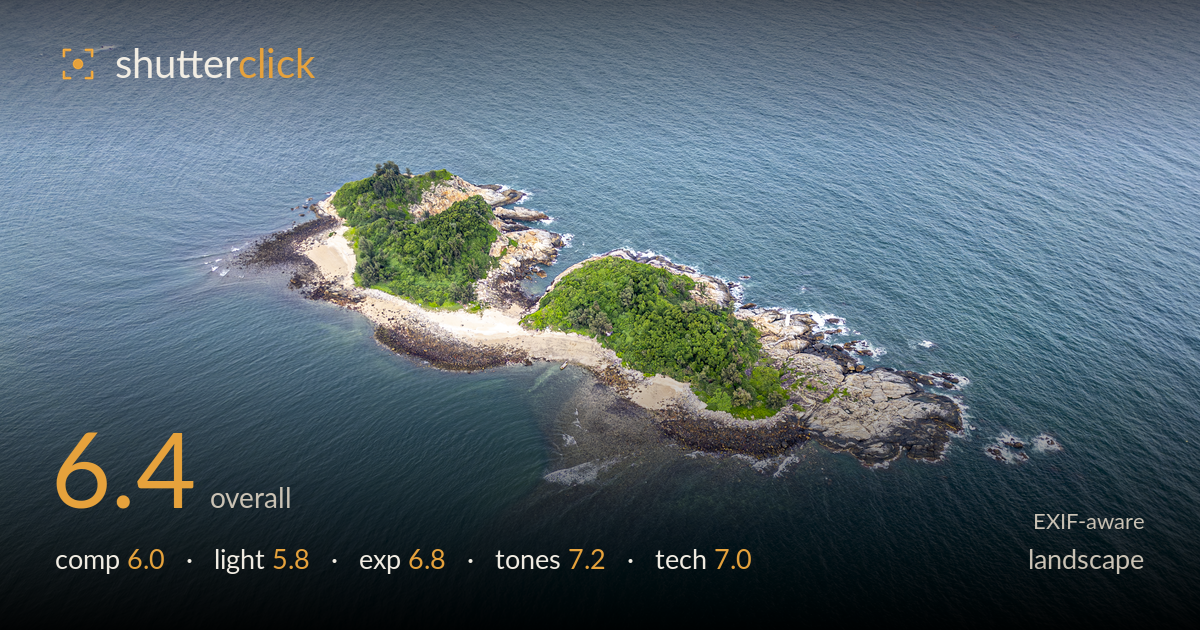
A lone island in blue water
Photo by YikyuenG

| Focal length | 7 mm |
| Aperture | f / 1.7 |
| Shutter | 1/250 s |
| ISO | ISO 100 |
| Exp. comp. | 0.0 EV |
| Shot at | 18:20 · Jul 15, 2025 |
An isolated island rendered small in a vast sea — the drone vantage delivers the sense of scale that defines the frame, but the subject sits too centrally and the light is flat. The turquoise shallows and the contrast of green canopy against deep blue water are the real assets, and the underwater reef shadow trailing off the sandbar adds a welcome secondary interest. What holds it back is midday overhead light with no directional modelling, and a subject placed close to dead centre that leaves the surrounding water reading as filler rather than deliberate negative space. Timing and framing are the levers here.
The island reads clearly against the open water, and the diagonal orientation of the landmass gives the frame some dynamism. But the subject sits close to the centre of the frame, and the surrounding sea, while vast, functions more as empty filler than intentional negative space. The underwater reef and sandbar trailing toward the lower left offer a natural leading element that is underused. Placing the island on a thirds intersection and letting that reef line lead the eye in would build a stronger, more purposeful arrangement.
The light is high and largely overhead, flat and even across the scene. It renders the water colour cleanly and keeps the canopy legible, but there is little directional modelling to give the rocks and terrain dimension — the island reads flat rather than sculpted. Midday aerials often struggle with this. Softer, lower light from golden hour would rake across the rocks and vegetation, revealing texture and casting the island's own shadow across the water for depth and a stronger sense of form.
Exposure is well controlled. The bright sandbars and the white water breaking over the reef hold detail without clipping, and the deep blue water in the lower frame retains tonal separation rather than blocking up. The overall brightness sits comfortably, with no meaningful loss at either end of the histogram. If anything the sea reads slightly hazy toward the top, a limitation of atmospheric conditions rather than metering. A deliberate, balanced exposure that serves the scene well.
The colour is the strongest element — the gradation from pale turquoise shallows to deep teal open water is rich and believable, and the saturated green canopy pops against it without tipping into garishness. White balance is neutral and the tonal range is broad. The upper sea shows some atmospheric haze that flattens contrast slightly toward the horizon. A touch of dehaze or a modest contrast lift in the far water would sharpen the separation between water zones and strengthen the overall depth.
The DJI drone was handled well for the conditions. ISO 100 keeps noise negligible and preserves the clean rendering of the water gradients, and 1/250s comfortably freezes any drone vibration and the moving water at this altitude. Focus sits accurately on the island, which is sharp across its extent. The fixed f/1.7 aperture is the sensor's native optimum for this small format at this distance — depth of field is irrelevant at aerial scale, so it poses no problem here. The 7mm (roughly 24mm equivalent) wide field suits the expansive seascape and the isolated subject. Detail on the rocks and canopy is respectable given the compact sensor, though fine texture softens toward the frame edges, a characteristic of this lens class. Overall the capture is technically clean and free of the exposure or motion errors that commonly plague drone work; the settings were appropriate and the execution reliable.
What would elevate it
Tags
Shot something like this?
Expert photo critique, on demand — scored across six categories, EXIF-aware. Start with 3 free critiques, no credit card.
critique my photo — free