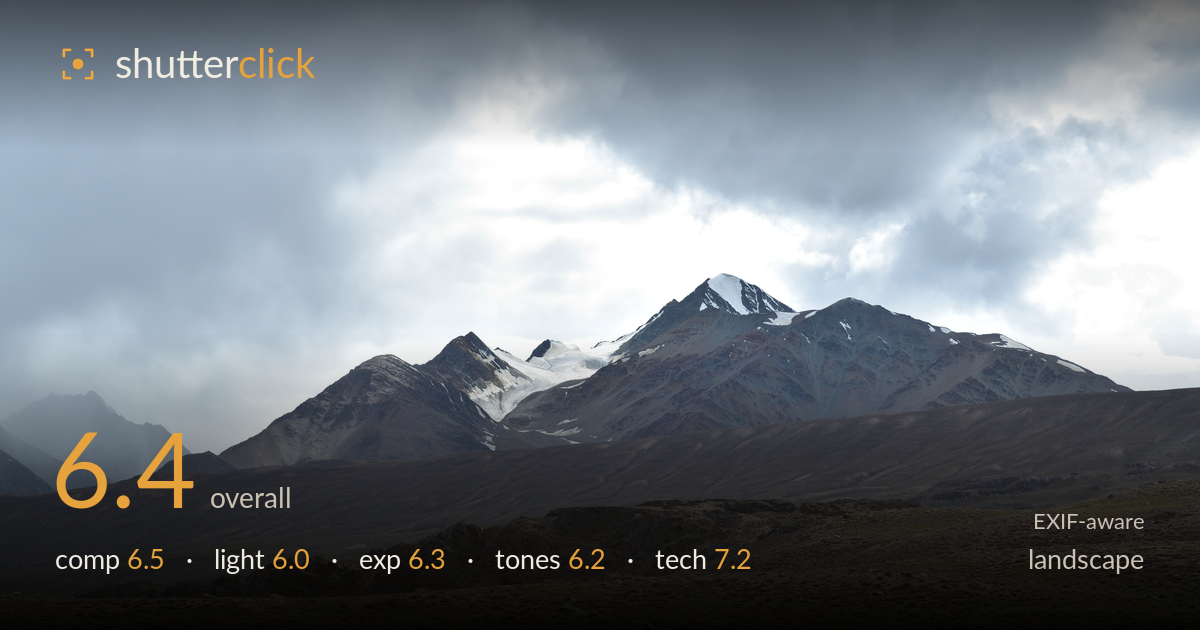
A lone tent beneath snowy peaks
Photo by Adarsh Patel

| Focal length | 55 mm |
| Aperture | f / 8.0 |
| Shutter | 1/500 s |
| ISO | ISO 200 |
| Exp. comp. | 0.0 EV |
| Shot at | 15:03 · Sep 10, 2021 |
A grand mountain range anchors this frame, and the small green tent lower right introduces welcome human scale that reads as the emotional heart of the scene. What most holds the image back is a heavy, flat-lit sky that occupies over half the frame without adding drama, and a mid-ground band of dun-coloured hillside that stalls the eye between the tent and the peaks. The three-part layering — meadow, ridge, mountains — has real depth, but the tonal separation is muted and the light is diffuse. Stronger light and a tighter sky-to-land ratio would elevate this considerably.
The layered structure works — foreground meadow, dark rocky ridge, and the snow-dusted range build genuine depth. The tent placed low and right gives scale and a resting point for the eye, though it sits a touch small and isolated. The sky claims more than half the frame while offering little in return, pushing the peaks low and flattening the sense of grandeur. A horizon lifted higher, giving the mountains more vertical presence, would strengthen the hierarchy and let the range dominate as the subject deserves.
Overcast, diffuse light dominates, softening the mountains and muting contrast across the whole scene. There is a faint break where brighter cloud spills light onto the central peaks, and that patch of illumination is the strongest lighting moment here. The rain veils to the left add atmosphere. But overall the flat, shadowless quality robs the terrain of the modelling that would reveal the ridgelines and rock texture. Raking side light, or a shaft breaking through the cloud onto the range, would transform this.
Exposure is reasonably judged for tricky mixed conditions. The bright cloud mass holds detail without blowing out badly, and shadow areas in the foreground rock retain information. The overall reading leans slightly flat and low in contrast, an inevitable consequence of the overcast light rather than a metering error. The histogram likely sits bunched in the midtones with little at either extreme. A small negative exposure compensation would have deepened the sky and let the terrain read with more weight against it.
The palette is honest but subdued — cool grey sky, muted browns and ochres in the hillside, and a soft green wash across the meadow. White balance sits neutral and believable. The trouble is a lack of tonal separation: the mid-ground ridge and the mountain bases blur into similar dun values, weakening the depth the composition sets up. A modest contrast lift and selective saturation on the greens and the snow would give the layers cleaner definition and more visual punch.
At 55mm, f/8, 1/500s and ISO 200, the settings are well matched to the conditions. f/8 sits in the lens's sweet spot and delivers front-to-back sharpness appropriate for landscape, keeping meadow, ridge and peaks all acceptably crisp. ISO 200 keeps noise negligible, and 1/500s is more than enough to counter any handheld shake or wind at this focal length — arguably faster than needed, leaving headroom that a lower ISO or smaller aperture could have used, though neither was necessary here. Focus appears set toward the mid-ground and carries adequately. The 55mm framing compresses the scene modestly but keeps the tent small; a slightly longer focal length would have pulled the peaks larger and emphasised the human-scale contrast. Overall the execution is clean and competent — the technical foundation is solid, and the limitations here are about light and composition rather than gear handling. A tripod and lower ISO would matter more if the light demanded a longer exposure.
What would elevate it
Tags
Shot something like this?
Expert photo critique, on demand — scored across six categories, EXIF-aware. Start with 3 free critiques, no credit card.
critique my photo — free