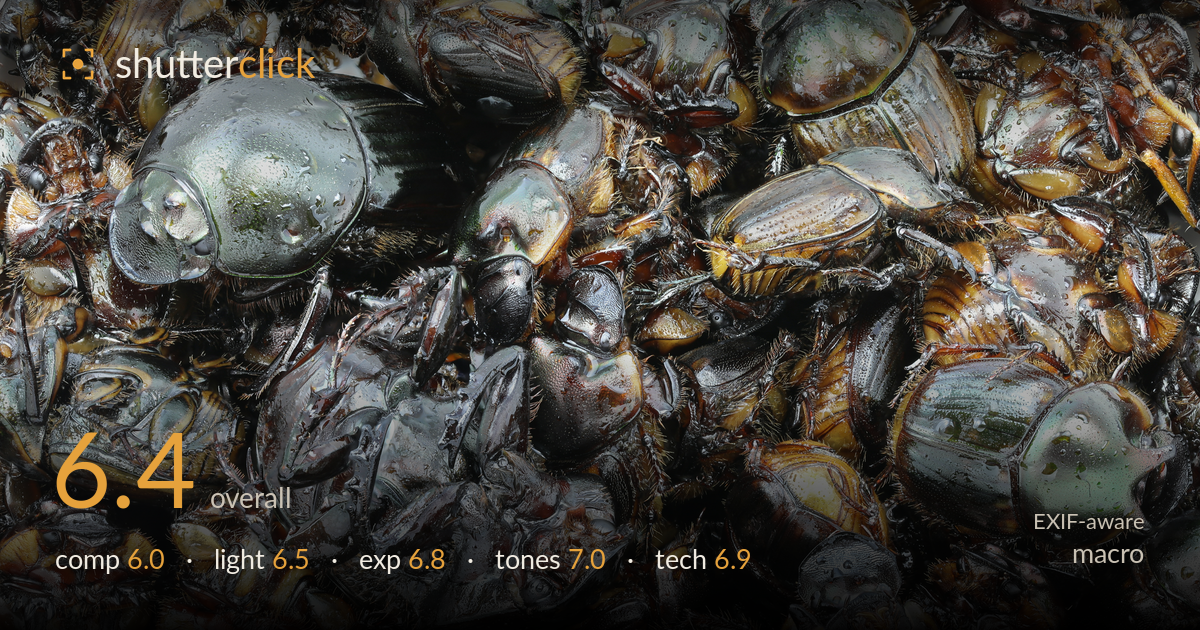
A mass of glossy beetles
Photo by Basile Morin

| Focal length | 100 mm |
| Aperture | f / 9.0 |
| Shutter | 1.6 s |
| ISO | ISO 160 |
| Exp. comp. | 0.0 EV |
| Shot at | 15:23 · May 12, 2018 |
A dense, texture-rich frame of massed beetles that reads more as pattern than as a portrait of any single insect. The iridescent greens and warm amber undersides carry real visual interest, and the wet, glossy surfaces catch light in a way that adds depth. What most holds it back is the lack of a clear anchor: the eye wanders across a uniform field without a resting point, and the shallow plane of focus at this magnification leaves much of the pile soft. The large green beetle upper-left is the natural focal candidate but isn't given compositional priority.
The frame works as an all-over pattern of overlapping carapaces, and the sheer density conveys mass effectively. But without a dominant subject the eye has nowhere to settle — every region competes equally. The large iridescent beetle upper-left is the strongest element and would benefit from being weighted more deliberately, whether by placement or by selective focus. The edge crops slice through insects arbitrarily, which suits a texture study but weakens any sense of intentional framing. A stronger diagonal or a single hero specimen would give the chaos an entry point.
Diffused, fairly even light keeps the wet chitin readable and pulls out the metallic greens without blowing the specular highlights on the glossy shells. The soft quality suits the subject and avoids harsh hotspots across a reflective, uneven pile. What's missing is direction — a raking side light would carve the sculptural ridges and hairs into relief and separate one layer from the next. As lit, the mass reads flat in places, and the tonal similarity between overlapping bodies flattens the sense of depth the pile could otherwise show.
Exposure is well controlled for a difficult subject: the glossy highlights on the shells hold detail rather than clipping, and the deep shadows between bodies retain some information without going fully black. The midtones sit comfortably, giving the amber undersides room to glow. A few of the wettest specular points approach clipping but stay within reason. The overall balance looks deliberate, using the full range without crushing the darks that give the pile its depth. A touch more shadow lift would reveal more of the buried detail.
The colour is the strongest element: iridescent green-to-bronze shells play against warm amber and rust undersides, and the wet sheen intensifies the saturation naturally. White balance reads neutral, letting the metallic hues stay convincing rather than tipping orange. Contrast is handled well, with the dark interstices setting off the brighter carapaces. The palette holds together as a cohesive earthy-jewel range. If anything, the tonal similarity across so many bodies reduces separation — slight local contrast on the standout green beetle would help it pull forward from the surrounding mass.
The EF100mm f/2.8L Macro is the right tool, and f/9 is a sensible compromise for extending depth of field across an irregular pile without pushing into heavy diffraction. The 1.6-second exposure at ISO 160 indicates a tripod and static subjects, and that pays off in clean, low-noise files with good detail in the sharp zones — the large green beetle's carapace and the eye detail there are crisp. The limitation is that even at f/9, the plane of focus can't cover a pile with this much depth, so large portions fall soft, and the near-far falloff is abrupt. At this magnification a focus stack of several frames would have been the way to hold sharpness front to back, and given the long exposure and stationary subjects the conditions were ideal for it. Focus placement itself is reasonable, landing on the upper-left specimen, but nothing else in the frame reaches that level of resolution.
What would elevate it
Tags
Shot something like this?
Expert photo critique, on demand — scored across six categories, EXIF-aware. Start with 3 free critiques, no credit card.
critique my photo — free