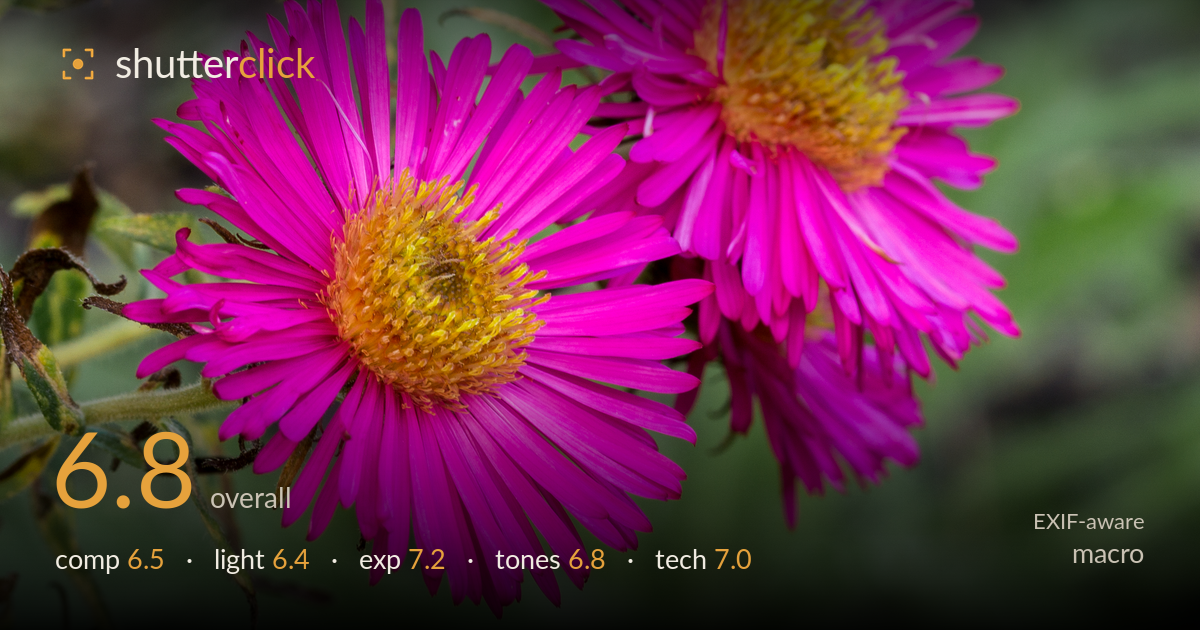
A pair of pink asters
Photo by Agnes Monkelbaan

| Focal length | 60 mm |
| Aperture | f / 11.0 |
| Shutter | 1/6 s |
| ISO | ISO 100 |
| Exp. comp. | 0.0 EV |
| Shot at | 13:45 · Oct 6, 2018 |
A vivid pair of magenta asters with a supporting bud, cleanly separated from a soft green-and-earth background. The colour and the bud's inclusion give the frame narrative interest, and the diagonal stem line ties the elements together. What most holds it back is focus precision: neither of the two main flower centres sits crisply on the sharpest plane, and the softness reads across the golden discs where detail matters most. Light is flat and directionless, muting the petal texture that macro thrives on. Tighter focus placement and raking side light would lift this from pleasant to compelling.
The two open blooms anchor the lower-right two-thirds while the deep-red bud in the top-left adds a useful counterpoint and a sense of the plant's cycle. The diagonal stem creates a natural line connecting them. The lower flower crowds the bottom edge slightly, clipping a few outer petals, and the busy tangle of leaves at far left competes for attention without resolving cleanly. Slightly more breathing room beneath the front bloom and a cleaner left margin would let the two-flower relationship read with less clutter.
The light is soft, even, and shadowless — likely overcast or open shade — which keeps the vivid pink from clipping but leaves the image flat. The petals and the golden central discs lack the directional modelling that reveals their fine radial texture; everything sits on one tonal plane. A low, raking side light would carve out the ribbed petals and the domed floret centres, adding depth. As shot, the rendering is clean but the flowers read as colour more than form.
Exposure is well judged. The saturated magenta petals hold without blowing the red channel, which is easy to clip with this hue, and the yellow centres retain gradation. Shadow areas in the foliage keep detail rather than blocking up. The overall brightness suits the subject and the histogram appears well spread with no meaningful clipping at either end. At ISO 100 the tonal transitions are smooth. Nothing here needs correction — the exposure choices read as deliberate and controlled.
The magenta is intense and true to the aster, and the yellow-to-orange centres provide warm contrast against it. White balance sits slightly cool-neutral, which keeps the greens natural but leans the pinks toward the electric end. The muted olive and earthy background is a restful foil for the saturated subject. Some may find the pink verging on oversaturated, where petal-tip detail begins to flatten into a single block of colour. A small saturation pullback in the magenta channel would recover subtle tonal separation between petals.
f/11 is a sensible choice for depth on a macro subject at this magnification, and ISO 100 delivers clean, noise-free files. The 60mm macro is well suited to the working distance. The weakness is focus placement combined with the 1/6s shutter: at this speed, even slight subject or camera movement softens fine detail, and the golden central discs — where the eye should land sharpest — read soft rather than crisp. Depth of field is adequate to cover both flower faces, but the plane of sharpest focus seems to have fallen between the ideal spots rather than on a floret centre. A tripod with a remote or delay was almost certainly used given the slow shutter, but any breeze on the flowers at 1/6s would blur the petals. Faster shutter with a touch more ISO, or focus stacking, would lock in the detail this subject deserves. Focus precision on the near central disc is the single most impactful fix.
What would elevate it
Tags
Shot something like this?
Expert photo critique, on demand — scored across six categories, EXIF-aware. Start with 3 free critiques, no credit card.
critique my photo — free