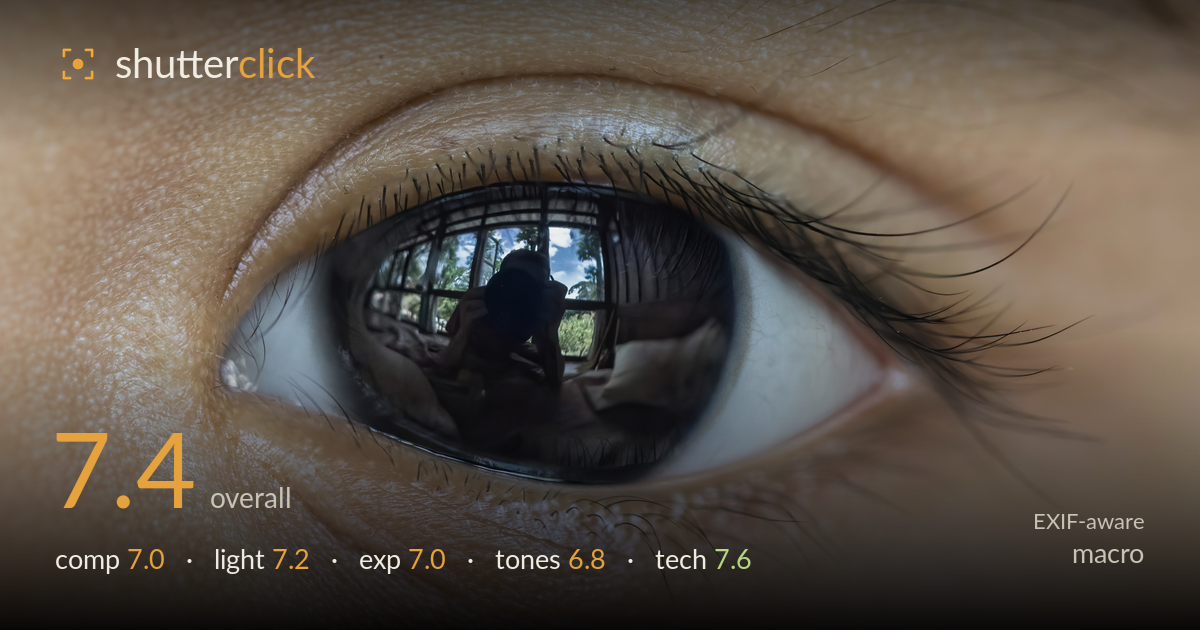
A photographer reflected in the eye
Photo by Basile Morin

| Focal length | 100 mm |
| Aperture | f / 3.2 |
| Shutter | 1/400 s |
| ISO | ISO 800 |
| Exp. comp. | -1.0 EV |
| Shot at | 11:34 · May 6, 2021 |
The reflected self-portrait inside the pupil is the whole payoff here — a photographer with a camera framed by window mullions and daylight, mirrored on the wet curve of the iris. That storytelling detail elevates a familiar macro-eye subject. What most holds it back is focus placement: the sharpest plane sits on the lower lashes and iris edge rather than resting cleanly on the reflection itself, so the strongest element is slightly soft. Skin tone runs a touch waxy and warm, and the frame leans heavily on the right-side lashes while the left of the iris crowds the border. A strong, clever image needing tighter execution.
Placing the eye low and letting the brow and lashes sweep across the upper frame gives good diagonal energy, and the reflection anchors attention exactly where it should. The problem is balance: the iris sits hard against the left edge with its reflection nearly cropped, while the right half is dominated by out-of-focus lashes and skin that carry less interest. Centering the pupil a hair more, or giving the reflection breathing room on the left, would let the payoff sit comfortably rather than fighting the border.
Soft, diffused daylight wraps the skin evenly and keeps harsh speculars off the eye surface, which is exactly what a reflection shot needs — a single clean window highlight rather than scattered glare. The wet iris renders the mirrored scene legibly because the light source is broad and directional. The trade-off is that flat frontal light gives the skin little texture modeling; a slightly more raking angle would carve the eyelid folds and lash roots with more dimension without blowing out the reflective catchlight.
The -1.0 EV compensation was a sensible call to protect the bright reflected sky inside the pupil, and it largely works — the window highlights hold detail rather than clipping. Shadow detail in the lash bases and pupil edge survives. The overall result reads a touch dark and heavy across the skin, which pushes midtones lower than flattering for a portrait-adjacent macro. Lifting the shadows a half stop in post would open the skin and lash detail without endangering the reflection's highlights.
The skin carries a warm, slightly orange cast that reads a little waxy and over-smooth, flattening the fine texture that macro should celebrate. White balance leans warm; a small pull toward neutral would restore realism. Contrast within the iris reflection is good, letting the mullions and figure separate. Across the skin, though, the tonal range is compressed and the saturation on the warm end is a shade heavy. A more restrained warmth and a touch more micro-contrast would make the pores and lash detail sing.
At f/3.2 on the 100mm L macro, depth of field is razor-thin, and that is the crux of the execution. The sharpest plane lands on the lower lashes and the near iris edge rather than on the reflection itself, so the most interesting content — the mirrored photographer — is marginally soft where it most needs to be crisp. The 1/400s shutter was well chosen for a moving subject at this magnification and froze any micro-movement cleanly, and ISO 800 keeps noise negligible on this sensor. Focus is the single lever worth pulling: stopping down to f/5.6–f/8 would deepen the plane enough to hold both the iris surface and its reflection, at the cost of needing more light or a higher ISO, both easily absorbed here. Alternatively, a two- or three-frame focus stack would keep the wide-open rendering while sharpening the reflection. The lens choice is ideal and the handling otherwise assured — this is a focus-precision issue, not a gear one.
What would elevate it
Tags
Shot something like this?
Expert photo critique, on demand — scored across six categories, EXIF-aware. Start with 3 free critiques, no credit card.
critique my photo — free