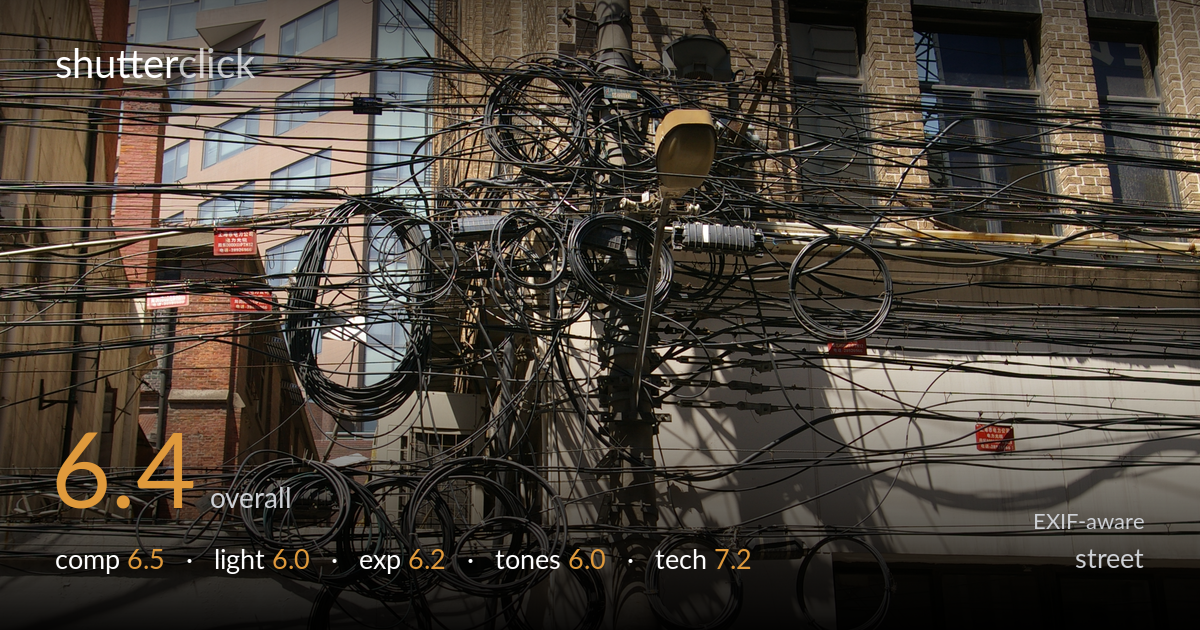
A tangle of overhead wires
Photo by Jakub Hałun

| Focal length | 31 mm |
| Aperture | f / 8.0 |
| Shutter | 1/250 s |
| ISO | ISO 200 |
| Exp. comp. | 0.0 EV |
| Shot at | 10:06 · May 10, 2009 |
A chaotic tangle of overhead cabling makes a genuinely arresting subject, and the dense coils of wire read as intentional visual overload rather than accident. What holds the frame back is the lack of a clear anchor: the eye enters the swirl of loops but never settles, and the composition sprawls to all four edges without a resolving point. The hard midday sun flattens the wires against the buildings and blows the pale wall on the right. A stronger organizing element — the lamp head or utility pole treated as the fulcrum — plus softer or lower-angled light would sharpen an already compelling document.
The frame is packed corner to corner with looping cable, which suits the subject's madness, but there is no clear entry point or resting place for the eye. The concentrated cluster of coils sits left of centre while the pole and lamp head anchor the right — the two halves compete rather than cooperate. The circular loops are the strongest graphic motif and could carry the image if isolated more deliberately. As it stands the building windows and signage add clutter without adding meaning, diluting the tangle's impact.
Hard, high midday sun rakes across the scene, throwing sharp diagonal shadows of the wires onto the pale wall on the right — an interesting secondary pattern. But the same light flattens the black cables against the darker brick on the left, collapsing depth where separation is most needed. The overhead angle offers little modelling on the coils themselves. Earlier or later light, raking more horizontally, would rim the loops and pull them off the background, giving the tangle the three-dimensional sculptural quality it deserves.
Exposure is a reasonable compromise for a high-contrast midday scene. The pale wall on the right edges toward clipping, and some highlight detail on the plaster is lost, while the shadowed brick and darkest cables sink into near-black with little recoverable detail. The midtones on the central wall hold well. A half-stop of negative compensation, or a bracketed frame to protect the wall, would have preserved the highlight texture without much cost to the already dark shadow areas.
Colour is muted and slightly cool, dominated by grey cable, tan brick and beige plaster — a restrained palette that fits the industrial subject. Contrast runs high from the hard sun, which strengthens the graphic read but crushes shadow gradation. The red signage provides the only real colour accent and could be leaned into. White balance looks accurate. A touch more shadow lift and a warmer grade would add tonal separation among the many near-black wires that currently merge into indistinct mass.
The settings are well matched to the scene. At f/8 the K100D's sensor is near its sharpness peak, and the deep depth of field keeps the front cables and the background brick acceptably crisp — appropriate given how many planes of wire fill the frame. ISO 200 keeps noise negligible and preserves what tonal range this high-contrast light allows. The 1/250s shutter is more than enough to freeze a static subject, and hand-holding a 31mm lens at that speed is comfortably safe. Focus appears accurate on the central cluster of coils. The main limitation is the older sensor's modest dynamic range, which struggles with the bright wall against dark brick — a challenge no single exposure fully resolves here. Focal length choice is sensible for the working distance, though a slightly longer lens would have let the tangle be isolated more tightly without stepping back into competing elements. Overall the execution is clean and deliberate.
What would elevate it
Tags
Shot something like this?
Expert photo critique, on demand — scored across six categories, EXIF-aware. Start with 3 free critiques, no credit card.
critique my photo — free