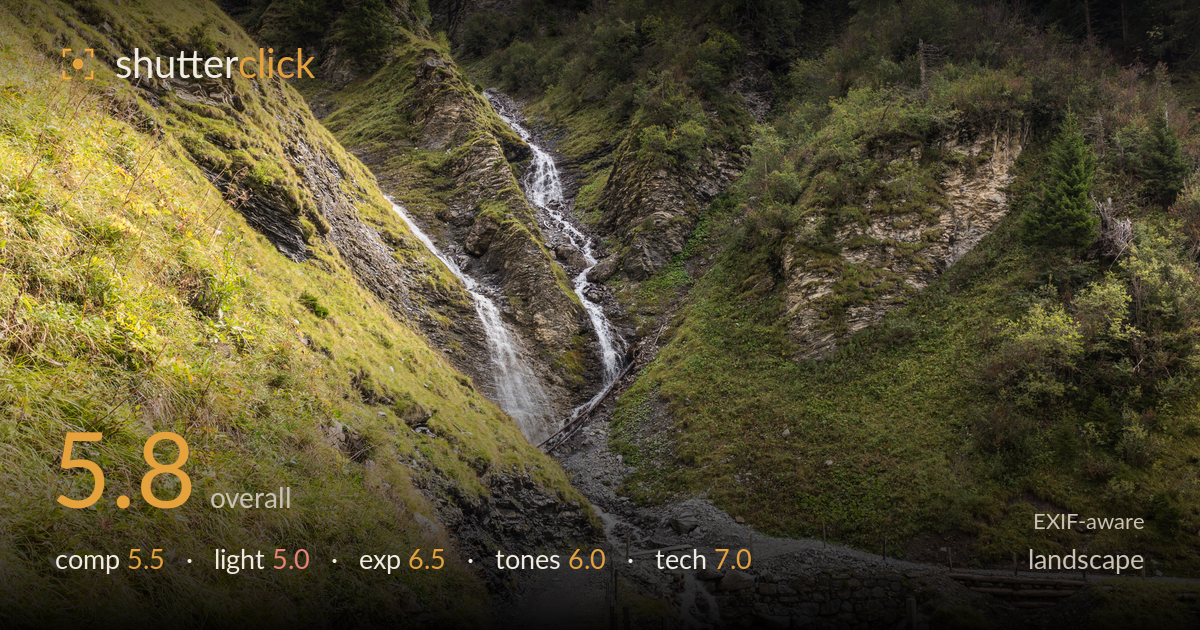
A thin cascade above the trail
Photo by Agnes Monkelbaan

| Focal length | 20 mm |
| Aperture | f / 7.1 |
| Shutter | 1/125 s |
| ISO | ISO 100 |
| Exp. comp. | 0.0 EV |
| Shot at | 14:04 · Sep 11, 2017 |
A busy alpine scene where the waterfall — the natural subject — competes with too many equally weighted elements and never dominates. The trail entering bottom-left is a genuine asset, offering a natural way into the frame, but the composition scatters attention across grassy slope, cascade, scree, and stone wall without a clear hierarchy. Flat overcast light drains the drama a scene like this needs. Exposure and focus are technically sound. What most holds it back is the lack of a decisive anchor and the absence of directional light to model the terrain and make the water read against the rock.
The frame carries a lot of information without a clear priority. The waterfall thins to a faint thread against busy rock, so it fails to command attention as the subject. The diagonal grass slope on the left is strong and the trail curving in from the bottom offers a genuine leading line, but it points toward the stone wall rather than the falls. The eye wanders between too many competing textures. A composition that isolated the cascade against darker rock, or committed fully to the trail as the journey, would resolve the ambiguity.
Flat, diffuse overcast light sits evenly across the whole scene, which keeps shadow detail intact but robs the terrain of depth and modelling. The rock faces read as texture rather than form, and the thin water lacks the contrast it needs to separate from the wet stone behind it. Cross-light or a break in the cloud would rake across the slope and give the cascade the luminance to stand out. As it stands the light is serviceable but does nothing to build drama or lead the eye.
Exposure is handled well for tricky conditions. The bright water thread holds highlight detail without clipping, and the shadowed rock and dense greenery retain information throughout. The histogram sits comfortably in the midtones with no significant loss at either end. Nothing appears blown or blocked up. The even overcast light made this straightforward, but the balance is judged correctly and no exposure compensation was needed. A touch more brightness on the falls in post could help lift them against the surroundings.
The greens dominate and lean slightly yellow, giving a somewhat flat, uniform palette across the slopes. Contrast is low, consistent with the overcast light, and the scene lacks tonal separation between the various green and grey masses. The wet rock and scree add welcome neutral grey, but the overall grading feels muted. Selective contrast on the rock faces and a cooler balance on the water would introduce more variation and stop the frame reading as a single wash of green.
The settings are well matched to the scene. At 20mm on the APS-C EOS M, f/7.1 gives ample depth of field for a landscape at this distance, and everything from the foreground trail to the distant slope reads acceptably sharp. ISO 100 keeps noise absent and preserves clean detail in the greenery and rock texture. The 1/125s shutter is a reasonable choice — it freezes the scene handheld, though a slower exposure on a tripod would have let the water blur into a softer, more cohesive ribbon that would help it separate from the rock. The 18-55mm kit lens performs competently here, with corner detail holding up and no obvious distortion at this focal length. Focus appears accurate across the frame. Technically this is a solid, well-executed capture; the limitations are compositional and lighting-driven rather than a matter of gear or execution. A polarizer would have cut glare on the wet stone and deepened the foliage.
What would elevate it
Tags
Shot something like this?
Expert photo critique, on demand — scored across six categories, EXIF-aware. Start with 3 free critiques, no credit card.
critique my photo — free