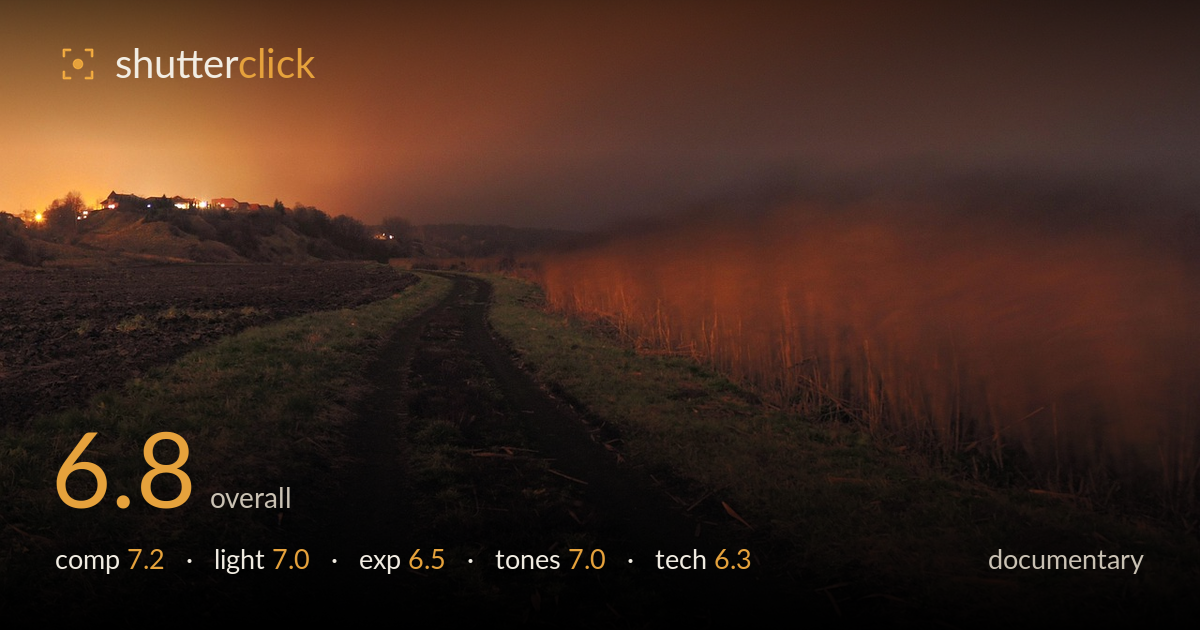
A track into the orange night
Photo by 15725821

No EXIF metadata in this file
Technical analysis based on visual assessment only.
An atmospheric night scene carried by a dirt track that draws the eye through the frame toward the light-pollution glow and the cluster of houses on the ridge. The mood is genuine and the story reads clearly: rural land at the edge of a settlement under a sky lit orange by distant lights or fog. What holds it back is softness on the right half — a wall of blur where the fog or long-exposure movement erases detail — and shadows that block up into featureless black in the foreground. The overwhelming single-hue orange cast also flattens the tonal separation.
The track works well as a leading line, curving from the lower centre up toward the lit ridge and giving the frame depth and a clear entry point. The village silhouette on the left balances the empty field. The right half, however, is a large indistinct mass of blurred vegetation and fog that carries little information and competes for weight without reward. A framing that gave more room to the houses and the sky glow, or tightened away from the murky right edge, would sharpen the narrative.
The scene is lit almost entirely by ambient light pollution — the orange glow over the horizon and the pinpoint lamps of the settlement. It creates a genuinely moody, otherworldly atmosphere that suits documentary night work. The low directional glow rakes across the grass and track, giving some texture in the mid-ground. The trade-off is that the light is flat and unidirectional, offering no shaping across most of the frame, and the far right receives almost no useful illumination, sinking into an undefined haze.
Exposure is a reasonable compromise for a difficult low-light scene, holding the sky glow without fully clipping the brightest lamps on the ridge. The foreground shadows, though, fall into near-total black with little recoverable detail, and the lower corners read as empty. The mid-ground track and grass are the best-placed tones. Lifting the shadows slightly in processing would reveal ground texture, though noise would likely rise. The overall brightness reads as deliberate for mood rather than accidental.
A single dominant orange cast unifies the image and reinforces the nocturnal, sodium-lit atmosphere, which is the picture's strongest asset. But that monochromatic pull is also a limitation: nearly every tone bends to the same hue, collapsing separation between sky, fog, and land. Introducing a cooler counterpoint in the shadows would restore some depth and stop the frame reading as a single wash. Contrast is soft in the hazy right half and abrupt in the black foreground.
Without EXIF, judgement rests on visual evidence. The left side and the track hold acceptable detail, suggesting focus was placed on the mid-ground, and the sharpness there is workable for a night frame. The right half tells a different story: a broad smear of blur consistent with either heavy fog, camera or subject movement during a long exposure, or a focus plane that fell away — it robs that portion of the picture of any structure. Noise appears controlled in the darker tones, which points to a considered exposure rather than a heavily pushed one, though the deepest shadows give little to inspect. For a scene like this, a small aperture with careful focus set toward the hyperfocal distance and a stable support would have carried sharpness across the field, while bracketing would have protected both the ridge lights and the foreground ground detail. As it stands, half the frame delivers technically and half dissolves.
What would elevate it
Tags
Shot something like this?
Expert photo critique, on demand — scored across six categories, EXIF-aware. Start with 3 free critiques, no credit card.
critique my photo — free