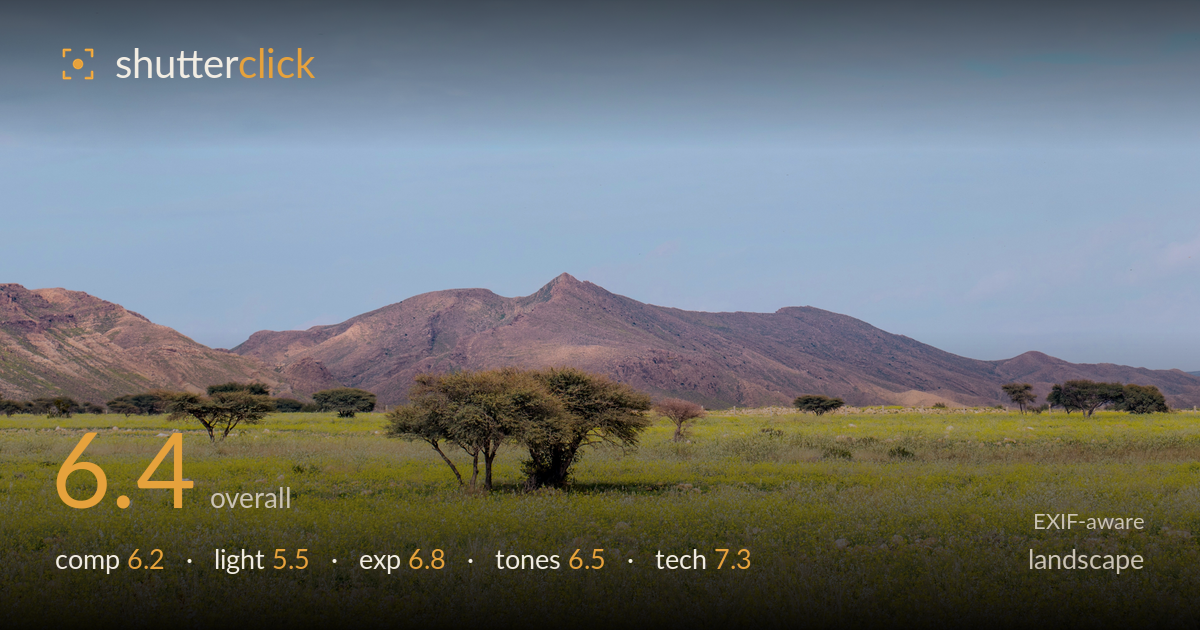
Acacia in a flowering desert plain
Photo by Smailtn Camera location34° 28′ 24.16″ N, 9° 28′ 40.22

| Focal length | 64 mm |
| Aperture | f / 8.0 |
| Shutter | 1/250 s |
| ISO | ISO 100 |
| Exp. comp. | 0.0 EV |
| Shot at | 16:34 · Feb 22, 2025 |
A pleasant desert-bloom scene where the yellow flowering plain plays nicely against the layered brown mountain and blue sky, but the flat midday light and generous, near-empty sky hold it back. The clustered acacia in the centre-left works as an anchor, yet the composition leans heavily on that one element while the top half is dominated by featureless sky. The three-band structure — flowers, mountains, sky — is naturally strong, but the framing gives too much weight to the least interesting band. Warmer, lower light and a tighter vertical crop would let the colour and terrain carry the frame.
The three-tier structure of flowering plain, mountain ridge and sky reads clearly, and the central acacia cluster provides a solid anchor with the peak conveniently placed just above it. The problem is proportion: sky occupies nearly half the frame while adding little, and the horizon sits near the middle. Weighting toward the foreground bloom and the mountain would strengthen the balance. The scattered smaller trees add rhythm across the plain, but the eye lacks a foreground element close enough to build real depth into the flower field.
This reads as flat, high-sun light. The mountain shows only weak modelling — its ridges and folds lack the raking shadow that would reveal their form, and the flower field is evenly lit without the dimensional glow warmer light would bring. The sky is a pale, hazy blue that dilutes contrast across the whole scene. It's clean and workable, but the light does little to shape the terrain or make the yellow bloom sing, which is what this subject most needs.
Exposure is well managed. Highlights in the pale sky are held without clipping, the mountain retains detail across its slopes, and the flowering foreground keeps its yellows without blowing out. Shadow areas within the trees stay open with usable detail. The overall rendering is a touch flat, partly a product of the light rather than the exposure itself, but the histogram is clearly under control and nothing important is lost at either end. A deliberate, balanced capture.
The colour relationship between the acid yellow bloom and the earthy brown ridge is the image's strongest asset, and white balance is broadly neutral. The blue sky, however, is hazy and slightly muddy, dragging down the contrast of the upper frame. The greens in the foreground plants and the yellows could carry more separation and vibrancy. Overall the palette is naturally appealing but sits at low contrast — some added tonal punch, particularly in the mountain midtones, would give it more dimension.
Settings are well chosen for the scene. At f/8 on the EF-S 18-135, the lens is near its sharpness sweet spot and delivers the deep depth of field a landscape wants — the foreground flowers, mid-ground trees and distant ridge all render with acceptable focus. ISO 100 keeps the file clean with no visible noise, and 1/250s at 64mm is more than fast enough to freeze any breeze in the vegetation and eliminate handshake. Focus appears placed around the central tree cluster, which is a sensible anchor point. Critical sharpness across the frame is good rather than exceptional, which is typical of this consumer zoom at longer focal lengths. The main technical missed opportunity is not the settings but the timing: the same competent execution under directional light would yield far more. A polariser would also have deepened the sky and cut some of the haze that softens the distant contrast. Solid, deliberate technical work overall.
What would elevate it
Tags
Shot something like this?
Expert photo critique, on demand — scored across six categories, EXIF-aware. Start with 3 free critiques, no credit card.
critique my photo — free