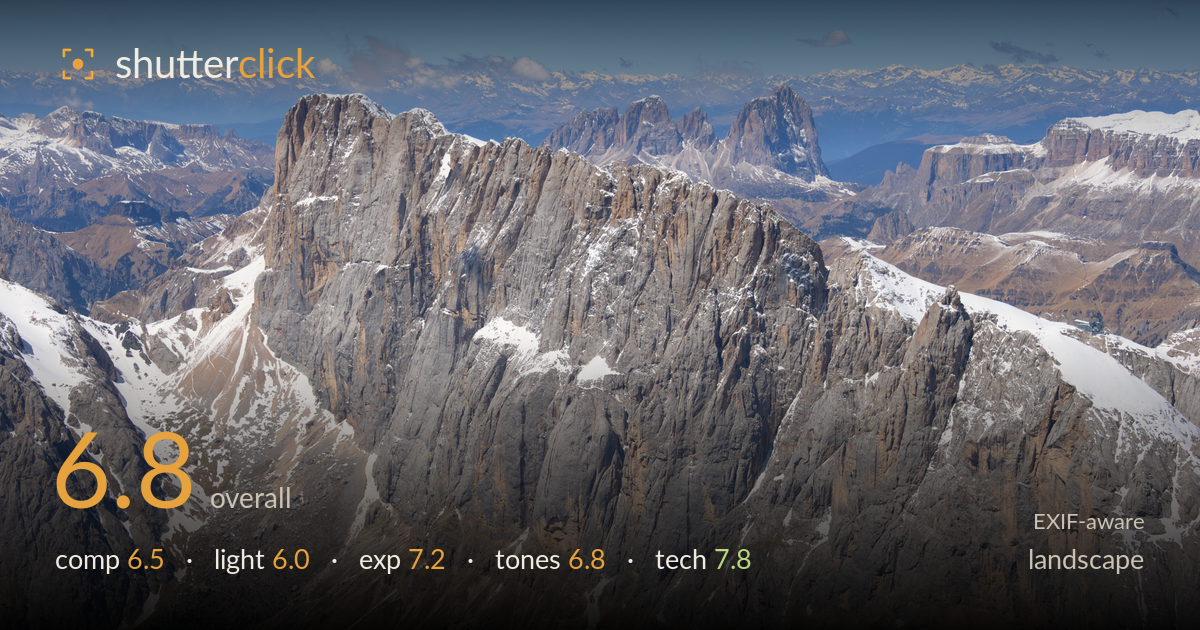
Aerial view of a dolomite massif
Photo by Carsten Steger

| Focal length | 50 mm |
| Aperture | f / 8.0 |
| Shutter | 1/2500 s |
| ISO | ISO 400 |
| Exp. comp. | 0.0 EV |
| Shot at | 11:13 · May 1, 2026 |
A commanding aerial view of a Dolomite massif with genuinely impressive geological detail across the ridge face. The sharpness and clarity carry the frame, and the layered background peaks add real depth. What holds it back most is the flat midday light, which robs the vertical rock striations of the raking shadow that would make them read three-dimensionally. The composition is competent but the eye lacks a clear anchor or entry point, and the sky occupies real estate without much drama. The scene has undeniable scale; the missing ingredient is directional light and a stronger organising line to lead through it.
The main ridge runs diagonally through the frame, giving a natural sense of movement, and the tiered background peaks establish good atmospheric depth. However, the eye lacks a clear resting point — the massif fills the centre without a dominant peak or foreground anchor to lead the viewer in. The band of pale sky along the top adds little and could be trimmed. The lower-left couloir and snow gully offer a subtle entry line that a lower framing would strengthen. Balanced but somewhat undifferentiated across the width.
Bright, near-overhead midday sun flattens the rock face and its dramatic vertical fissures. Those striations are the subject's greatest asset, yet without a raking side light they lose depth and read as texture rather than sculpted form. The snow patches hold detail and the distant peaks retain some atmospheric separation, but overall the scene lacks the modelling that morning or late-afternoon light would carve into the walls. The flat illumination is the single biggest limitation on an otherwise dramatic subject.
Exposure is well judged for a high-contrast alpine scene. The snow retains detail without blowing out, and the shadowed rock faces hold recoverable information in the darker gullies. Highlights on the bright limestone stay in check, and the sky is clean without clipping. There is a slight overall brightness that mutes some midtone punch, and the deepest shadow pockets sit a touch flat, but nothing is lost. A deliberate, safe exposure that handles the wide dynamic range of snow and rock competently.
White balance leans slightly cool, which suits the alpine setting and keeps the snow neutral. The rock renders in muted grey-browns with hints of ochre where the sun catches, and the graduated sky is clean. The overall palette is honest but a little low in contrast and saturation, giving the frame a slightly hazy, flat feel — partly atmospheric haze in the distance, partly the midday light. A modest contrast lift and clarity boost would give the rock striations more separation and depth without looking artificial.
The 50mm on the D5 delivers excellent per-pixel detail across the rock face, and f/8 is the right aperture choice — deep enough for front-to-back sharpness while sitting in the lens's sweet spot. Focus is accurately placed on the main massif, with the far peaks holding their crispness thanks to the small aperture and long subject distance. From what appears to be an aircraft, the fast 1/2500s shutter was a smart call to counter platform vibration and motion, and it has clearly frozen the scene without blur. ISO 400 introduces no visible noise and provides headroom for that shutter speed. Distant haze softens the background layers slightly, but that is atmospheric rather than a focus or optical fault. Execution here is the strongest element of the frame: settings are well matched to the shooting conditions, and the image is clean, sharp, and free of aberration. Technically this is close to fault-free for the circumstances.
What would elevate it
Tags
Shot something like this?
Expert photo critique, on demand — scored across six categories, EXIF-aware. Start with 3 free critiques, no credit card.
critique my photo — free