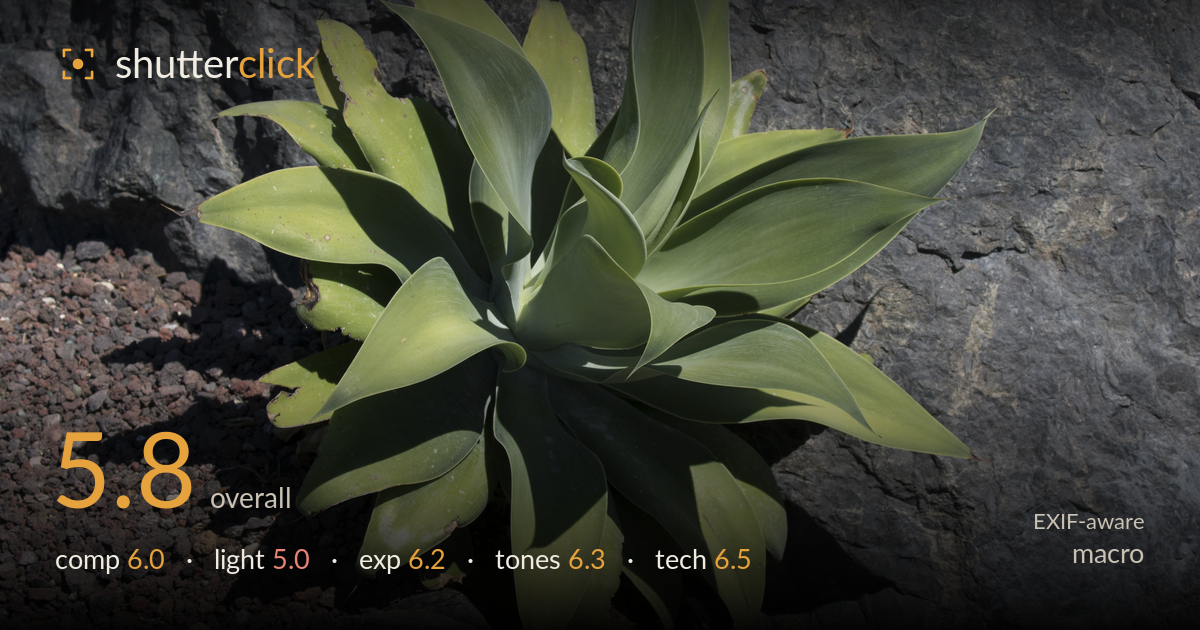
Agave rosette against lava rock
Photo by Zeynel Cebeci

| Focal length | 110 mm |
| Aperture | f / 10.0 |
| Shutter | 1/500 s |
| ISO | ISO 320 |
| Exp. comp. | 0.0 EV |
| Shot at | 15:20 · Sep 25, 2016 |
This is closer to a plant portrait than a macro study — the whole agave sits in frame with its lava-rock setting, so it reads as botanical documentation rather than the tight detail work the genre rewards. The rosette's spiralling leaves are the strongest asset, offering natural radial symmetry that could anchor a much stronger image. What most holds it back is harsh midday light flattening the leaves and the plant's slightly off-centre, cramped placement against the dark rock. A tighter frame on the whorl's centre, or a return in softer light, would transform this from record shot to composition.
The rosette's radial spread of leaves is the natural focal point and its spiralling geometry has real potential. Placement is a touch high and left, leaving the plant slightly cramped against the frame edges while the lower-right corner opens onto empty soil and a stray intruding leaf. The dark lava rock provides good separation behind the pale green, but the foreground gravel competes for attention. Filling the frame more deliberately with the whorl, or centring on its heart, would strengthen the graphic pull.
Hard, high-angle midday sun is the main limitation here. It flattens the leaves, blows small highlights along their upper surfaces, and casts busy, distracting shadows across the gravel. The light does little to reveal the sculptural curve and texture of the agave — the very qualities that make this plant photogenic. Overcast diffusion or low, raking side light would model the leaves' form and bring out surface detail. As shot, the illumination is functional but works against the subject rather than for it.
Exposure is broadly well judged for a bright scene. The green midtones sit at a sensible brightness and the dark rock retains texture rather than blocking up. Some highlight clipping shows on the sun-facing leaf edges where specular reflections catch, though these are small and hard to avoid in this light. Shadow areas on the gravel hold detail. Overall a competent read of a high-contrast situation with no gross error, but the clipped leaf tips cost a little polish.
White balance is neutral and believable, with the cool green of the agave sitting naturally against the grey rock and rust-red lava gravel — a pleasing colour relationship. Contrast runs high courtesy of the direct sun, which pushes shadows deep and slightly hardens the tonal transitions on the leaves. Saturation is restrained and natural. The green tones could benefit from a gentler gradient across the leaf surfaces; as it stands the tonal range is honest but a little brittle in the highlights.
The settings are sound for the subject. At 110mm and f/10, depth of field is deep enough to hold most of the rosette acceptably sharp, which suits a plant of this three-dimensional spread. ISO 320 keeps noise negligible, and 1/500s is far more shutter than a static plant needs — that speed reflects the long telephoto's stabilisation demands rather than motion concerns, so there was headroom to drop ISO or stop down further for even more depth. Focus lands on the central leaves where it should. The choice of the 100-400mm zoom for what is really a working-distance botanical shot is unusual but effective, compressing the background rock nicely. This is not true macro — no frame-filling detail or shallow selective focus on a single texture — so judged as macro it under-delivers on intimacy. Technically clean execution; the limitation is conceptual reach rather than sharpness or exposure control.
What would elevate it
Tags
Shot something like this?
Expert photo critique, on demand — scored across six categories, EXIF-aware. Start with 3 free critiques, no credit card.
critique my photo — free