Allianz arena from day to night
Photo by Richard Bartz, Munich aka Makro Freak , Composition Niabot

No EXIF metadata in this file
Technical analysis based on visual assessment only.
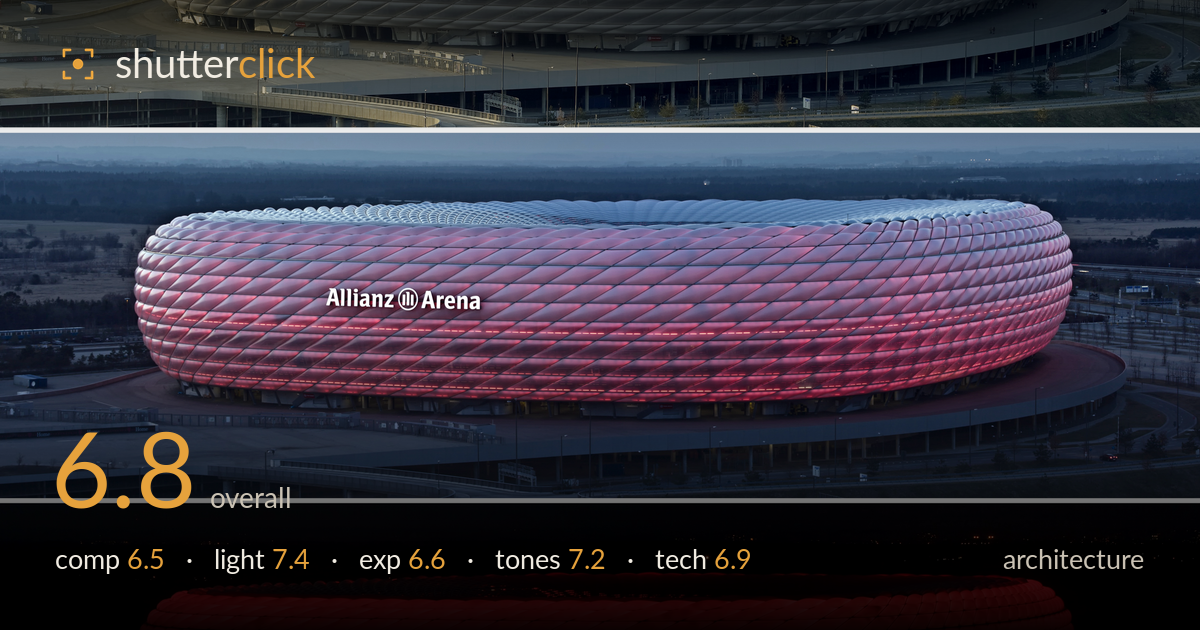
This triptych of the Allianz Arena at day, dusk, and night is a smart concept that showcases the building's signature illuminated skin — the same viewpoint carried across three light conditions makes the transformation the subject, and that idea carries the piece. What holds it back is consistency: the three frames don't share exactly the same framing or crop, so the stacking reads as assembled rather than locked. The daytime panel sits flatter than the other two, and the vertical stack compresses each frame into a letterbox that undersells the arena's scale. A rigorously matched viewpoint would elevate the whole.
The three-panel comparison is a strong editorial device — one subject, one angle, three moods. But the frames aren't precisely aligned: the arena sits at slightly different heights and scales across the panels, breaking the illusion of a single locked tripod position. The horizon placement varies too, and the letterbox proportion of each strip crops the foreground plaza and sky tightly, flattening the sense of the building's mass. The sweeping elliptical form is well placed centrally, which suits the symmetry, but tighter registration between panels would make the sequence feel intentional rather than compiled.
The concept lives on light, and the progression works. The top frame's hazy low sun rakes softly across the diamond-quilted facade, revealing the panel texture nicely. The dusk frame catches the sweet spot where ambient sky and the red illumination balance, giving the skin dimension and roundness. The night frame goes full saturated red glow against black, dramatic but the least modelled — the facade reads as a flat wall of colour with the pillow texture largely lost. The middle panel is the strongest lit of the three for showing form.
Each frame is individually controlled but they don't hold together tonally. The daytime panel is bright and slightly flat with a washed, low-contrast sky. The night frame pushes the red near clipping — the brightest cushions lose separation and detail in the highlights, while the surrounding grounds fall to near-black with little recovered shadow information. The dusk frame is the most balanced, holding highlight and shadow detail across the facade. Slightly pulling the night reds back from saturation would preserve the quilted structure that makes the building distinctive.
The colour story is the payoff — cool neutral silver by day, warm-to-red transition at dusk, and pure Bayern red at night. The dusk frame's blend of blue-hour sky against the red facade is the most sophisticated, with a genuine complementary tension. The night red is punchy and on-brand but veers toward monochrome saturation that flattens gradation. White balance shifts between panels are expected given the conditions, but a hint more consistency in the neutral grounds would tie the set. Overall the tonal arc is the strongest single element here.
Shot from an elevated distant vantage with a long lens, the compression flattens the arena's depth, which suits a comparison layout but reduces the sense of the structure's curvature. Focus appears adequate across all three frames, with the facade texture resolved cleanly in the day and dusk panels; the night frame loses fine detail more to blown highlights than to focus error. There's no obvious motion blur, suggesting stable support was used for the low-light frames — sensible given the night exposure. The main technical weakness is the lack of precise registration between the three viewpoints: the scale and horizon drift indicate the frames were captured on different occasions or slightly different positions rather than a single locked rig, which the comparison format demands. Highlight handling in the night panel is the other limiter — the reds sit at the edge of clipping and swallow the pillow detail. A held-back exposure there would retain more structure.
What would elevate it
Tags
Shot something like this?
Expert photo critique, on demand — scored across six categories, EXIF-aware. Start with 3 free critiques, no credit card.
critique my photo — free