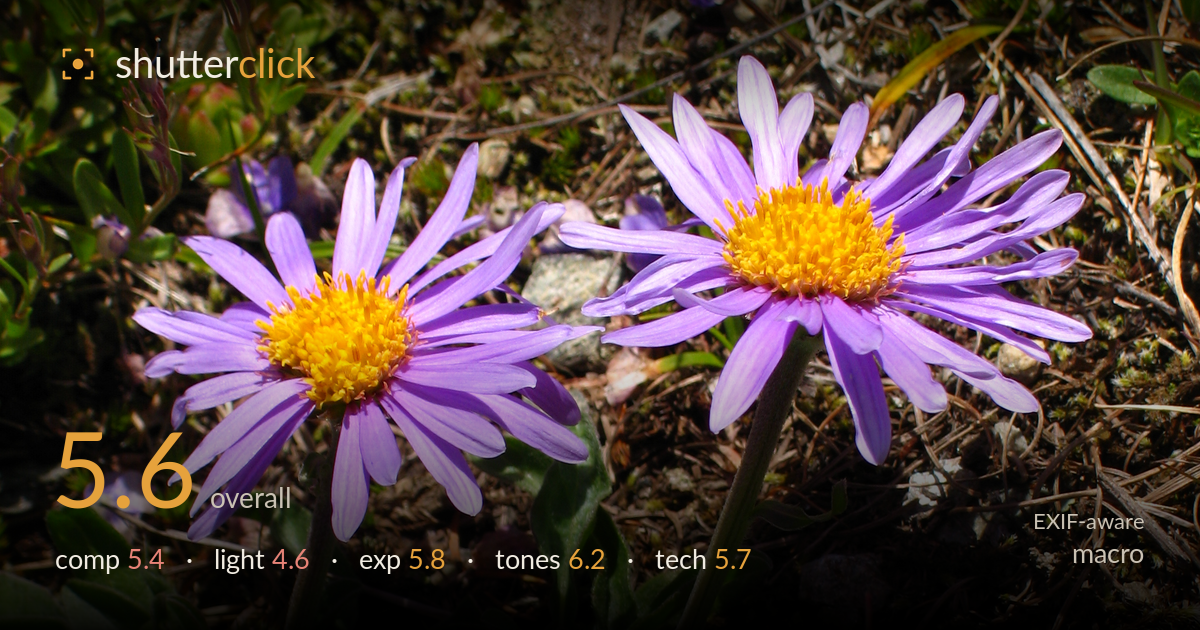
Alpine asters in bright sun
Photo by Robert Flogaus-Faust

| Focal length | 29 mm |
| Aperture | f / 6.3 |
| Shutter | 1/500 s |
| Exp. comp. | -1.0 EV |
| Shot at | 14:16 · Jul 12, 2007 |
Two alpine asters sit in strong sun that flattens the mood and scatters harsh highlights across the surrounding litter. The subject reads clearly and the violet-against-yellow colour pairing is appealing, but the hard midday light and busy, cluttered background pull the eye away from the blooms. The paired flowers point in slightly awkward directions rather than working as a unified subject, and the fuzzy stems and leaves — the most macro-worthy texture here — are relegated to shadow. A softer light, a cleaner backdrop, and a tighter framing on one bloom would lift this from a competent record shot toward something more expressive.
Two flower heads anchor the upper frame while stems and foliage fill the lower half, giving a reasonable sense of the plant in its habitat. The problem is division of attention: the two blooms compete rather than cooperate, and the tangle of dry stems, rocks and grass behind them is restless. The right-hand flower is the stronger subject but sits crowded against the frame edge. A tighter composition on a single bloom, or a lower angle isolating both against clean ground, would resolve the pull between the two heads.
Hard, high, near-overhead sun is the biggest limitation here. It renders the petals with harsh specular sheen, blows small highlights on the litter behind, and drops the stems and lower leaves into heavy shadow, killing the fine hairy texture that macro rewards. The yellow centres hold, but the light gives the scene no modelling or depth. Overcast light or open shade would soften the petals, even out the background, and reveal the fuzz on stems and leaves that is a genuine feature of this plant.
The -1.0 EV compensation was a sensible call against bright petals and sunlit ground — it keeps the violets and the yellow discs from clipping, and they largely hold detail. The trade-off is that shadowed foliage and soil go quite dark and muddy, compressing the lower half. The bright litter behind the right flower still edges toward glare. It is a defensible protective exposure for hard light, but the scene's dynamic range simply exceeds what a single frame in this light can hold gracefully.
Colour is the strongest aspect: the cool violet petals against the saturated orange-yellow centres is a natural, pleasing complementary pairing, and white balance looks accurate for direct sun. Greens in the foliage read healthy without oversaturation. Contrast is high — a product of the light rather than grading — which deepens the shadows and adds a slight harshness. The dry background browns are a little flat and dull. Softer light would broaden the midtone gradation and let these good colours breathe rather than fighting hard contrast.
The Canon G6 at 29mm and f/6.3 was worked competently within its limits. 1/500s easily froze any breeze, and f/6.3 on this small-sensor compact gives generous depth of field — both flower heads and much of the foliage sit acceptably sharp, which suits documenting the whole plant. Focus lands well on the flower centres. The compromise is that this is not true macro magnification or subject isolation; the deep depth of field keeps the cluttered background in play rather than melting it away, so nothing separates cleanly. At base ISO the image is clean, though fine petal detail shows the softness typical of this camera's small sensor. A closer working distance with the lens racked longer, or a dedicated macro setup, would deliver finer texture and a shallower, cleaner backdrop. As executed it is a solid, sharp field record — sound settings, but the gear and approach cap how far it can go as a macro study.
What would elevate it
Tags
Shot something like this?
Expert photo critique, on demand — scored across six categories, EXIF-aware. Start with 3 free critiques, no credit card.
critique my photo — free