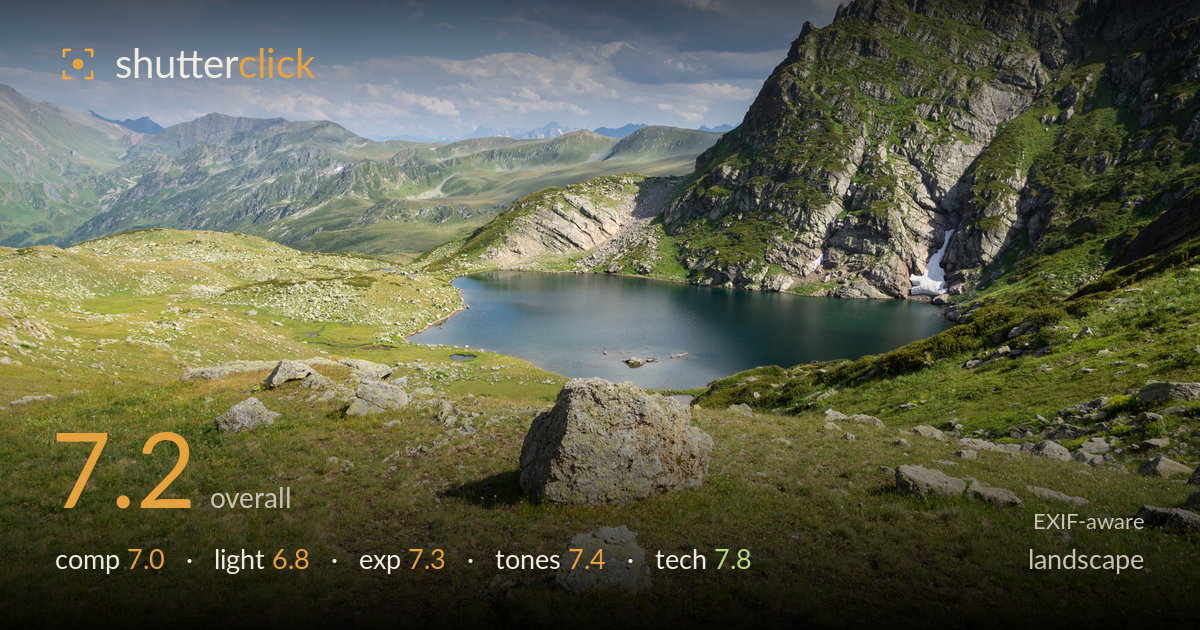
Alpine tarn beneath a rugged peak
Photo by Vyacheslav Argenberg

| Focal length | 17 mm |
| Aperture | f / 7.1 |
| Shutter | 1/250 s |
| ISO | ISO 100 |
| Exp. comp. | 0.0 EV |
| Shot at | 15:23 · Aug 11, 2015 |
A classic alpine tarn scene with strong depth, anchored by the lichen-covered boulder in the foreground that gives the eye a firm entry point. The layering from grass to lake to jagged peak works, and the receding ridgelines on the left build genuine scale. What most holds it back is midday light that flattens the mountain's texture and desaturates the scene slightly, plus a foreground boulder placed a little too centrally, competing with the lake for attention. A return in warmer, lower light and a small compositional shift would lift this from a solid record shot toward something more memorable.
The foreground boulder anchors the frame and establishes depth, and the diagonal sweep of the grassy slope leads the eye down to the lake. The peak on the right provides a strong terminating mass, balanced by the softer ridgelines fading left. The main hesitation is the central boulder sitting almost dead-centre horizontally, pulling attention from the lake rather than pointing to it. The lake also sits low and small in the frame. A slightly lower angle or a shift left would let the boulder gesture toward the water more deliberately.
The light is high, near-midday sun, which reads in the short shadows and the somewhat flat rendering of the dominant peak. The rock face retains some modelling on its right flank, but the overall scene lacks the raking directional light that would carve out the ridge's texture and the grassy contours. Cloud shadows drifting across the far slopes add welcome tonal variation. The sky holds decent cloud structure, but the moment is more documentary than dramatic. Lower, warmer light would transform the same composition.
Exposure is well judged for a bright high-altitude scene. Highlights in the brightest cloud tops sit near clipping but hold enough detail, and the shadowed rock faces on the right retain structure rather than blocking up. The lake's dark surface is rendered without crushing, keeping the subtle turquoise-to-navy gradient. The grass midtones are placed sensibly. Nothing looks accidental here; the histogram appears well-controlled across the range. A touch more shadow lift on the right-hand cliff would recover a little more of the rock's form.
White balance is neutral and believable for the daylight conditions. The greens of the alpine meadow are rich without oversaturation, and the lake's blue-green holds nicely against the surrounding rock. Contrast is moderate and suits the airy mood. The distant ridges carry a natural atmospheric haze that reinforces depth. The main limitation is a slight flatness in the midday palette; the peak in particular reads grey-green rather than richly modelled. A gentle contrast and vibrance lift, or warmer light at capture, would give the tones more life.
The settings are well matched to the subject. At 17mm on the APS-C SLT-A55V, f/7.1 delivers front-to-back sharpness that keeps the foreground boulder and the distant peak both acceptably crisp, which is exactly what this deep landscape needs. ISO 100 keeps noise negligible and preserves tonal smoothness in the sky and lake. The 1/250s shutter is more than enough for a static scene handheld, leaving no motion blur. Focus appears set well into the scene, giving good hyperfocal coverage, though the very nearest grass at the bottom edge softens slightly. The 17-50mm f/2.8 is a capable lens here and shows reasonable corner performance, with only mild softening at the frame edges. A slightly smaller aperture such as f/9 or f/11, combined with careful hyperfocal focusing, would sharpen the immediate foreground without meaningfully risking diffraction. Overall a technically sound capture with no significant errors in execution.
What would elevate it
Tags
Shot something like this?
Expert photo critique, on demand — scored across six categories, EXIF-aware. Start with 3 free critiques, no credit card.
critique my photo — free