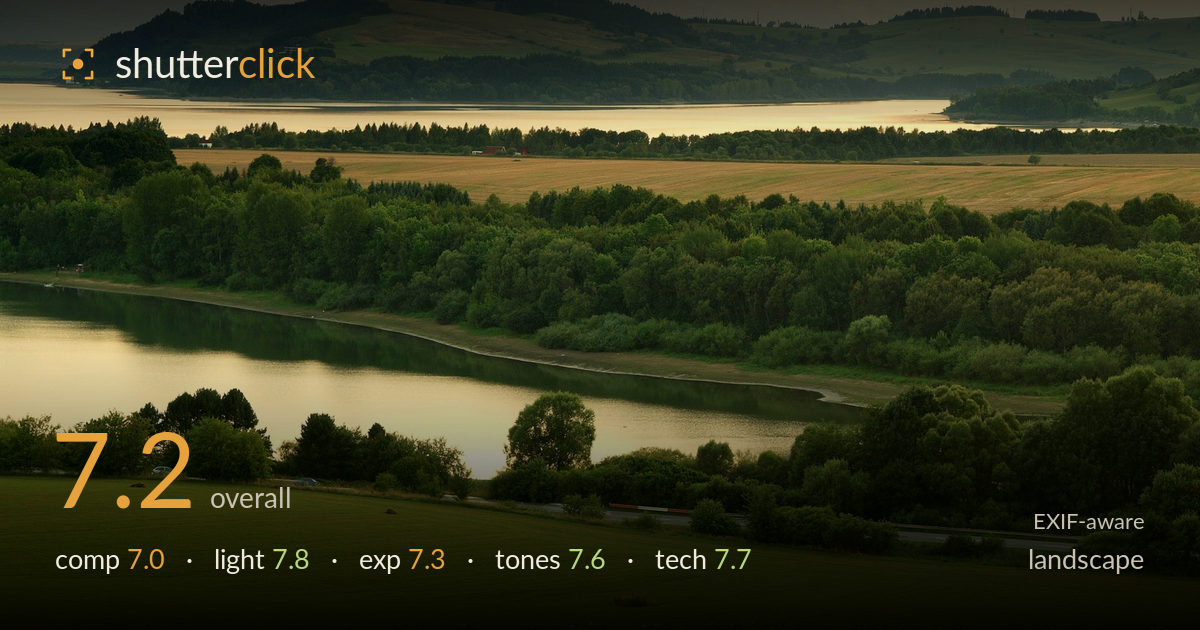
Amber evening over the lake
Photo by Martin Sojka

| Focal length | 39 mm |
| Aperture | f / 8.0 |
| Shutter | 2/5 s |
| ISO | ISO 100 |
| Exp. comp. | 0.0 EV |
| Shot at | 19:40 · Aug 15, 2009 |
A layered, atmospheric evening landscape carried by warm sky and receding hills. The strength here is depth — foreground meadow, mid-ground water and treeline, then hills and a hazy ridgeline stack cleanly into distinct planes. What holds it back most is the middle band: the broad tan field and dense treeline form a slightly monotonous horizontal strip that lacks a strong focal anchor, and the eye drifts without a clear resting point. The two lake surfaces catch the warm light nicely, but neither is placed to lead decisively into the frame. Refined focal emphasis and a slightly stronger foreground element would lift this from pleasant to compelling.
The layered recession from meadow to lake to hills to ridgeline builds real depth, and the diagonal shoreline in the lower third draws the eye inward. The foreground meadow is generous but somewhat empty — the scattered wildflowers along the bottom edge don't quite anchor it. The frame is level and the horizon sits high, which suits the layering, but the tan mid-ground field spreads as a flat horizontal band with no clear focal subject. A single strong anchor in the mid-ground would give the eye a destination.
The warm post-sunset glow is the picture's best asset, washing the sky in amber and gilding both stretches of water. The low, soft light rakes gently across the hills, separating the wooded slopes from the hazier distant ridge and creating the atmospheric depth. Direction is largely frontal-to-side, which flattens the mid-ground treeline slightly and leaves the near meadow a touch dull in shadow. Catching this ten minutes earlier, with more directional side light skimming the fields, would have added the modelling the foreground currently lacks.
Exposure is well judged for the conditions — the bright amber sky holds without blown highlights, and the water reflections retain their warm luminosity. Shadow areas in the dark wooded slopes stay readable rather than crushing to black. The overall balance leans slightly toward the darker mid-ground trees, which sit heavy against the glowing sky. A touch of shadow lift in the treeline and foreground would open the tonal range without sacrificing the mood. Highlight retention across the sky gradient is clean and deliberate.
The warm-to-green palette works: amber sky and golden water play against the cool, saturated greens of the forest and meadow. White balance leans warm, appropriate to the hour, and the tonal gradation across the sky is smooth. The greens edge toward heavy saturation in the mid-ground trees, flattening some detail into a dense mass. A slight reduction in green saturation and a small contrast lift in the shadowed foliage would restore separation between the layers of trees and add subtlety to the overall grade.
The settings are well matched to the scene. At f/8 on the E-30's Four Thirds sensor, depth of field is ample — foreground meadow through distant ridge all resolve, which is exactly what a layered landscape needs. ISO 100 keeps noise negligible and preserves tonal smoothness in the sky gradient, the hardest area to hold clean. The 2/5-second shutter is slow enough to demand a tripod, and the sharpness across the frame suggests one was used or the camera was well braced — there's no visible camera shake. The 39mm focal length (roughly 78mm equivalent) gives a natural compression that stacks the hills pleasingly without exaggeration. Focus appears set for overall depth rather than a single plane, appropriate here. The only refinement worth noting: with a long exposure already in play, a graduated ND or a slightly slower shutter to smooth the water further were both options. Execution is clean and the gear choices are sound throughout.
What would elevate it
Tags
Shot something like this?
Expert photo critique, on demand — scored across six categories, EXIF-aware. Start with 3 free critiques, no credit card.
critique my photo — free