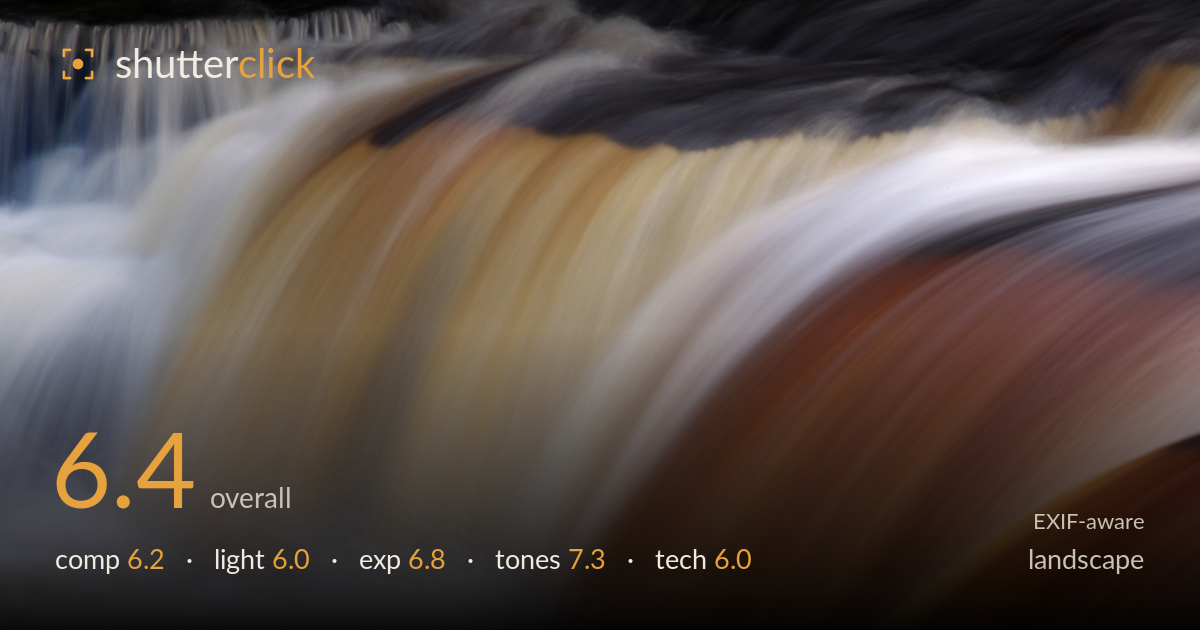
Amber water over the falls
Photo by mattbuck (category)

| Focal length | 133 mm |
| Aperture | f / 40.0 |
| Shutter | 1.0 s |
| ISO | ISO 100 |
| Exp. comp. | 0.0 EV |
| Shot at | 17:10 · Sep 12, 2012 |
A tight, abstract study of tannin-stained water pouring over a lip, and the peaty amber-to-cream colour palette is the strongest asset here. The long exposure renders the flow as silky ribbons, which suits the intimate treatment. What holds the shot back is the busy, unresolved top third — dark rocks and churned water compete without a clear anchor — and the diagonal drift of the falls edge, which reads slightly unbalanced. The frame is all motion and little rest, so the eye never settles. A cleaner edge, a defined focal point, or a touch more structure among the darks would lift this from pleasant abstract to compelling image.
The near-abstract framing leans into pattern and flow, and the amber ribbons carry the eye down the falls effectively. But the top third is congested — dark rock and turbulent water jostle without a clear anchor, and the lip of the falls runs on a slightly awkward diagonal that leaves the frame feeling tilted rather than dynamic. The pure-white foreground froth at bottom-left is a heavy, detail-less block. A cleaner separation between the calm upper flow and the cascade, or a defined focal point, would give the composition a place to rest.
The light is flat and even, typical of overcast or shaded conditions, which is a sound choice for long-exposure water — it avoids blown highlights on the white torrents and keeps the tannin colours saturated. That said, the illumination does little to model form; the rocks stay muddy and the water lacks the directional sheen that raking side light would bring. There is no timing advantage exploited here. Softer overcast works, but a low-angle glancing light would reveal texture in the dark stone and add dimensionality.
Exposure is well judged for a tricky high-contrast scene. The white water retains subtle detail rather than clipping to paper, and the dark rocks hold together without crushing to pure black. The amber midtones sit richly in the middle of the histogram. The bright froth at lower-left comes closest to blowing out but stays just within range. The one-second shutter at ISO 100 was the right call to balance motion blur against clean tonality. Overall a deliberate, controlled exposure with good dynamic-range management.
The colour is the highlight. The tannin-stained amber, ochre and cream tones are beautifully rendered and give the frame its identity, with a warmth that reads authentically like peat-fed moorland water. White balance is neutral and believable, and the transition from cream through gold to deep russet at right is smooth and appealing. Contrast is gentle, suiting the silky treatment. The only weakness is the murky, slightly flat rendering of the dark rocks, which lack tonal separation and pull down an otherwise rich palette.
The one-second shutter at ISO 100 delivers the intended silky flow while keeping noise nonexistent — the correct exposure triangle for long-exposure water. The problem is aperture: f/40 on the K-x is deep into diffraction territory, and it shows in the overall softness. Even the static dark rocks, which should be crisp, lack bite. Stopping down that far was likely a means to reach a one-second exposure in daylight, but an ND filter at f/11–f/16 would have preserved sharpness while holding the same shutter speed. At 133mm the framing is a tight, compressed crop that works for the abstract intent, though a tripod's stability is essential at that length and appears to have been used. Focus placement is hard to assess given the motion, but the diffraction-driven softness affects the whole frame. The fundamentals — ISO, shutter, stability — are handled well; the aperture choice is the single technical decision most worth revisiting.
What would elevate it
Tags
Shot something like this?
Expert photo critique, on demand — scored across six categories, EXIF-aware. Start with 3 free critiques, no credit card.
critique my photo — free