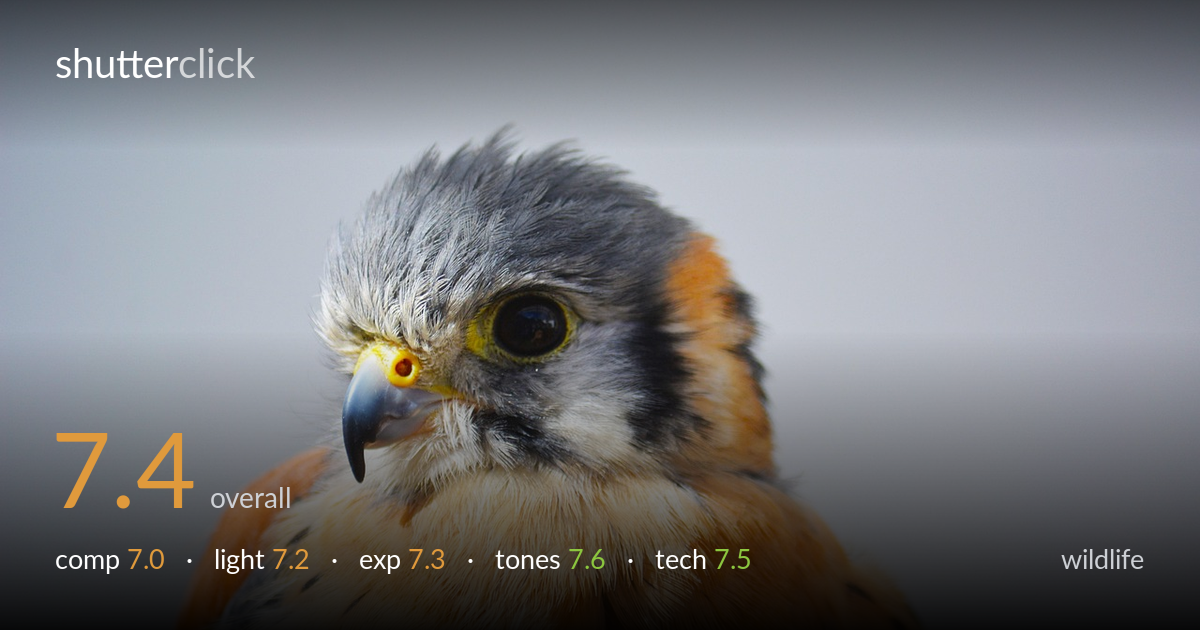
American kestrel against grey
Photo by RAFABRITTO

No EXIF metadata in this file
Technical analysis based on visual assessment only.
A clean, intimate portrait of an American kestrel, carrying strong colour and a confident eye-level perspective. The bird's slate cap and rust-orange plumage read beautifully against the muted grey backdrop, and the dark eye anchors the frame with a clear catchlight. What holds it back is placement: the subject sits low and left with most of the negative space pooled empty in the upper right, leaving the head crowded by the top edge. The light is soft and flattering but flat, giving little form to the feathers. A reframe and a touch more directional light would lift this from a good record shot to a striking one.
The bird occupies the lower-left, gazing across the frame, which gives the gaze room to travel — a sound instinct. But the balance tips too far: the upper-right quadrant is a large expanse of empty grey while the head presses near the top edge, leaving the composition both crowded and hollow at once. Cropping the dead space on the right and lifting the headroom slightly would tighten the relationship. The downward tilt of the head and beak is expressive and the diagonal of the body adds energy.
The light is soft and even, likely overcast or open shade, which avoids harsh shadows and renders the plumage colours cleanly. A visible catchlight gives the eye life. The trade-off is flatness — there is little directional modelling to separate the layered feathers or carve the contours of the head, so the bird reads slightly two-dimensional. A lower, raking side light would reveal feather texture and add depth. For a portrait this gentle light is workable, but it leaves form on the table.
Exposure is well controlled. The bright rust and cream tones hold detail without clipping, and the dark eye and beak retain shape rather than crushing to black. The grey background sits at a comfortable mid-tone that flatters the subject. Shadow detail in the breast feathers is preserved, and the histogram appears balanced with no obvious blown highlights on the lit feather edges. A slight lift in the darkest facial markings could recover a touch more texture, but the overall brightness placement is deliberate and accurate.
Colour is the image's strongest asset — the warm rust and apricot plumage plays cleanly against the cool neutral grey, a classic complementary balance that makes the bird pop. White balance is accurate, with natural feather hues and no colour cast. Contrast is gentle and suits the soft light, and saturation looks honest rather than pushed. The dark spotting on the lower breast adds tonal texture. A marginally deeper black point would add a little snap, but the rendering is pleasing and true.
Focus lands accurately on the eye, which is the priority in any wildlife portrait, and the catchlight confirms it. Sharpness across the face and cap is good, resolving individual feather barbs, and the spotted breast holds fine detail. The background falls into a smooth, even wash, indicating a wide aperture and good subject-to-background separation — exactly right for isolating the bird. There is no visible motion blur, so shutter speed handled the still subject well, and noise is well controlled with clean tonal transitions in the grey backdrop. The slight softness toward the lower breast is consistent with shallow depth of field rather than missed focus, which is acceptable given the focus plane sits on the eye. The main limitation is not technical execution but framing decisions. A touch more depth of field would carry sharpness further down the breast if the whole bird were the intent, but for a head-and-shoulders portrait the current rendering is well judged.
What would elevate it
Tags
Shot something like this?
Expert photo critique, on demand — scored across six categories, EXIF-aware. Start with 3 free critiques, no credit card.
critique my photo — free