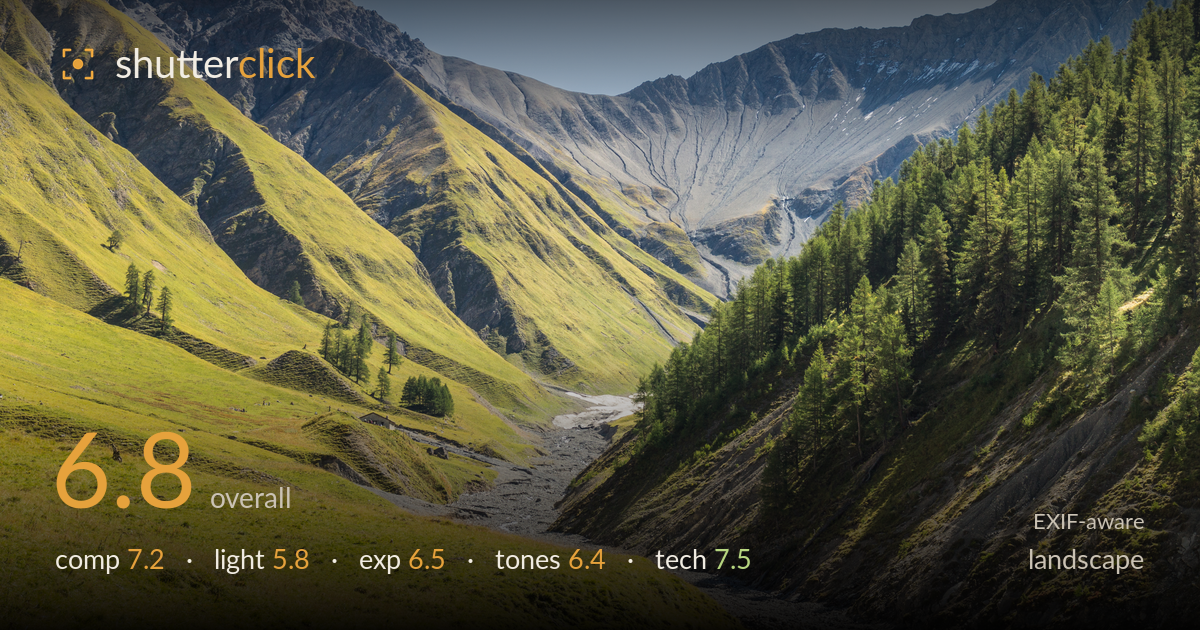
An alpine valley in summer
Photo by Agnes Monkelbaan

| Focal length | 35 mm |
| Aperture | f / 11.0 |
| Shutter | 1/100 s |
| ISO | ISO 100 |
| Exp. comp. | 0.0 EV |
| Shot at | 12:53 · Sep 18, 2019 |
A strong alpine valley with genuine depth, carried by the S-curve of the dry riverbed drawing the eye toward the distant scree slopes. The composition reads clearly and the layering of grassy foreground, forested flank, and grey peaks builds real scale. What most holds it back is midday light: hard, near-overhead sun flattens the modelling on the slopes and leaves the sky a pale, empty blue that adds little. The greens skew slightly toward yellow and the overall contrast is high but not shaped. Shot at the softer edges of the day, this same valley would gain the dimensionality it's currently missing.
The dry riverbed forms a natural leading line that snakes from foreground into the valley, and the diagonal ridgelines converge to reinforce that pull. The grassy left slope and the forested right flank frame the scene with good balance, and the tree scatter adds mid-ground interest. The horizon and peaks sit comfortably in the upper third. The large empty blue sky along the top edge does little work, though, and a slightly tighter crop from the top would concentrate attention on the valley where all the interest lives.
This is the weakest element. The near-overhead midday sun renders the slopes flatly, washing out the surface texture that raking light would have revealed on the grass and scree. Shadows are short and offer little to model the terrain's contours. The right-hand forest catches some directional light that hints at what the whole scene could have looked like earlier or later in the day. The pale, cloudless sky compounds the problem, offering no tonal drama to anchor the upper frame.
Exposure is handled competently for a bright high-contrast scene. The grey scree in the distance holds detail without blowing out, and the shadowed valley floor retains information. Some of the brightest sunlit grass edges toward clipping but doesn't lose meaningful texture. The pale sky sits well within range. The overall brightness reads a touch flat for the conditions — a slight pull on the shadows and a lift in local contrast would give the terrain more punch without risking the highlights.
The greens lean warm and yellow-heavy, which reads slightly unnatural against the cool grey of the rock. White balance is a little too warm overall for a clear high-altitude day, where the light typically carries more blue. Contrast is high from the harsh sun but not deliberately shaped, so the midtones on the slopes feel a bit muddy. The grey scree and the green pasture separate well tonally, but a cooler, more neutral grade would let both colours sit more convincingly together.
The technical execution is sound and well matched to the subject. At 35mm and f/11 on the EF-M kit lens, depth of field carries sharpness cleanly from the foreground grass to the distant peaks — the right call for a landscape wanting front-to-back detail. ISO 100 keeps noise absent and preserves maximum tonal quality in the greens and greys. At 1/100s the static scene is comfortably frozen with no camera shake evident, so the tripod-free handheld approach was viable here. The kit lens performs respectably at f/11, holding acceptable corner-to-corner detail, though this aperture flirts with diffraction on this sensor and a stop wider at f/8 would likely yield marginally crisper fine detail in the foliage. Focus appears well placed for hyperfocal coverage. The main technical limitation isn't the settings but the single-exposure capture of a very high-contrast scene — the dynamic range is stretched, and bracketing would have banked more latitude for the shadows and the brightest grass.
What would elevate it
Tags
Shot something like this?
Expert photo critique, on demand — scored across six categories, EXIF-aware. Start with 3 free critiques, no credit card.
critique my photo — free