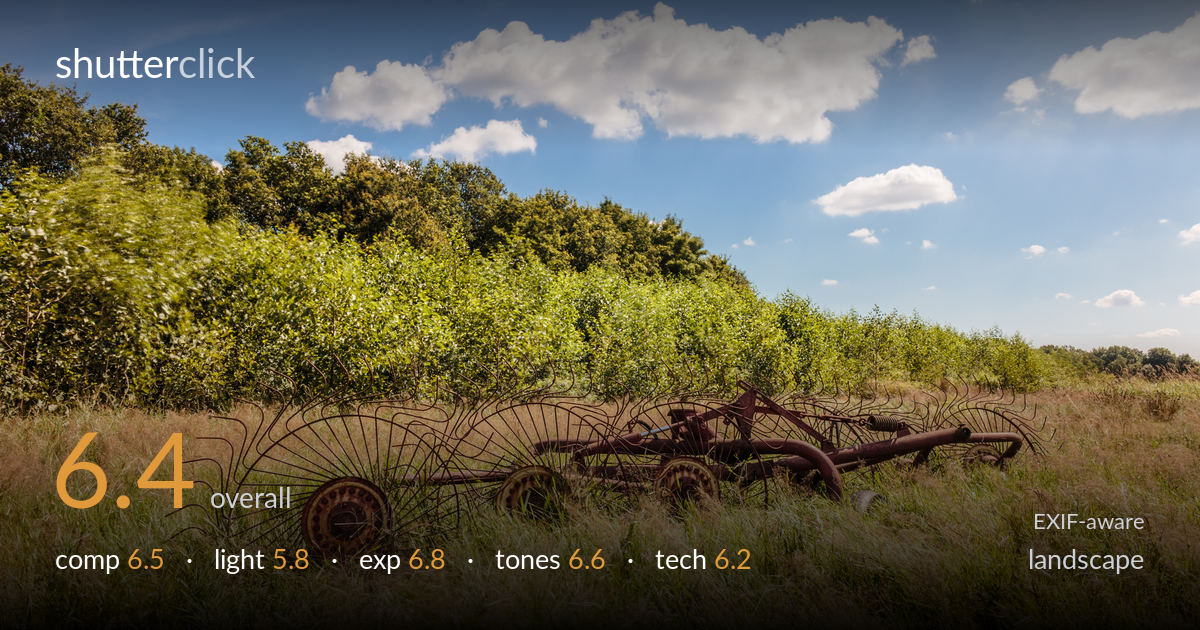
An old hay rake in the field
Photo by Dominicus Johannes Bergsma

| Focal length | 18 mm |
| Aperture | f / 11.0 |
| Shutter | 3.2 s |
| ISO | ISO 100 |
| Exp. comp. | 0.0 EV |
| Shot at | 12:53 · Aug 7, 2022 |
A rusted hay rake nested in tall grass makes a characterful subject, and the sweeping curve of its tines is the strongest graphic element in the frame. What most holds the photograph back is flat midday light: the high sun flattens the rake's form and renders the scene without depth or modelling. The composition reads as a centred band of subject under a large, somewhat empty sky. A lower angle, raking light, and a tighter relationship between rake and sky would lift this from a documentary record into something with mood and presence. The bones of a strong image are here.
The rake's arc of curved tines is a genuine gift — it draws the eye along its length and gives the frame rhythm. Placement is roughly central, with the machine occupying a horizontal band across the lower third while the upper half is sky and treeline. That split feels a little static, and the right side trails off into less-resolved machinery and grass. A lower shooting position would let the tines rise against the sky and separate from the busy treeline behind, which currently camouflages much of the rusted metal.
This is the weakest element. The overhead midday sun produces flat, near-shadowless light that does little for the rake's rusted texture or three-dimensional form. The cumulus clouds add some interest overhead, but the subject itself sits in even, characterless light that blends it into the surrounding greens and golds. Side light from a low sun — early morning or late afternoon — would rake across the tines and ironwork, separating the machine from its background and revealing the surface decay that makes the subject compelling in the first place.
Exposure is well managed for difficult contrast. The bright sky and clouds hold detail without clipping, and the grass and rusted metal retain shadow information across the foreground. The histogram appears to use the full range without crushing blacks. At ISO 100 the file is clean. There is a slight overall brightness that flattens the deepest shadows, but nothing is lost to over- or underexposure. A touch more contrast in the midtones during processing would give the rake more presence against the lighter grass.
Colour is natural and pleasant — the warm rust and dried-grass golds play against cool blue sky and green foliage in a balanced way. White balance reads accurate, with believable greens and clean cloud whites. The overall rendering is a little soft in contrast, leaving the subject competing tonally with its surroundings rather than standing apart. Deepening the rust tones and adding local contrast on the metalwork would help the rake assert itself. The sky's blue-to-white gradation is handled well and anchors the upper frame.
The settings reveal a contradiction worth noting. At 18mm and f/11 with ISO 100, depth of field is generously deep and the aperture choice is sensible for a landscape. But the 3.2-second shutter is far too long for a handheld or even tripod-mounted daytime scene with moving vegetation — the grass and leftmost bushes show clear motion blur from wind, softening areas that should be crisp. This long exposure at base ISO in bright sun suggests a strong ND filter or a metering quirk; either way, the moving foliage suffers. A shutter near 1/125s would have frozen the grass while f/11 and ISO 100 kept the file clean and sharp front to back. The rake's ironwork appears acceptably sharp where it is still, and the lens resolves fine detail well at this aperture. Focus placement on the machine is correct. The core issue is motion, not focus or depth — a faster shutter would resolve it entirely.
What would elevate it
Tags
Shot something like this?
Expert photo critique, on demand — scored across six categories, EXIF-aware. Start with 3 free critiques, no credit card.
critique my photo — free