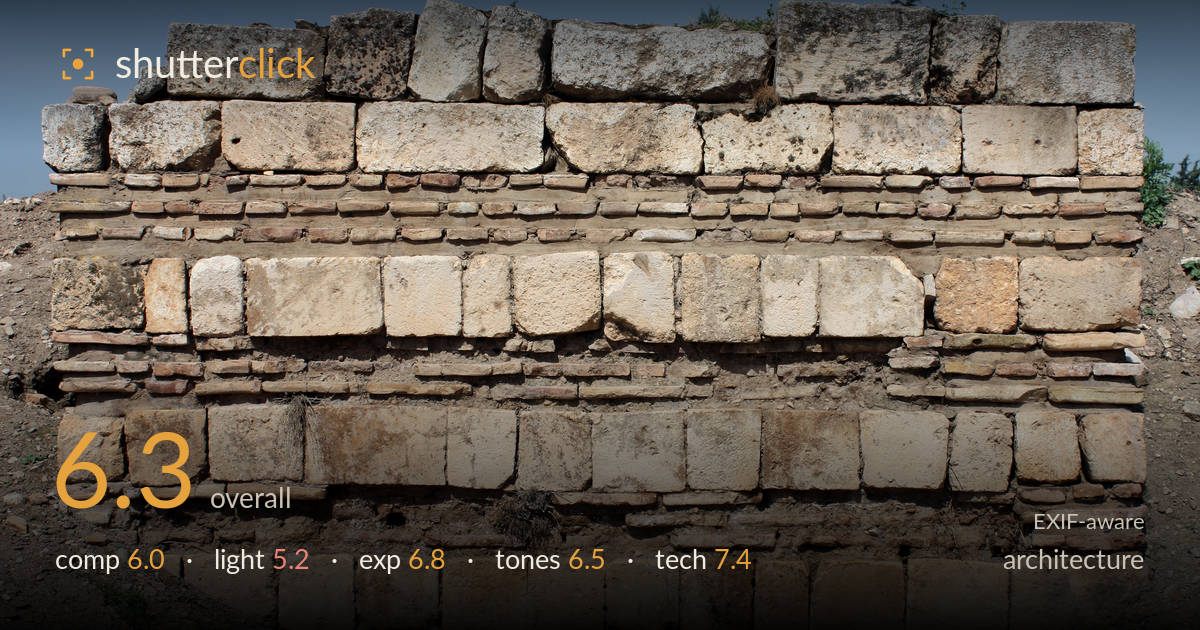
Ancient masonry wall in the sun
Photo by Eusebius

| Focal length | 32 mm |
| Aperture | f / 11.0 |
| Shutter | 1/200 s |
| ISO | ISO 100 |
| Exp. comp. | 0.0 EV |
| Shot at | 09:20 · Apr 18, 2010 |
A methodical, documentary-style record of an ancient masonry wall, capturing the alternating courses of large ashlar blocks and thin brick-like layers with clarity and completeness. The frontal, level approach serves the archaeological subject well, keeping the coursework readable across the frame. What most holds it back is the flat midday light, which flattens the stone's texture and mutes the depth of the joints. The wall floats slightly without a defined edge on the left, and the foreground rubble and weeds add clutter without narrative value. As a record it succeeds; as an image it would gain from raking light and a cleaner frame.
The straight-on framing suits a documentary record, presenting the courses squarely and legibly. The wall fills most of the frame with the strip of blue sky giving useful breathing room at the top. However, the base is cluttered with rubble and scrubby weeds that draw the eye without adding meaning, and the left side dissolves into an ambiguous mound rather than resolving into a clear edge. A slight tightening to exclude the busy foreground, or a viewpoint that defined the wall's terminus, would strengthen the geometry.
Overhead midday sun is the weakest choice for masonry like this. The light falls near-frontal and steep, flattening the relief between the large blocks and the thin intervening courses, so the joints and surface texture read as tonal patches rather than dimensional form. Shadows are shallow and offer little modelling. Low, raking side light in early morning or late afternoon would rake across the stone, throwing each joint and pockmark into relief and revealing the wall's construction far more vividly.
Exposure is handled competently. The sunlit stone holds highlight detail without clipping, and the recessed brick courses retain shadow information, so the full range of the masonry is legible. The bright sky sits comfortably without blowing out. Contrast is modest, a consequence of the flat light rather than an exposure fault. There is room to lift midtone separation in the joints during processing, but the capture preserves the detail needed to do so.
The warm sandstone palette reads honestly against the clean blue sky, and white balance appears neutral and true to a sunny day. The range of ochre, tan and grey across the blocks is pleasant and varied. Contrast is on the low side, which suits documentation but leaves the image feeling slightly muted. A modest contrast lift and selective clarity on the stone would deepen the joint shadows and give the coursework more tonal punch without misrepresenting the subject.
The settings are well chosen for the task. At f/11 the depth of field carries the flat, frontal wall sharply from edge to edge, exactly what an architectural record needs, and diffraction is not yet a concern at that aperture on this sensor. ISO 100 keeps noise absent and preserves the fine stone texture. 1/200s at 32mm is more than fast enough for a static subject handheld, eliminating any motion or shake. Focus is accurate across the plane of the wall, with individual pockmarks and joints crisply resolved. The 32mm focal length on the APS-C body gives a roughly normal field of view that avoids obvious wide-angle distortion, keeping the coursework rectilinear. Execution here is solid and deliberate. The only technical gain would come at the shooting stage rather than in the settings: the near-frontal position and the light, not the camera work, are what limit the sense of relief. A polarizer could have deepened the sky and cut glare on the stone slightly.
What would elevate it
Tags
Shot something like this?
Expert photo critique, on demand — scored across six categories, EXIF-aware. Start with 3 free critiques, no credit card.
critique my photo — free