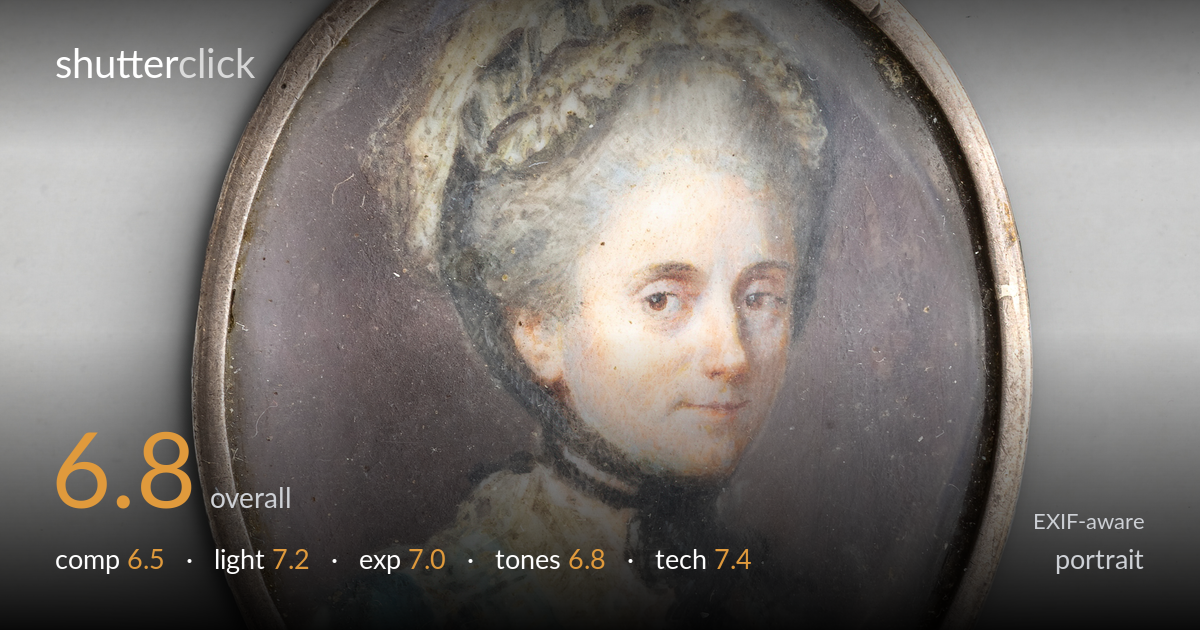
Antique portrait miniature in silver frame
Photo by Valentine Manchon Duchesne

| Focal length | 100 mm |
| Aperture | f / 13.0 |
| Shutter | 1/4 s |
| ISO | ISO 100 |
| Exp. comp. | -0.33 EV |
| Shot at | 19:02 · Apr 28, 2024 |
This is a documentation shot of an antique portrait miniature rather than a portrait in the conventional sense, and on those terms it succeeds at its primary job: the painted face is sharp, the silver bezel is rendered with its scratches and patina intact, and a scale bar anchors the object's true size. What most holds it back is the centred, slightly loose placement of the oval against generous grey field, and the absence of any raking light to reveal the surface relief and brushwork of the miniature. The flat, even lighting is safe but undersells the object's three-dimensional craft.
The oval miniature sits roughly centred on a neutral grey ground, which suits cataloguing but leaves the framing a touch static and loose. The scale bar in the lower right is a useful reference yet competes mildly for attention with the subject. The object tilts slightly off the vertical axis of the frame, so the surrounding negative space is uneven. A cleaner alignment, or a deliberate placement that lets the bezel breathe symmetrically, would read as more considered. The grey backdrop is appropriately quiet and non-distracting.
The light is soft and even, minimizing glare on the curved glass cover and keeping the painted face legible across its tonal range. That flatness is the trade-off: it's safe and reflection-free but does nothing to reveal the relief of the bezel or any surface texture in the paint. A slightly raking side light, or a second light to model the metal rim, would give the object dimensionality. As recorded the highlights on the silver are controlled and no specular hotspots blow out, which serves the documentary purpose well.
Exposure is well judged for a reflective object under glass. The -0.33 EV compensation protects the silver bezel highlights while keeping shadow detail in the dark ribbon and hair of the painted figure. The grey background sits in a clean mid-tone with no clipping at either end, suggesting good histogram discipline. The painted face retains its delicate pale gradations without washing out. If anything, a fraction more light in the deepest shadow of the lower bezel would open it slightly, but the current balance is deliberate and accurate.
The neutral grey ground is rendered cleanly with accurate white balance, letting the muted period palette of the miniature — the dusty blues, ivories and warm flesh tones — read truthfully. Contrast is gentle and appropriate for archival work, avoiding any harsh punch that would falsify the aged surface. The silver bezel carries a believable cool-neutral cast. Colour separation between the pale lace and the background is a little soft, but that reflects the object's own faded condition rather than a grading fault.
The settings are sensible for product-style copy work. f/13 on the 100mm L macro provides enough depth of field to hold the entire slightly domed glass and bezel in acceptable focus, and at ISO 100 the file is clean and detail-rich, resolving the scratches in the silver and the fine brushwork of the painted face. The 1/4s shutter is fine on a tripod with a static subject. Focus appears placed on the painted face, which is the correct priority, and it is crisp. One caution: f/13 begins to invite diffraction softening on this sensor, so f/8–f/11 with careful focus might recover a touch of micro-contrast while still covering the shallow depth of the object. The IS is irrelevant tethered down. Overall execution is competent and purpose-fit; the main missed opportunity is lighting choice rather than camera settings — the gear handled the job cleanly.
What would elevate it
Tags
Shot something like this?
Expert photo critique, on demand — scored across six categories, EXIF-aware. Start with 3 free critiques, no credit card.
critique my photo — free