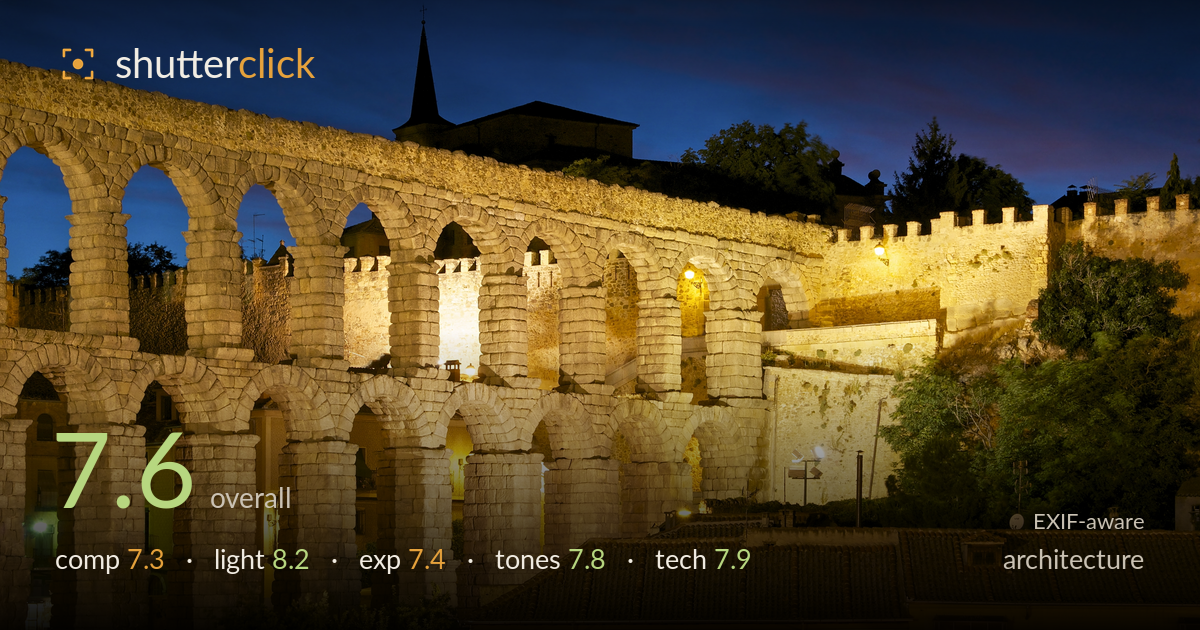
Aqueduct arches at blue hour
Photo by Jebulon

| Focal length | 50 mm |
| Aperture | f / 10.0 |
| Shutter | 1.3 s |
| ISO | ISO 200 |
| Exp. comp. | 0.0 EV |
| Shot at | 22:20 · Jul 21, 2012 |
The blue-hour timing is the strongest asset here — the deep cobalt sky against warm floodlit stone gives the Roman aqueduct real presence and dimensional depth. The tiered arches march across the frame with rhythm, and the layering from foreground arches to castellated wall behind builds scale. What holds it back is the busy lower-right corner, where the yellow-lit shop facade and rooflines compete with the aqueduct for attention and slightly muddle the hierarchy. Verticals lean subtly and the horizon reads a touch tilted. A cleaner compositional decision about the modern buildings would let the monument dominate as it deserves.
The receding rows of arches create strong visual rhythm and the diagonal descent from upper-left to lower-right gives the frame energy and depth. Layering the aqueduct against the castellated wall behind establishes scale well. The weakness is the lower-right quadrant: the illuminated shopfront and tiled roofs pull the eye away from the monument and clutter the base. The tension between ancient and modern could be intentional, but here it reads as competing subjects rather than dialogue. A tighter framing on the arches would strengthen the hierarchy.
Blue-hour timing is judged well — the sky retains saturated cobalt and magenta rather than going black, and the balance against artificial floodlighting is close to ideal. The warm uplighting rakes across the aqueduct stone, revealing the coursing and joints of the masonry with genuine texture. Some floodlight hotspots on the nearer piers run slightly hot, and the shop lighting in the foreground is a harsher, cruder colour that clashes with the monument's warmth. Overall the timing captures the fleeting balance most miss.
The long exposure holds a wide dynamic range across a difficult scene, retaining sky colour while lifting the lit stone. Shadow areas in the dark arch openings keep some detail without going fully black. The lit shopfront and a few floodlit stone faces push toward clipping, with the yellow facade approaching blown highlights around the lamps. Overall the exposure reads deliberate and well controlled for blue hour, though a slightly darker rendering or bracketing would have tamed those hot artificial-light patches.
The complementary pairing of warm sodium-lit stone against the cool blue sky is the tonal engine of the image and it works. The gradation in the sky from deep blue to violet near the horizon is handled cleanly. White balance leans warm, which flatters the ancient stone but pushes the foreground shop into an oversaturated amber that feels slightly artificial. Mid-tones in the masonry hold good separation. Slightly restraining the warm channel would keep richness without the candied glow in the lower right.
The settings are well matched to the scene. At f/10 the depth of field carries sharpness from the near arches through the distant castellated wall, appropriate for architecture where front-to-back detail matters. ISO 200 keeps noise negligible even in the shadowed arch interiors, and the 1.3-second shutter is exactly the tool for blue hour, gathering enough light to hold sky colour and floodlit stone together. This length demands a tripod, and the image shows no camera shake, so stability was handled. The 50mm focal length on this APS-C body gives a natural, undistorted perspective that renders the arches without wide-angle stretching. Focus is accurate on the stonework. The one technical refinement worth noting is perspective control: the verticals lean slightly and the frame reads marginally tilted, which a level or later correction would fix. A smaller aperture was unnecessary and would only have introduced diffraction — f/10 was the right call for balancing sharpness and light gathering.
What would elevate it
Tags
Shot something like this?
Expert photo critique, on demand — scored across six categories, EXIF-aware. Start with 3 free critiques, no credit card.
critique my photo — free