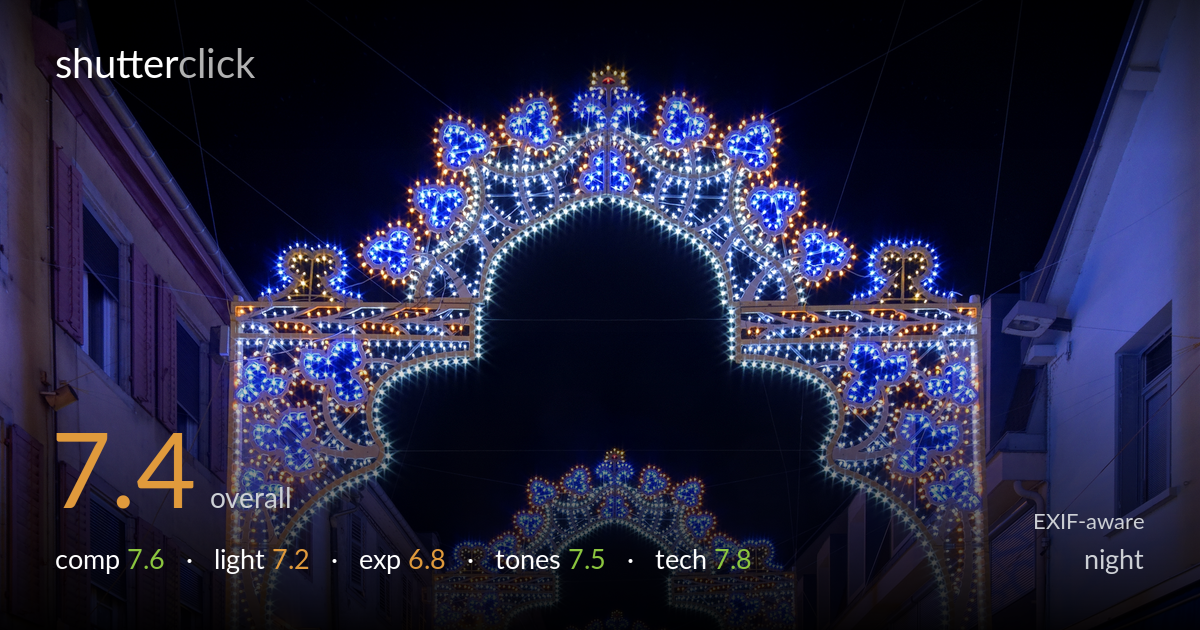
Arches of light down a quiet street
Photo by Thomas Bresson

| Focal length | 6 mm |
| Aperture | f / 8.0 |
| Shutter | 15.0 s |
| ISO | ISO 100 |
| Exp. comp. | 0.0 EV |
| Shot at | 19:13 · Dec 21, 2013 |
A genuinely effective use of receding light arches to build a tunnel of depth down a quiet street, anchored by a deep blue-hour sky. The repeating illuminated arches pull the eye cleanly toward the vanishing point, and the symmetry is largely well held. What most holds it back is highlight handling — the dense LED clusters blow out into solid white blobs, losing the intricate pattern the arches are built from. A touch of keystone correction and a slightly darker exposure on the brightest arch would recover that detail and sharpen the whole frame.
The stacked arches receding to a vanishing point are the strength here — a textbook tunnel of depth, with the foreground arch dominating and successive arches stepping the eye back. The street centred between flanking buildings reinforces the symmetry. The framing leaves a little dead headroom of sky above the main arch, and the foreground road is somewhat empty. A marginally lower angle or tighter top crop would tighten the balance, and the bins and planters at the base add useful grounding without clutter.
The light is almost entirely from the installations themselves against a clean blue-hour sky, which is the right window to shoot this — the sky retains colour rather than going dead black. Warm shopfront glow on the left and right balances the cool blue of the LEDs nicely. The main weakness is intensity: the nearest arch is so bright it overwhelms its own structure, while the distant arches read better. Shooting slightly earlier, with more ambient sky light, would have evened the contrast between near and far elements.
The 15-second exposure holds the deep sky and shadow detail in the buildings well, but the brightest LED clusters on the foreground arch are clipped to pure white, erasing the lace-like pattern that makes the display interesting. The street surface and shopfronts sit at a comfortable midtone. Exposing for the brightest arch — or blending two frames — would have preserved both the dark sky and the highlight structure. As is, the dynamic range of the lights exceeds what this single frame captured cleanly.
The blue-and-white LED palette against the warm sodium and shopfront tones is the image's strongest colour relationship — cool and warm playing off each other with the deep navy sky tying it together. White balance is well judged, neither pushing the warmth orange nor the blues cyan. Contrast is healthy and the midtones in the buildings hold gradation. Saturation in the blue lights is intense but stays just short of garish. The clipped highlights are the only place where tonal information is genuinely lost.
Solid execution for a small-sensor compact. ISO 100 keeps noise minimal across the shadows, and f/8 gives front-to-back sharpness suited to a deep street scene — the distant arches and the foreground arch both hold detail. The 15-second exposure on what must have been a tripod renders the static scene cleanly, with no visible camera shake. The 6mm focal length (roughly 28mm equivalent) is a sensible wide choice for the tight street, though it introduces mild converging verticals on the flanking buildings. The main technical limit is the sensor's dynamic range against extreme point-source brightness — the LEDs clip hard, and the P7100's small sensor offers little headroom to recover them. A two- or three-frame bracket merged in post would have been the cleaner route. Focus is accurate on the foreground arch and holds through the street. Overall the gear was handled competently within its constraints; the clipping is more a limitation pushed than an error made.
What would elevate it
Tags
Shot something like this?
Expert photo critique, on demand — scored across six categories, EXIF-aware. Start with 3 free critiques, no credit card.
critique my photo — free