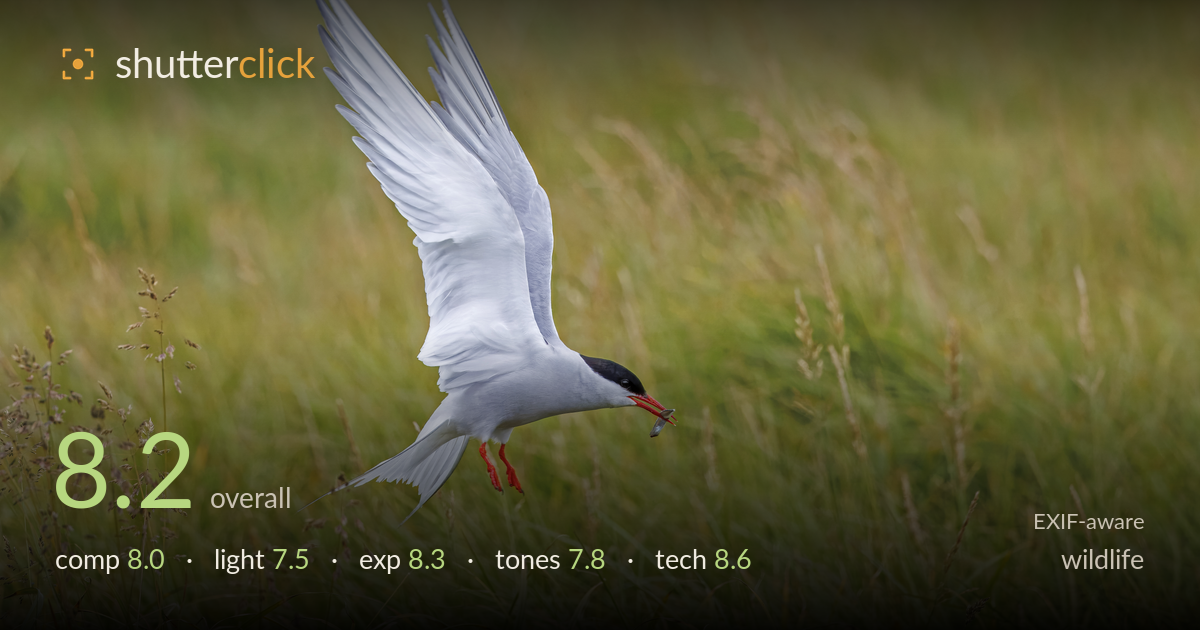
Arctic tern in flight with catch
Photo by Charles J. Sharp

| Focal length | 343 mm |
| Aperture | f / 5.6 |
| Shutter | 1/2000 s |
| ISO | ISO 800 |
| Exp. comp. | -0.33 EV |
| Shot at | 13:31 · Aug 5, 2025 |
A well-timed capture of an Arctic tern in flight with prey in its bill — the raised wings and delivered catch give the frame genuine behavioural interest. The bird is tack-sharp against a soft, uncluttered wash of green and gold, and the red bill and legs read cleanly against cool white plumage. What holds it back is the flat, slightly hazy light that mutes contrast on the white feathers, and the descent toward the lower frame leaves a lot of empty green above. A hair more separation between subject and background, and stronger directional light, would lift this from a strong record to a standout.
The tern is placed left of centre with its bill and gaze pointing into open space, which gives the flight direction room to breathe. The raised wings extend into clean negative space above, and the diagonal grass tufts at lower left add foreground anchoring. The descending posture, however, drops the subject toward the lower third while a large expanse of unbroken green sits above, feeling slightly top-heavy. Tucking the bird marginally higher, or cropping some of the empty upper green, would tighten the balance without losing the wing sweep.
Light is soft and diffuse, likely from an overcast or hazy sky, which keeps the white plumage from blowing out and preserves detail in the feathers. It renders the scene evenly but flatly — there is little directional modelling to sculpt the wing feathers or add dimension to the body. The catchlight in the eye is weak, and the overall low contrast leaves the whites feeling slightly grey. Side or backlight would have separated the wing structure and given the plumage more sparkle.
Exposure is well judged for a bright white subject against a mid-toned background. The -0.33 EV compensation protects the highlights on the white plumage, which retain feather detail rather than clipping. Shadows on the underside of the wing and body hold information without going murky. The midtones of the grass sit comfortably, giving a balanced histogram with no evident clipping at either end. A confident, deliberate exposure that handles the tricky white-on-green dynamic range cleanly.
The green-and-gold background is pleasant and complements the cool whites and reds of the bird, though the overall palette leans slightly muted from the flat light. White balance is neutral and believable, and the red bill and legs provide welcome pops of colour. The whites verge on grey in places, wanting a touch more contrast and luminance to feel crisp. The grass tones are a little uniform; some tonal separation between foreground and background stalks would add depth.
The settings are well matched to the subject. At 343mm on the RF100-500, f/5.6 gives enough depth to hold the whole bird sharp while dissolving the grass into smooth bokeh — the background separation is excellent. 1/2000s cleanly freezes the wingtips and legs with no motion blur, exactly what a flight shot with delivered prey demands, and even freezes the small fish in the bill. ISO 800 is well within the R6 II's comfort zone, delivering clean files with negligible noise. Focus is locked precisely on the head and eye, which is the priority for wildlife, and the plane of sharpness carries through the body and near wing. The only quibble is that stopping down marginally, or the natural focus falloff, leaves the far wingtip fractionally softer than the near one — minor, and arguably natural given the wing angle. Overall this is a technically clean, confidently executed capture that gets the fundamentals right.
What would elevate it
Tags
Shot something like this?
Expert photo critique, on demand — scored across six categories, EXIF-aware. Start with 3 free critiques, no credit card.
critique my photo — free