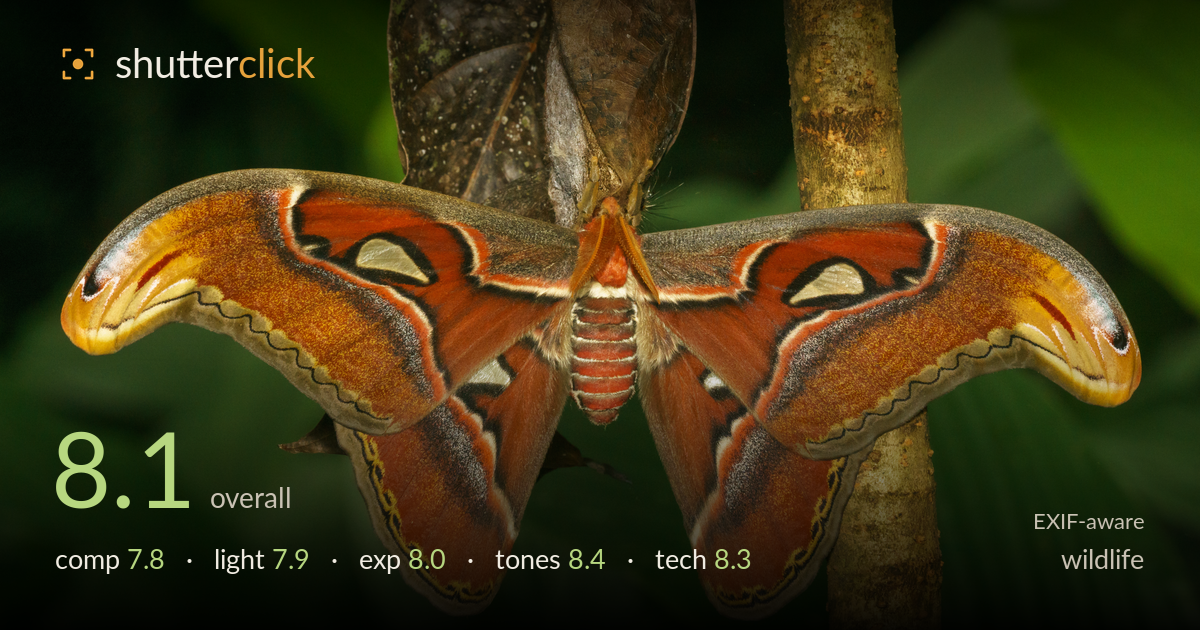
Atlas moth on a branch
Photo by Jeevan Jose, Kerala, India

| Focal length | 150 mm |
| Aperture | f / 14.0 |
| Shutter | 1/250 s |
| ISO | ISO 400 |
| Exp. comp. | 0.0 EV |
| Shot at | 10:40 · Jul 7, 2018 |
A commanding frame-filling study of an atlas moth, with the wings spread nearly symmetrically across the width and the intricate scale patterning rendered in fine detail. The green foliage backdrop sets off the warm rust and ochre tones cleanly. What holds it back most is the vertical branch running through the right third — it competes with the moth for attention and crowds the right wing tip, which nearly touches the frame edge. The dead leaf overhead is a natural anchor but sits slightly heavy at the top. Strong subject rendering, though the arrangement could breathe a little more.
The moth is placed large and near-centred, letting the wing patterns dominate — appropriate for the subject's scale and detail. The dead leaf overhead gives a natural perch and context. The wing tips, however, run very close to both frame edges, and the right tip against the bright branch feels pinched. The vertical branch on the right divides the frame and pulls the eye from the animal. A touch more breathing room on the left and a repositioned branch would balance the near-symmetry the moth already offers.
Soft, diffuse light — likely overcast or shaded forest — wraps the moth evenly and avoids blown highlights on the pale eyespot windows. This flattering, low-contrast quality suits the delicate scale texture and keeps the reds saturated without harsh speculars. The tradeoff is a slight lack of modelling; a hint more directional light would lend the furred body and wing ridges more dimensionality. The dark foliage falls into shadow naturally, isolating the subject well against the background.
Exposure is well judged across a tricky tonal spread. The dark green background retains shadow detail without muddiness, while the pale window patches on the wings hold texture rather than clipping. The rust and ochre midtones sit right where they should. The histogram is weighted toward the darker end because of the foliage, but the subject itself is exposed cleanly with no evidence of accidental underexposure. Highlights on the branch are the brightest point and stay just under blowing out.
The colour rendering is a highlight — the warm palette of rust, brick red, ochre and cream reads richly against the deep, desaturated green background, a natural complementary contrast that makes the moth pop. White balance looks accurate, with neutral browns and believable greens. The tonal range is full, from the near-black eyespots to the pale windows, with smooth gradation across the wing gradients. Saturation is strong but not pushed into unnatural territory, preserving the subtle scale detail.
The f/14 aperture on the 150mm macro was a sound call for a subject this large and flat — it holds both spread wings in acceptable focus across the plane, which a wider aperture would have failed to do. Focus lands crisply on the body and inner wings, resolving the fur and scale texture well. The 1/250s shutter is more than adequate for a stationary roosting moth, and ISO 400 keeps noise negligible, giving clean shadows in the dark foliage. The 150mm focal length offers comfortable working distance and pleasant background compression, rendering the greenery into soft washes. Diffraction from f/14 costs a fraction of edge sharpness, but the depth-of-field gain is the right trade for a wide, planar subject. The only minor execution note is that the extreme wing tips soften slightly, partly focus falloff and partly the moth's natural curvature. Overall a technically assured capture with settings well matched to the subject.
What would elevate it
Tags
Shot something like this?
Expert photo critique, on demand — scored across six categories, EXIF-aware. Start with 3 free critiques, no credit card.
critique my photo — free