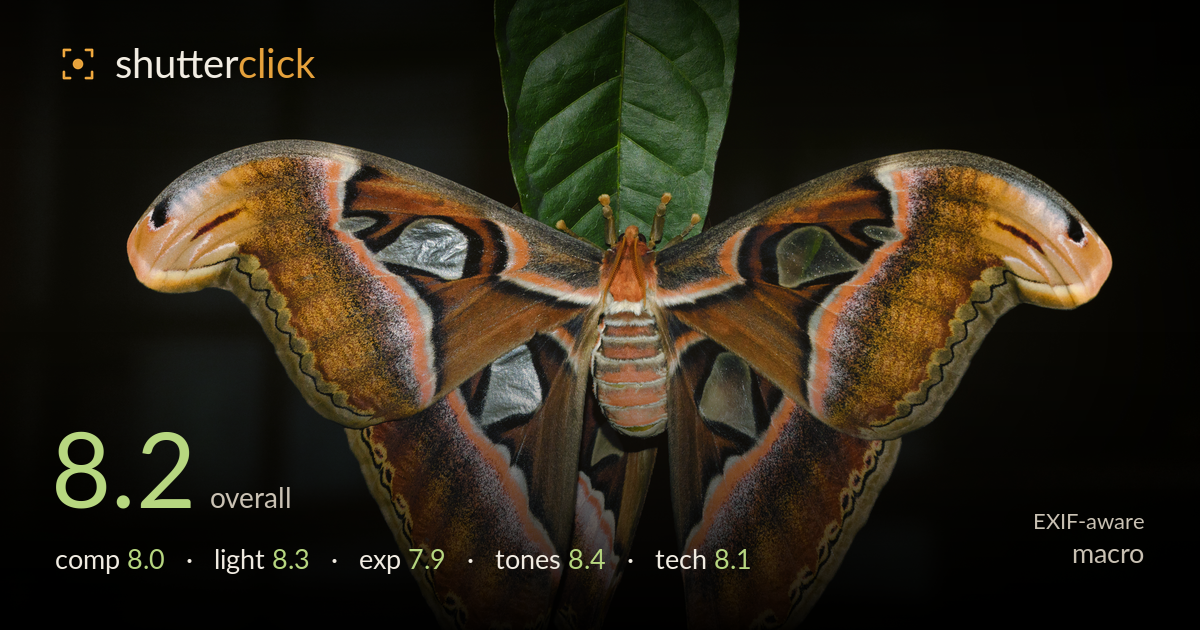
Atlas moth spread on a leaf
Photo by Jeevan Jose, Kerala, India

| Focal length | 150 mm |
| Aperture | f / 14.0 |
| Shutter | 1/250 s |
| ISO | ISO 400 |
| Exp. comp. | 0.0 EV |
| Shot at | 16:27 · Jul 13, 2018 |
A commanding specimen study of an atlas moth, rendered with symmetry and rich colour against a clean dark ground that lets the wing pattern dominate. The near-perfect bilateral spread, the translucent wing windows, and the intricate scalloped margins all read with clarity. The dark background separates the subject cleanly. What holds it back most is the leaf overlapping the head and thorax — it competes with the most detail-rich part of the moth and interrupts the antennae. The lower wing tips also press against the frame edge. A touch more shadow lift in the darkest wing regions would recover texture without flattening the mood.
The bilateral symmetry of the wingspan is the driving force here, and it's handled well — the moth fills the frame with authority and the dark ground isolates it cleanly. The dividing leaf, however, cuts down through the head and thorax, obscuring the very structure the eye wants to inspect and interrupting the antennae. The lower wing tips crowd the bottom margin, and the left wing tip clips the frame edge. Slightly more room around the wings and a leaf placed behind rather than across the head would resolve the tension.
Soft, even frontal light wraps the wings without hard specular hotspots, revealing the powdery scale texture and the subtle tonal gradients from ochre to rust. The translucent wing windows pick up a faint sheen that reads convincingly. Shadow falls gently into the background, keeping it black. The trade-off is a slight flatness across the wing surface — the light describes colour and pattern well but adds little dimensional modelling. A hair of raking side light would lift the scale relief and give the furry thorax more sculptural depth.
Exposure is well judged for a dark-ground subject: the moth sits bright and legible while the background falls cleanly to black without muddy grey. Highlights on the pale wing tips and translucent windows hold detail rather than blowing out. The darkest rust-brown wing regions, particularly the lower inner wings, sink close to blocked, losing some scale texture. A modest shadow lift in post would recover that detail without lifting the background. Overall the histogram appears deliberate and the midtones on the wing pattern are placed with care.
The colour rendering is a real strength — warm ochres, coppery rusts, salmon-pink accents and the cream margins are saturated but never garish, and white balance is neutral with no colour cast. The tonal range runs from the pure black ground to the bright wing tips with smooth gradation across the wing scales. The green leaf provides a clean complementary counterpoint without pulling attention. Contrast is nicely controlled so the intricate pattern stays readable. Only the deepest wing browns lose a little separation, but the overall palette is coherent and rich.
The 150mm macro at f/14 is a sound choice for a subject this large, and it pays off — depth of field spans the full wing plane while keeping the wings acceptably sharp corner to corner, with focus landing well on the thorax and inner wing detail. ISO 400 is clean with no intrusive noise, and 1/250s is ample for a static subject on a still leaf. The wing scales, scalloped margins and antennae all resolve crisply where the light reaches them. At f/14 some diffraction softening is inevitable but it stays within acceptable limits for this magnification. Focus is best on the near wing surface; the slightly recessed head sits marginally softer, though the obscuring leaf makes this hard to judge. The lens and settings are well matched to the task. Focus stacking would have squeezed out even more edge-to-edge acuity across the thorax and both wing planes, but the single frame holds up strongly.
What would elevate it
Tags
Shot something like this?
Expert photo critique, on demand — scored across six categories, EXIF-aware. Start with 3 free critiques, no credit card.
critique my photo — free