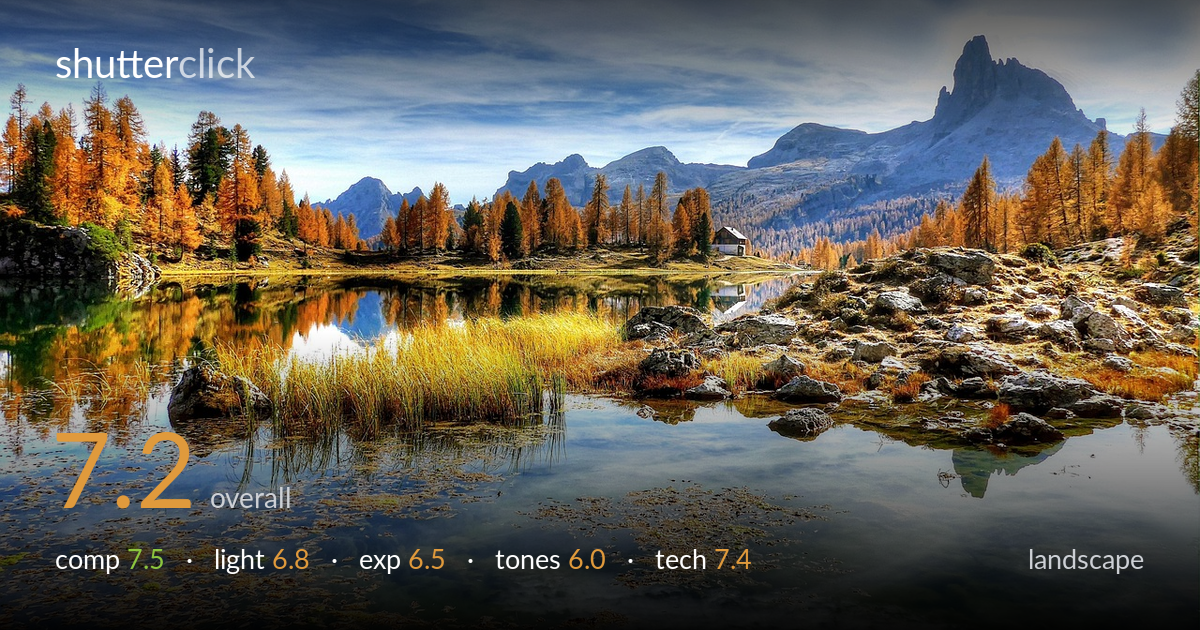
Autumn dolomites lake reflection
Photo by kordi_vahle

No EXIF metadata in this file
Technical analysis based on visual assessment only.
A classic Dolomites lake scene with strong natural ingredients — the jagged peak anchoring the upper right, autumn larches in full colour, and clear foreground water with reeds and reflections that pull the eye inward. The biggest limitation is the heavy HDR processing: tones are pushed toward oversaturation, the sky takes on a grey, flattened look, and local contrast haloing appears around the ridgelines. The composition layers nicely from foreground water to distant peak, though the foreground rocks on the right crowd the frame slightly. Dialing back the processing would let this genuinely strong location breathe.
The frame builds clear depth: foreground reeds and submerged debris, a mid-ground band of golden larches, then the layered peaks with the dramatic spire pulling weight to the upper right. The reflection of that peak in the still water on the right is a smart anchor. The horizon sits reasonably high, giving the water room. The right-side foreground rocks compete a little and crowd the edge, and the small chapel near centre is an underused secondary subject. A touch more breathing room on the right would settle the balance.
Light appears to be soft and fairly flat, likely overcast or hazy, which suits the autumn palette but robs the peaks of the modelling that raking side light would give. The larches glow well, but there is little directional shadow to give the rock faces dimension or the scene a defined time of day. The sky is bright and somewhat featureless toward the upper right. Earlier or later light skimming across the ridges would have carved more texture into the stone and added warmth to the slopes.
Exposure leans bright overall, and the HDR treatment compresses the dynamic range so heavily that midtones flatten and the sky loses its tonal separation. The brightest cloud areas near the peak edge toward washed-out, while the clear foreground water holds detail well down into the submerged stones. The histogram likely lacks a clean black point, leaving the image feeling slightly hazy. A more restrained tone-mapping with deeper shadows and a recovered, more natural sky would restore the punch this scene deserves.
This is where the processing shows most. Saturation is pushed hard — the oranges verge on artificial and the blues in the water swing toward an unnatural teal. The sky has that grey, desaturated HDR cast that fights the warm foliage. Local contrast haloing rings the ridgelines and treetops. White balance feels slightly cool against the autumn warmth. Pulling saturation back ten to fifteen percent, warming the sky, and removing the halo artifacts would yield a far more believable and ultimately more striking colour rendering.
From visual evidence the capture is technically competent. Depth of field is deep, holding sharpness from the foreground reeds through to the distant spire, consistent with a small aperture and a wide-to-normal focal length suited to this kind of grand vista. Focus appears accurate across the plane, and there is no obvious motion blur in the still water or grasses. Noise is well controlled, suggesting a low ISO. The main technical concerns are not in capture but in processing: the aggressive HDR tone-mapping introduces haloing and edge artifacts that read as over-sharpening around high-contrast boundaries. A polarizer appears to have been used or would help, given the strong reflection control and the saturated water — though it may also explain some of the uneven sky brightness. A graduated approach to the sky and gentler global contrast would preserve the clean underlying technical execution while removing the synthetic look.
What would elevate it
Tags
Shot something like this?
Expert photo critique, on demand — scored across six categories, EXIF-aware. Start with 3 free critiques, no credit card.
critique my photo — free