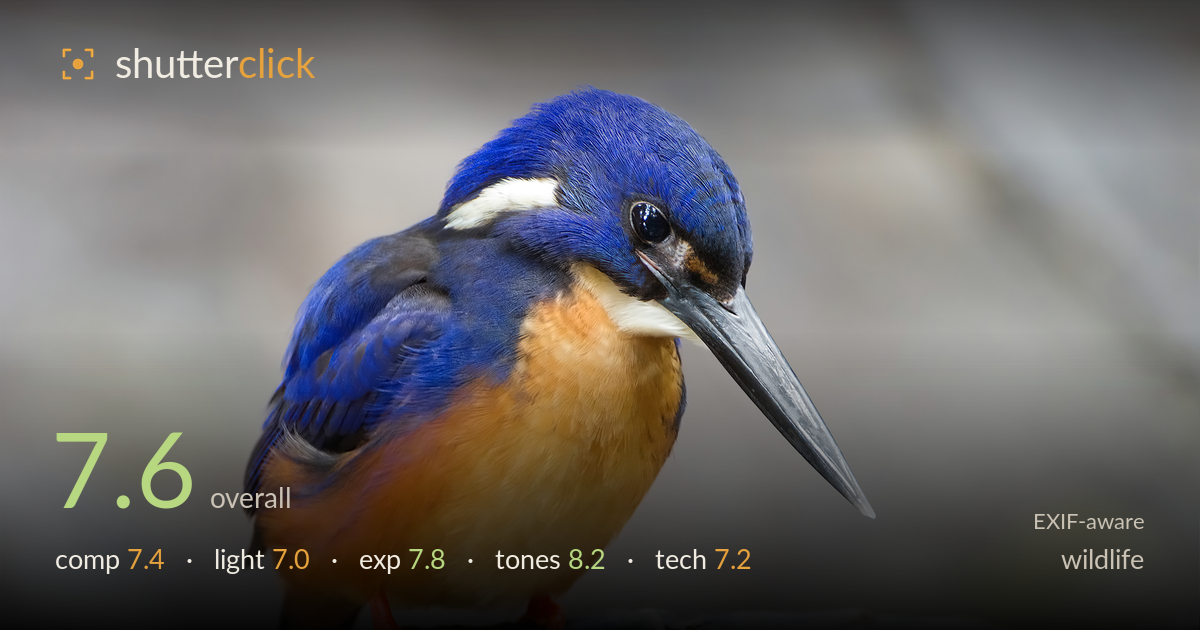
Azure kingfisher on a branch

| Focal length | 700 mm |
| Aperture | f / 5.6 |
| Shutter | 1/20 s |
| ISO | ISO 1600 |
| Exp. comp. | 0.0 EV |
| Shot at | 15:17 · Jul 4, 2011 |
A frame-filling azure kingfisher rendered with excellent feather detail and beautifully saturated blue-and-orange plumage. The eye is sharp with a clean catchlight and the bird sits at a natural, engaged angle on a diagonal perch. What most holds the shot back is the busy, mid-toned background: the pale grey tangle of out-of-focus branches lacks the tonal separation that would let the subject pop, and it competes for attention behind the head. The composition also leaves considerable empty space at upper left while the bill nearly touches the right edge. A cleaner backdrop and more breathing room in the bill's direction would lift this from a very good record shot to a portfolio piece.
The bird fills the frame well and the diagonal branch gives a solid anchor, with the crouched pose reading naturally. The eye and bill dominate the upper-right third, which works. However, the bill points hard right and nearly runs off the edge, giving the subject nowhere to look into — the large empty area sits at upper left, opposite the gaze. Flipping that breathing room to lead the bill would strengthen balance. The branch exiting bottom-right and lower-left frames the perch adequately without being distracting.
Soft, diffused light — likely overcast or shaded — wraps the bird evenly and avoids harsh highlight blowout on the bright orange breast, which is a real asset. A clean catchlight sits in the eye, essential for a bird portrait. The trade-off is flatness: there is little directional modelling to sculpt the head and back, so the plumage relies on its own colour rather than light to give form. A touch of side or rim light would separate the dark back from the pale background and add dimension.
Exposure is well judged. The bright orange underparts hold texture without clipping, the white throat retains detail, and the dark blue back and near-black wing tips keep shadow information. The eye is exposed cleanly with no muddy blocking. The high-key background sits bright but is not distractingly hot. Midtones are placed sensibly for the subject rather than the scene, which is the right call. No obvious under- or over-exposure — the histogram appears comfortably contained across the frame's key tones.
The strongest category. The complementary blue and orange are vivid yet believable, with the electric azure crown and warm rust breast reading true rather than oversaturated. White balance is neutral and accurate, and the tonal gradation through the orange belly is smooth. The muted grey background provides a restrained tonal counterpoint that keeps the plumage as the colour event. Contrast is well controlled — the dark bill and wing retain depth without crushing. A shade more separation from the greys would be the only refinement.
The result is impressive given 1/20s handheld-equivalent exposure at 700mm — a shutter speed far below the reciprocal rule for that reach, which demands a tripod or very steady support. The eye and facial feathers are genuinely sharp, so focus landed on the critical plane and camera shake was largely avoided, a real achievement at this focal length and speed. f/5.6 gives just enough depth to keep the head sharp while the far wing softens slightly, acceptable for the pose. ISO 1600 on the 7D introduces some luminance noise, visible in the smoother orange and grey areas, but it is well within reason for the low light. The main technical risk is that slow shutter: any subject movement would have ruined it, and a faster speed with a modest ISO bump would be safer and more repeatable. Overall the capture is technically strong, with sharpness where it matters most and colour rendering intact.
What would elevate it
Tags
Shot something like this?
Expert photo critique, on demand — scored across six categories, EXIF-aware. Start with 3 free critiques, no credit card.
critique my photo — free