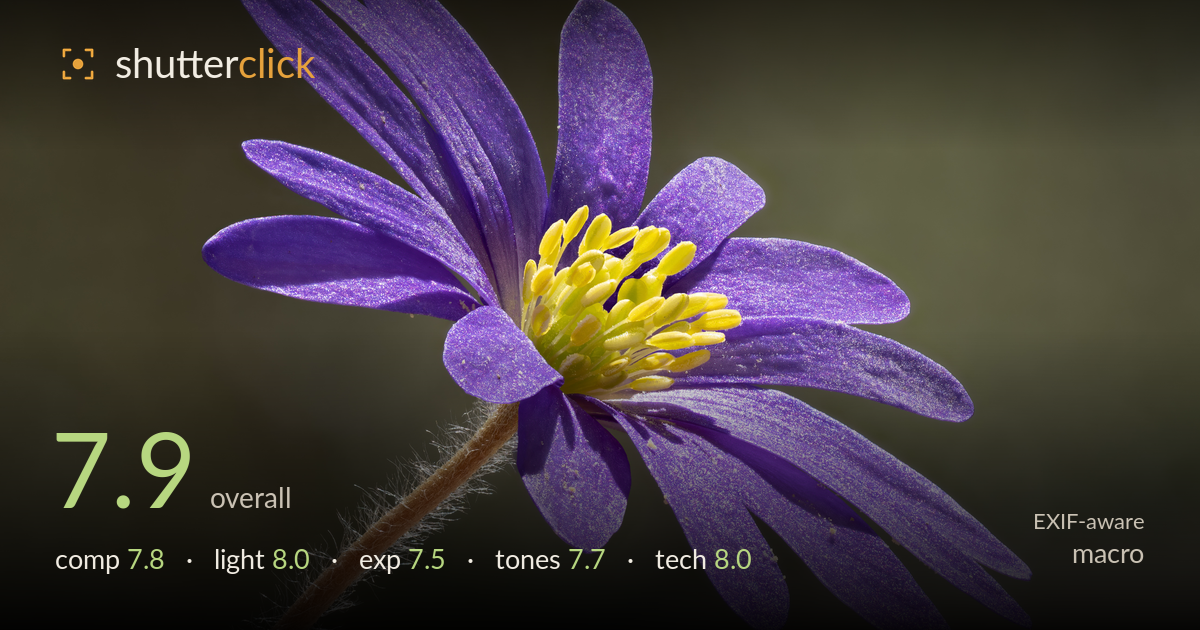
Backlit anemone on a hairy stem
Photo by Ermell

| Focal length | 60 mm |
| Aperture | f / 6.3 |
| Shutter | 1/200 s |
| ISO | ISO 200 |
| Exp. comp. | 0.0 EV |
| Shot at | 12:45 · Apr 7, 2023 |
A confident three-quarter view of an Anemone blanda that reads with real energy, the diagonal stem anchoring the bloom against a clean, muted background. The furry stem is the quiet triumph — that raking backlight turning the hairs into fine silver filaments gives the frame its craft and depth. What holds it back is focus placement: the yellow stamens, the natural focal point, sit slightly soft while the nearest petals carry the crispest detail. The petals also show blown highlight patches where sun catches the reflective surface. A touch more depth or a stack would resolve the centre.
The rising diagonal of the stem into the open bloom is dynamic and well judged, giving the frame movement rather than a static head-on flower. Placing the blossom in the upper right and letting the stem sweep from the lower left builds a strong compositional line. Negative space on the right balances the mass of petals on the left. The tight framing crops the topmost petal tips slightly, which pinches the reach of the bloom. A hair more room at the top would let the petals breathe.
Low, raking light does the heavy lifting here, skimming across the stem to reveal every hair as a bright filament — genuinely the strongest lighting element in the frame. The same directional sun models the petals, catching their sparkling texture and separating the yellow centre. The trade-off is harshness: several petal surfaces catch the light at an angle that pushes them toward highlight glare. A slight diffusion, or shooting when the sun sits behind thin cloud, would tame those hot patches while keeping the texture.
Exposure sits mostly well, holding the deep violet saturation and rich background falloff. The problem is the specular highlights on the sunlit petals — several patches, particularly on the lower and right petals, are pushed to near-clipping and lose their surface detail and colour. The yellow stamens are close to the edge too. The background and stem tones are handled cleanly with detail retained throughout. A third of a stop of negative compensation, or shooting in softer light, would have preserved the petal highlights without darkening the shadows meaningfully.
The violet-to-yellow complementary pairing is the colour engine of the shot, and the muted olive-brown background is a smart, non-competing backdrop that lets the bloom sing. The purple carries good saturation without tipping into oversaturation on the whole, though the brightest petal areas drift toward a washed, chalky look where the light overwhelms them. White balance reads accurate and natural. The tonal separation between the warm stem, cool petals, and yellow centre is clean. Reining in the highlight areas would restore fuller colour density across the petals.
The OM-1 with the 60mm macro is an ideal pairing for this subject, and f/6.3 is a sensible choice — enough depth to carry much of the flower without collapsing the background, which renders as smooth wash. ISO 200 keeps the file clean with no visible noise, and 1/200s froze any breeze-driven movement of a notoriously fidgety subject. The execution issue is focus plane placement: the sharpest zone falls on the nearest petals and the stem hairs rather than the stamens, which sit slightly behind the plane of critical focus and read soft. For a flower this three-dimensional, f/6.3 cannot cover the full depth from front petals through to the far ones, so a small focus stack of three to five frames would have delivered crisp stamens and petals together. Alternatively, focusing precisely on the stamens and accepting soft petal tips would have prioritised the natural focal point. Sharpness where achieved is excellent.
What would elevate it
Tags
Shot something like this?
Expert photo critique, on demand — scored across six categories, EXIF-aware. Start with 3 free critiques, no credit card.
critique my photo — free