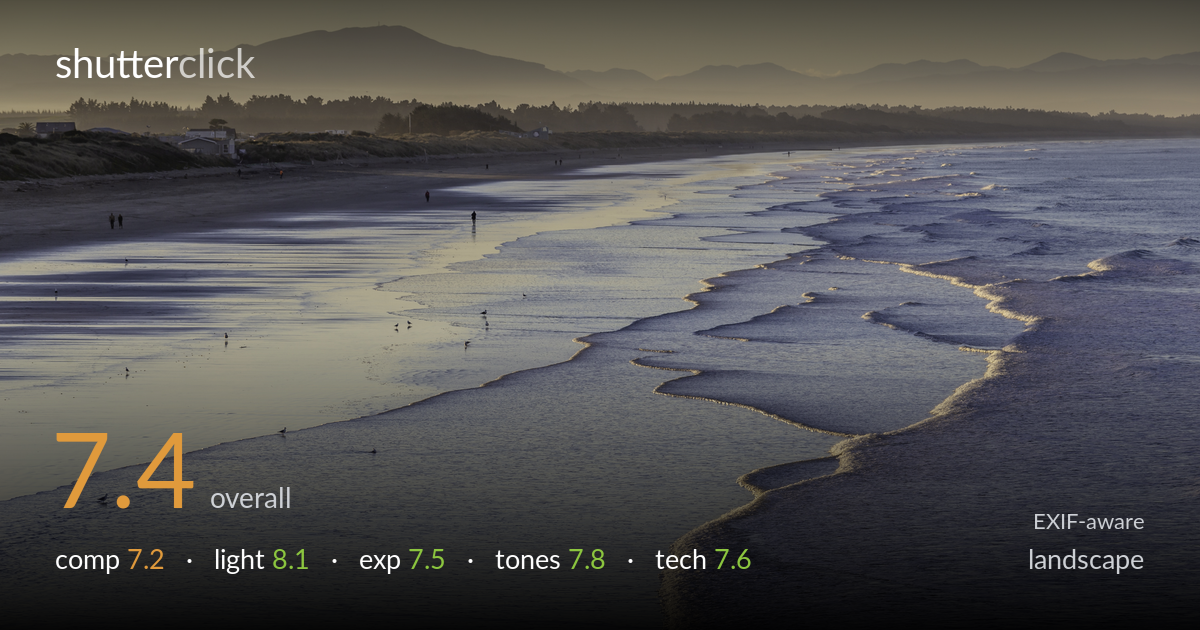
Backlit coastal surf
Photo by Michal Klajban

| Focal length | 173 mm |
| Aperture | f / 10.0 |
| Shutter | 1/160 s |
| ISO | ISO 100 |
| Exp. comp. | 0.0 EV |
| Shot at | 16:43 · May 24, 2019 |
A quietly accomplished coastal study that uses a telephoto compression to stack the curving surf line, dune, treeline, and hazy mountains into clean layers. The low backlight catching each breaking wave is the strongest element, threading silver highlights through the frame. What holds it back is a slightly indecisive composition: the S-curve of the shoreline carries the eye, but the foreground sits a touch empty and the human and bird figures are too small to register as anchors. The mountain horizon is interesting yet pushed high. A stronger near-foreground element would give the depth a clearer entry point.
The telephoto compression works well, stacking the surf line, dune, distant trees, and hazy ranges into readable bands. The sinuous shoreline acts as a natural leading line drawing the eye toward the upper-left figures and mountain. The horizon sits high, which suits the emphasis on the wave pattern, though it leaves the foreground water comparatively empty and slightly flat. The walkers and feeding birds are pleasant grace notes but too small to anchor the frame. A nearer foreground element or a slightly lower angle would strengthen the entry into the scene.
Low-angle backlight is the picture's real asset, rimming every breaking wave with bright silver and giving the wet sand a luminous sheen. The haze softens the mountains into receding tonal layers, building atmospheric depth that telephoto landscapes thrive on. Direction is well chosen — raking across the surf rather than flattening it — and the warmth in the dunes and sky reads as genuine late-day light. The only limit is that the foreground water receives flatter, cooler light, so the drama concentrates in the central wave band rather than across the whole frame.
Exposure is handled with restraint. The bright specular highlights along the wave crests are held just short of clipping, preserving texture in the foam, while shadow areas in the dunes and treeline retain detail. The histogram appears to favour the brighter midtones, which suits the airy, hazy mood. The pale sky near the horizon edges toward washout but stays within recoverable range. Overall it reads as a deliberate, controlled rendering rather than an accident, with no meaningful loss at either end of the tonal scale.
A gentle warm-to-cool gradient carries the mood — amber haze in the sky and dunes shifting to cooler blues in the foreground water. White balance leans warm, appropriate for the hour. Saturation is held back, letting the pastel atmosphere breathe rather than forcing colour. The tonal separation between the stacked mountain layers is the standout, a subtle gradation of greys and mauves. The foreground water is slightly muddy where warm and cool overlap, and a touch more contrast there would help it sing alongside the brighter central band.
The 70-200mm at 173mm is an ideal choice for this compressed coastal scene, pulling the distant ranges forward and stacking the surf bands tightly. f/10 gives ample depth of field for the layered subject, and at this distance everything from the near water to the mountains sits acceptably sharp. ISO 100 keeps the image clean with no visible noise, exactly right for a tripod-friendly, well-lit scene. The 1/160s shutter freezes the slow-rolling surf adequately, though it is fast enough that the waves read as crisp lines rather than softened motion — a creative choice either way. Focus appears accurately placed across the mid-frame. The only refinement worth considering is whether a smaller aperture was needed at all; f/8 would have been equally sharp with marginally less diffraction softening, though the difference here is negligible. Execution is technically sound throughout, with settings that match the subject and conditions sensibly.
What would elevate it
Tags
Shot something like this?
Expert photo critique, on demand — scored across six categories, EXIF-aware. Start with 3 free critiques, no credit card.
critique my photo — free