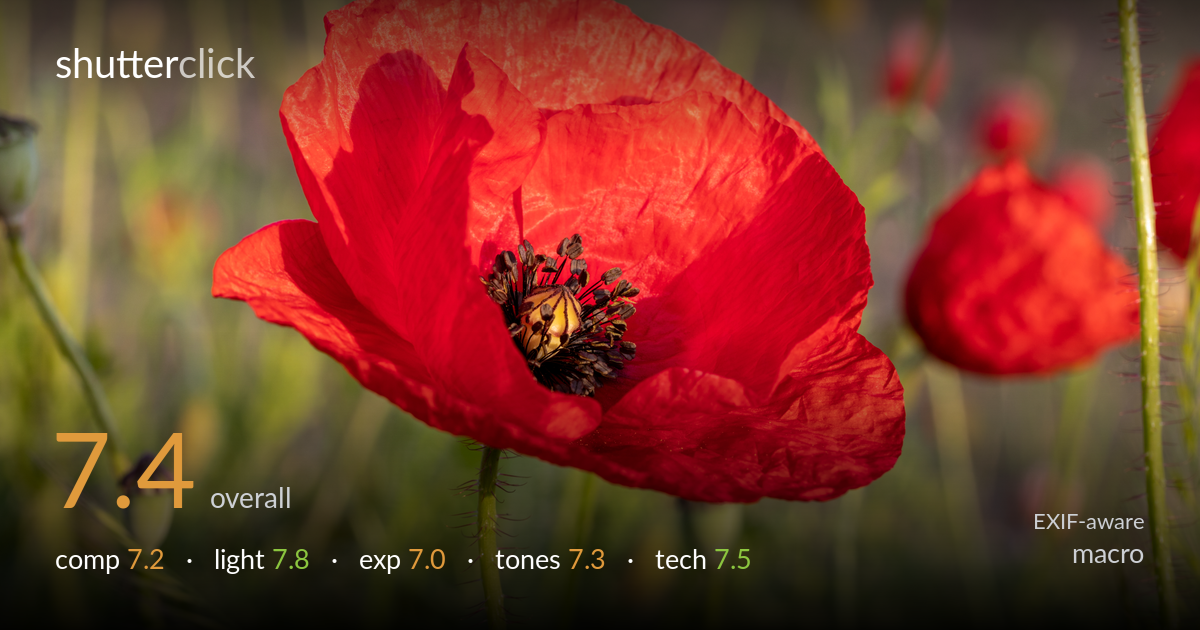
Backlit poppy glowing in the field
Photo by Dietmar Rabich

| Focal length | 105 mm |
| Aperture | f / 11.0 |
| Shutter | 1/50 s |
| ISO | ISO 200 |
| Exp. comp. | 0.0 EV |
| Shot at | 04:52 · Jun 8, 2021 |
A backlit poppy rendered with luminous, translucent petals — the warm rim of light through the crinkled tissue is the image's real strength. The dark stamen cluster anchors the frame and the surrounding poppy field, with its scattered buds and out-of-focus blooms, gives genuine context and depth. What most holds it back is highlight handling: the brightest red petals push toward clipping and lose some of their fine surface texture. The composition is solid but the bloom sits slightly large and central; a touch more breathing room or a stronger diagonal would lift it. Strong, well-observed flower work with room to refine.
The bloom is placed left of centre with the stamen core near the lower middle, which reads naturally and lets the eye travel into the field of buds on the right. The opposing poppy head and seed pod on the right edge balance the weight well and add narrative. The flower fills a lot of frame, though, and the petal edge crowds the top. A fraction more negative space above, or a slightly lower angle to set the bloom against the field, would give the subject more room to breathe.
Low, warm side-back light is the heart of this image — it passes through the petals and makes the red glow from within, while raking across the hairy stem and bud to reveal texture. The directional quality separates the bloom cleanly from the soft background. Shadows in the petal folds add form rather than muddiness. The main limitation is that the same intensity pushing the highlights to glow also threatens the brightest petal faces. Slightly softer or marginally lower-angle light would hold more of that surface detail.
Overall brightness is well judged for a backlit subject, keeping the dark stamen mass legible while letting the petals glow. The strongest reds on the upper petals, however, edge into clipping where saturation and luminance both peak, flattening the tissue-paper texture in those zones. Shadow detail in the flower's throat holds nicely. A third of a stop less exposure, or pulling those red highlights in raw, would recover the crinkle detail without darkening the mood. The histogram is mostly deliberate, just running hot in the reds.
The red-against-green complementary palette is vivid and the warm low light unifies the scene with a golden cast. White balance leans warm, which suits the hour. The reds are intense and largely controlled, though the most saturated petal areas lose tonal separation where they approach clipping. The greens are pleasantly desaturated by the soft focus, keeping attention on the bloom. A slight reduction in red saturation would restore gradation in the brightest petals and let the subtle folds read as form rather than a single flat sheet of colour.
At 105mm and f/11 on the 5D Mark IV, depth of field is sensibly chosen — enough to carry the full bloom and stamen cluster sharp while dissolving the background into smooth, creamy bokeh that isolates the subject cleanly. Focus is placed accurately on the stamen core and the near petal edges, exactly where it needs to be for this kind of flower study. ISO 200 keeps the file clean with no intrusive noise. The one settings tension is shutter speed: 1/50s handheld at this focal length leaves little margin, and any breeze on a poppy stem risks softness — the petals hold up here, but the fine stem hairs hint at the edge of safety. A tripod with a remote release, or 1/200s with a small ISO bump, would lock down critical sharpness and allow focus stacking to extend the in-focus zone across the stamens. Lens choice and aperture are well matched to the subject overall.
What would elevate it
Tags
Shot something like this?
Expert photo critique, on demand — scored across six categories, EXIF-aware. Start with 3 free critiques, no credit card.
critique my photo — free