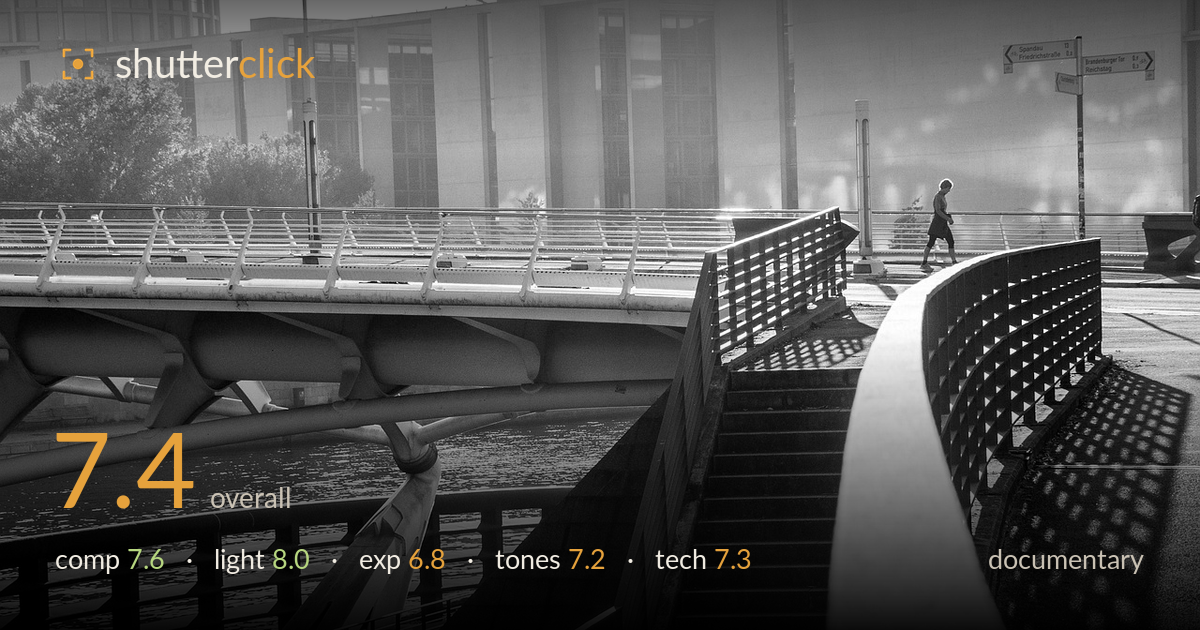
Backlit stairway by the bridge
Photo by wal_172619

No EXIF metadata in this file
Technical analysis based on visual assessment only.
A strong graphic study of urban infrastructure, carried by backlight that turns the perforated railing into a field of scattered light-dots and lends the concrete curves real dimensionality. The lone walking figure at upper right gives scale and a human anchor, though placed small and near the edge it competes weakly against the dominant architectural geometry. The composition leans on converging rails and the sweeping foreground wall to lead the eye, and it mostly works. What most holds it back is the crushed foreground shadow and the atmospheric haze flattening the far buildings — the contrast is dramatic but sacrifices tonal information at both ends.
The frame is built on strong diagonals — the descending stairway, the curved white parapet, and the crossing bridge rail all converge and pull the eye through the scene. The walking figure at upper right supplies scale and a documentary beat, but sits small and close to the edge where it easily gets lost against the architecture. The stairwell going dark at the bottom leaves a heavy, near-empty anchor. A slightly higher vantage or the figure given more room would sharpen the human narrative.
Low, raking backlight is the image's greatest asset. It rims the concrete forms, models the curved parapet with a clean bright edge, and — best of all — throws the perforated railing pattern into a scatter of light spots across the pavement and structure. The haze diffuses the sun into a soft glow behind the buildings, giving atmospheric depth. Direction and timing are well judged for texture and separation. The only cost is the extreme range this hard light creates between lit surfaces and blocked shadow.
Exposure was set to hold the bright highlights and hazy background, which is the right call, but the foreground stairwell and lower shadows have collapsed to near-black with little recoverable detail. The bright parapet edge sits just under clipping and reads well. The haze pushes the upper buildings toward flat, milky highlights that lack punch. This is a defensible high-contrast interpretation, but a touch more shadow lift would preserve the stair structure without softening the drama that makes the frame work.
The black-and-white conversion suits the geometric, light-driven subject well. Mid-tones on the concrete render cleanly and the highlight roll-off on the parapet is controlled. However, the darkest shadows block up rather than retaining gradation, and the hazy upper third sits in a narrow grey band that feels slightly washed. A firmer black point in the walls paired with a gentle recovery of the deepest stair shadows would give the tonal range more spine while keeping the airy background intact.
Focus and sharpness are handled well across the key planes — the near parapet, railing perforations, and stair treads all hold crisp detail, and the depth of field is deep enough to keep the mid-ground bridge and background acceptably sharp, suggesting a stopped-down aperture appropriate to this architectural subject. The perforated shadow pattern is rendered with clean edges, indicating steady handling and a fast enough shutter for a static scene. Noise is well controlled in the mid-tones, though the deepest shadows may hide some grain simply because detail is gone there. The lens choice frames the geometry effectively without obvious distortion on the verticals. The main technical limitation is dynamic range: the scene's contrast exceeds what a single exposure captured cleanly, leaving crushed foreground shadows. Bracketing or shooting to protect shadow detail, then tone-mapping conservatively, would extend the usable range without compromising the crispness already achieved here.
What would elevate it
Tags
Shot something like this?
Expert photo critique, on demand — scored across six categories, EXIF-aware. Start with 3 free critiques, no credit card.
critique my photo — free