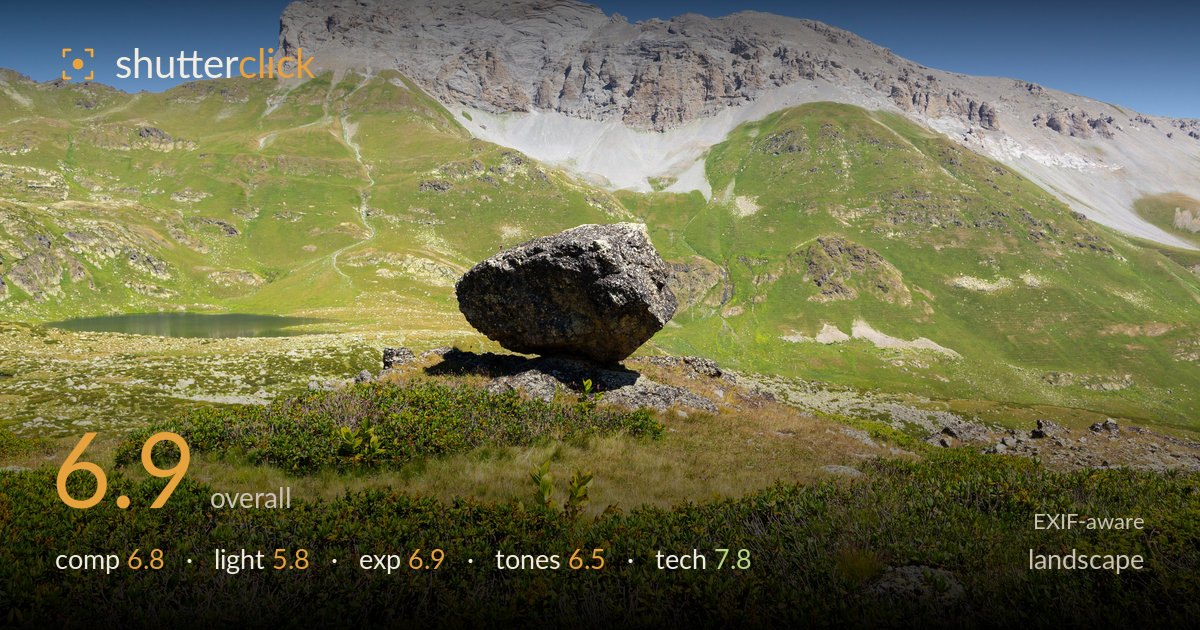
Balanced boulder beneath the summit
Photo by Vyacheslav Argenberg

| Focal length | 17 mm |
| Aperture | f / 7.1 |
| Shutter | 1/250 s |
| ISO | ISO 100 |
| Exp. comp. | 0.0 EV |
| Shot at | 11:06 · Aug 10, 2015 |
A strong natural anchor — the balanced glacial erratic perched on its flat plinth — gives this alpine scene a genuine focal point, and the layering from foreground shrubs to lake to peak reads well. What most holds it back is the light: flat midday sun renders the mountain face high in contrast but low in modelling, and the sky is a featureless gradient of blue. The boulder itself sits slightly too central and low, competing with, rather than leading toward, the summit. Sharpness and depth of field are handled cleanly, and the depth of the composition is the real asset here.
The perched boulder is a natural anchor and the tiered recession — foreground vegetation, tarn, grassy slopes, then the pale summit — builds real depth. Placement is the weak point: the boulder sits almost dead-centre horizontally and low in the frame, so it competes with the peak rather than directing the eye upward. The lake tucked at left is an asset but nearly lost. Offsetting the boulder toward a third, and giving the tarn more room, would tie the layers into a stronger diagonal.
Flat, near-overhead midday sun is the main limitation. It flattens the modelling on the mountain face, leaving the pale rock looking chalky and dimensional cues weak, while the boulder shows a small hard shadow beneath but little sculpting across its own surface. There is no directional raking to reveal the texture of the tundra foreground either. Early or late side light would carve shape into both the summit and the erratic, and warm the cool, high-key rock into something with more presence.
Exposure is well controlled for a bright high-altitude scene. The pale summit rock holds detail without blowing out, and the shadowed underside of the boulder and the darker slopes retain information. The green foreground sits at a healthy midtone. The deep blue sky is dense but not clipped. Overall the histogram looks full and deliberate, with no accidental crushing. If anything the brightest rock faces flirt with the top end; a touch of highlight recovery would secure the finest texture there without compromising the rest.
Colour is clean and believable — the alpine greens are vivid without tipping into oversaturation, and the rock stays neutral. The sky, however, is a very saturated, slightly heavy blue that darkens noticeably toward the top of the frame, hinting at polariser use, and it pulls attention. Overall contrast is a little punchy for the flat light, exaggerating the chalky mountain. Dialling back blue saturation and softening the sky gradient would balance the palette and let the greens and grey rock breathe.
Execution is the strongest aspect. At 17mm on the APS-C body the wide field captures the full sweep from foreground shrubs to summit, and f/7.1 delivers front-to-back sharpness — the near vegetation, the boulder, and the distant ridge all resolve cleanly, which is exactly what this deep composition needs. ISO 100 keeps noise absent and preserves fine detail in the rock and grass. 1/250s is more shutter than a static scene requires but does no harm and guards against any breeze in the foreground plants. Focus appears placed well into the scene, giving good depth of field coverage. The 17-50mm f/2.8 is a capable choice, and stopping down to f/7.1 sits near its sharpness sweet spot. The only refinement worth noting: with a static subject and a tripod, f/8–f/11 with a lower position would extend near-foreground sharpness further and let a closer foreground element anchor the base of the frame. Technically, though, this is well judged.
What would elevate it
Tags
Shot something like this?
Expert photo critique, on demand — scored across six categories, EXIF-aware. Start with 3 free critiques, no credit card.
critique my photo — free