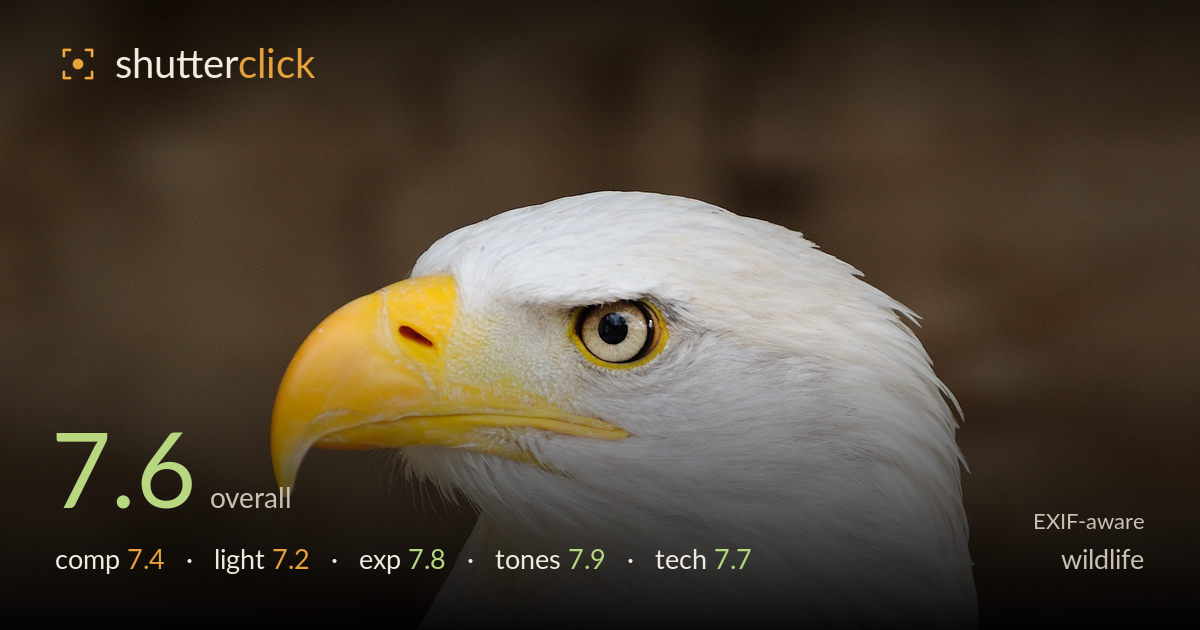
Bald eagle in profile
Photo by Saffron Blaze

| Focal length | 220 mm |
| Aperture | f / 5.6 |
| Shutter | 1/200 s |
| ISO | ISO 400 |
| Exp. comp. | 0.0 EV |
| Shot at | 16:24 · Feb 19, 2012 |
A clean, well-executed head-and-shoulders portrait of a bald eagle with a sharp eye and rich feather detail carrying the frame. The profile pose reads clearly, the yellow beak and white head separate cleanly from a muted, uncluttered backdrop, and colour rendering is faithful. What most holds it back is the framing: the bird sits centred and slightly cramped on the left, leaving generous but empty space behind the head rather than in front of the gaze. The flat, diffuse light also keeps the plumage from gaining dimension. Small adjustments to placement and light quality would lift a competent portrait toward a striking one.
The profile is classic and legible, with the beak and eye reading instantly. But the bird is placed slightly left with the bulk of open space falling behind the head rather than ahead of the gaze, which fights the natural sense of looking-room. The crop also clips the top of the head a touch tightly. A composition that gives more space in the direction the eagle faces, with a hair more headroom, would feel more balanced and let the pose breathe.
The light is soft and even, likely overcast or open shade, which flatters the white head and avoids blown highlights on the bright plumage. The trade-off is dimensionality: the flat, near-frontal quality leaves the dark body feathers reading as a single mass with little modelling, and the catchlight in the eye is faint. Slightly directional side light, or a stronger single catchlight, would carve texture into the feathers and add life to the eye without risking clipped whites.
Exposure is well judged for a difficult subject that pairs bright whites with near-black feathers. The white head retains texture rather than clipping, and the dark body holds enough shadow detail to read individual feathers. Midtones on the beak and facial skin sit naturally. There is a slight tendency for the darkest wing feathers to approach pure black in the lower corners, but nothing critical is lost. A well-controlled tonal range across a wide-contrast subject.
White balance is neutral and believable, with the beak's yellow-orange rendering vividly without oversaturation. The muted brown background is a smart choice, letting the white and black plumage stand out. Contrast is handled well, holding both the bright head and dark body within range. The neutral, slightly warm palette suits the subject. If anything, the background brown is a touch flat and could benefit from marginally more separation in luminance from the darkest feathers.
At 220mm, f/5.6, 1/200s and ISO 400 on the D700, the fundamentals are sound. Focus lands on the eye, which is critically sharp with visible detail in the iris and pupil, and the feather texture across the head and beak is crisp. f/5.6 provides enough depth of field to keep the whole profile acceptably sharp while throwing the background into smooth defocus, aiding subject isolation. 1/200s is adequate for a still, perched bird and shows no motion blur, though it leaves little margin had the eagle moved its head. ISO 400 keeps noise negligible, well within the D700's comfortable range, and preserves clean shadow detail in the dark plumage. The 220mm reach compresses the scene nicely and yields a flattering perspective on the head. The main technical caution is the modest shutter speed for a wildlife subject prone to sudden movement; a faster speed with a small ISO bump would have added safety margin at no visible cost.
What would elevate it
Tags
Shot something like this?
Expert photo critique, on demand — scored across six categories, EXIF-aware. Start with 3 free critiques, no credit card.
critique my photo — free