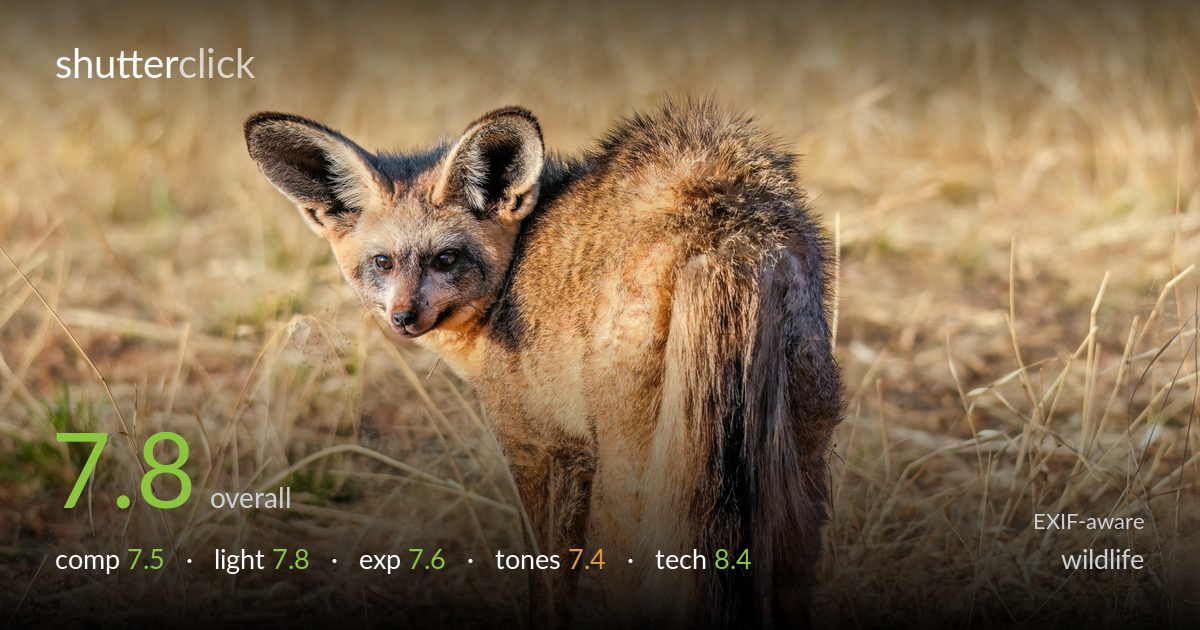
Bat-eared fox glancing back
Photo by Giles Laurent

| Focal length | 670 mm |
| Aperture | f / 8.0 |
| Shutter | 1/1000 s |
| ISO | ISO 400 |
| Exp. comp. | 0.0 EV |
| Shot at | 15:35 · Aug 1, 2025 |
A bat-eared fox caught mid-turn with the body away and the head swinging back over the shoulder — a posture that builds tension and showcases those signature ears beautifully. The low warm light rims the fur and the eye carries detail and a faint catchlight. What most holds the shot back is the busy, same-tone grass that nearly camouflages the animal, and a few crossing stalks that clutter the foreground. Exposure on the dark face is right at the edge of muddiness. A cleaner background angle and a touch more separation would lift a strong frame to an excellent one.
The over-the-shoulder turn is the strength here — it positions the head and ears toward the left third while the body fills the right, giving the frame a satisfying diagonal flow. Plenty of room sits in the direction of gaze. The dry grass, however, blends so closely with the fur that the animal nearly merges with its surroundings, and the bright stalk slicing across the lower right pulls the eye. A lower shooting angle or a gap in the grass behind the head would have carved out cleaner separation.
Low-angle warm light, likely early or late in the day, rakes across the fur and lights the rim of the ears and back, giving the coat texture and dimension. The face is turned slightly into shadow, which keeps the eye readable while preserving form. The overall warmth suits the savanna setting. The trade-off is that the same directional light renders the dry grass and the fox in nearly identical tone, flattening the subject-background distinction that good light could otherwise have helped exploit.
Exposure is well controlled for a tricky subject — the bright grass holds highlight detail without clipping, and ISO 400 keeps the file clean. The darker fur of the face and tail tips sits near the bottom of the range, where detail starts to thin, but the critical eye retains information. A small lift of exposure compensation would have opened the shadowed muzzle, though it risked pushing the grass highlights. The current balance is a defensible compromise for the backlit warm conditions.
The palette is monochromatic warm — amber grass, tan fur, dark accents — which is authentic to the habitat but leaves the subject and ground sharing one tonal family, reducing pop. White balance leans warm, appropriate for the golden light. Contrast is moderate; the deep tones in the tail and ear edges anchor the frame. A subtle cooling of the background or a slight selective contrast boost on the fox would have given it more visual lift against the uniform field.
The 670mm reach on the FE 400-800mm at f/8 is exactly the right tool for a wary animal at distance, and the execution backs it up. Focus lands on the near eye, which is sharp and detailed — the priority in any wildlife frame — and the ear texture confirms the focal plane is well placed. 1/1000s comfortably freezes the head turn with no motion smear, and ISO 400 keeps noise negligible while preserving fine fur detail. f/8 is near the lens's wide-open at this focal length, so depth of field is shallow enough to soften the background nicely while still holding the whole face acceptably sharp. The long focal length compresses the scene and renders pleasant background blur. The only technical limitation is the background itself — separation depends on tonal difference the grass doesn't provide — but that is a positioning issue, not a settings one. A solid, disciplined capture across the board.
What would elevate it
Tags
Shot something like this?
Expert photo critique, on demand — scored across six categories, EXIF-aware. Start with 3 free critiques, no credit card.
critique my photo — free