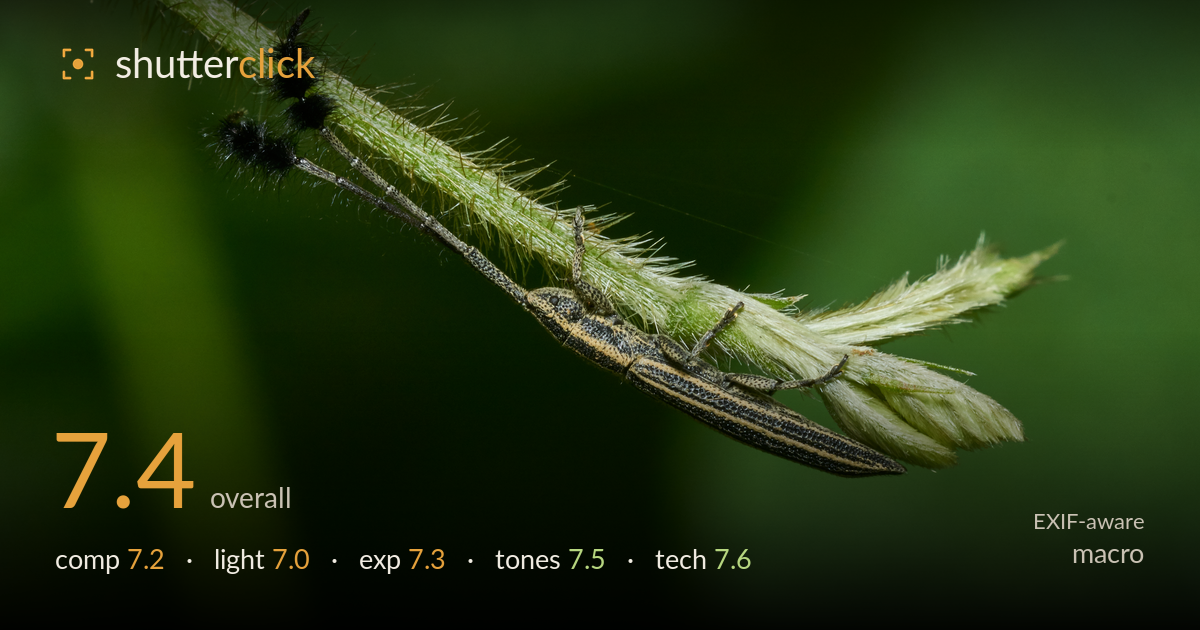
Beetle clinging beneath a grass stem
Photo by Jeevan Jose, Kerala, India

| Focal length | 150 mm |
| Aperture | f / 14.0 |
| Shutter | 1/250 s |
| ISO | ISO 250 |
| Exp. comp. | 0.0 EV |
| Shot at | 11:31 · May 23, 2017 |
A longhorn beetle clinging beneath a hairy grass stem, rendered with excellent fine detail on the hairs and the striped elytra. The strongest asset is the crisp bristle rendering catching backlight, set against a clean green wash. What holds it back is the diagonal composition running corner to corner with the beetle pushed low and slightly cramped against the seed head, and the fact that the beetle's dark, striped body reads as a busy silhouette against shadow rather than being cleanly lit. Focus lands well on the head and body but softens over the seed head. A touch more separation and light on the beetle itself would elevate it.
The strong stem diagonal from top-left gives the frame movement and the fuzzy seed head at right anchors the descent nicely. The beetle hanging underneath makes an appealing narrative. But the subject sits low and quite far right, leaving a large expanse of empty green through the left and lower third that isn't doing enough work. The head and antennae, the most expressive elements, crowd the frame's centre while the beetle's abdomen nearly touches the seed head. A slightly wider berth around the insect would let it breathe.
Backlight rakes across the stem hairs beautifully, lighting each bristle into a bright halo, and that is the image's best light. The problem is the beetle itself sits largely in shadow, its dark striped body reading as a murky mass with little modelling to reveal form or the eye. The green background is evenly and softly lit, which keeps it clean. A fill from the front or a reflector bounced onto the beetle would have shaped its body and lifted the head detail without losing the rim glow on the hairs.
Exposure is well judged for the highlights — the bright backlit hairs stay just short of clipping and retain texture, which is the harder call here. The green background holds midtone density without muddiness. The beetle's darker body loses some shadow separation, sitting close to the low end of the histogram, so the stripe pattern is harder to read than it should be. A third of a stop more, or shadow lifting in post, would recover that detail. Overall a deliberate, controlled exposure with no accidental drift.
The green palette is handled cleanly, with the darker background greens giving way to the yellow-green of the lit seed head — a pleasant tonal range that isolates the subject. White balance looks neutral to slightly cool, appropriate for the shaded foliage. The beetle's ochre stripes provide a warm counterpoint that keeps the frame from feeling monochromatic. Saturation is restrained and natural. The main limitation is the compressed contrast within the beetle's dark body, where shadow tones merge; a little mid-tone separation there would help the patterning stand out.
The 150mm f/2.8 macro at f/14 is a sound choice for this subject, giving depth enough to carry the beetle's body and the near stem in acceptable focus while the background dissolves cleanly. Focus is placed accurately on the head and thorax, and the bristle detail confirms sharp capture there, though the plane falls off across the abdomen and the seed head goes soft — expected at this magnification, but a focus stack of three or four frames would have held the whole insect and the seed head crisp. ISO 250 keeps noise negligible, and 1/250s was fast enough to freeze the static subject, though at macro scale even slight breeze or handshake can blur, so a tripod or flash would add insurance. The stopped-down aperture flirts with diffraction softening at f/14 on this sensor; f/11 might have held marginally more bite. Solid, disciplined execution overall — the settings match the intent well.
What would elevate it
Tags
Shot something like this?
Expert photo critique, on demand — scored across six categories, EXIF-aware. Start with 3 free critiques, no credit card.
critique my photo — free