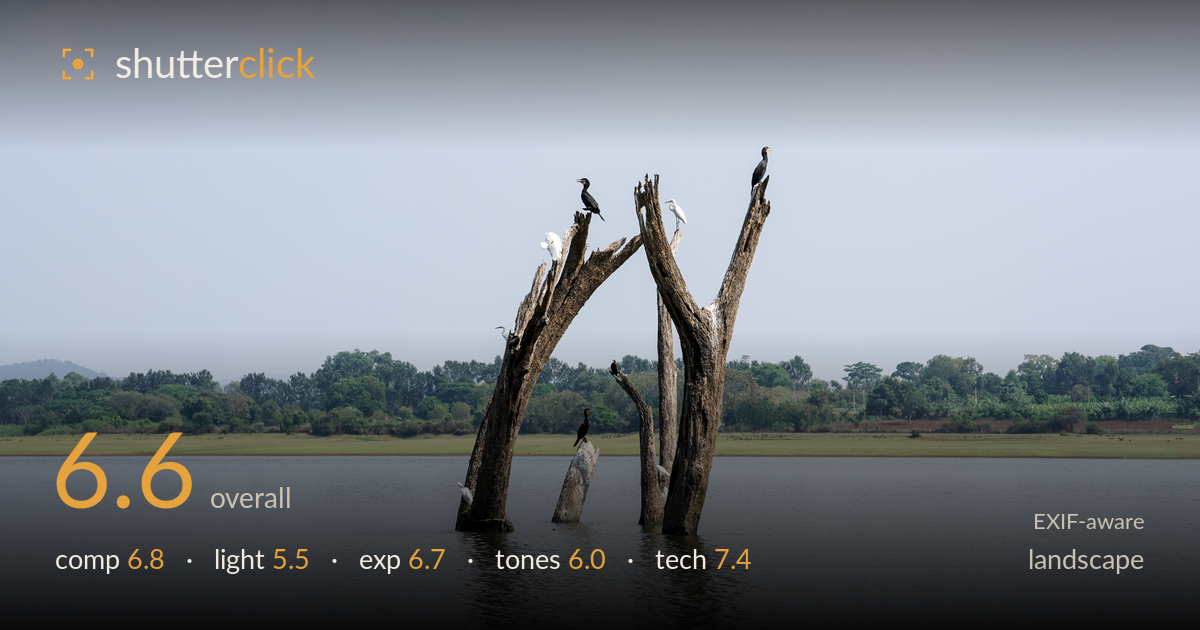
Birds on dead trees in the lake
Photo by This Photo was taken by Timothy A. Gonsalves. Feel free to use my photos, but pl

| Focal length | 84 mm |
| Aperture | f / 11.0 |
| Shutter | 1/160 s |
| ISO | ISO 100 |
| Exp. comp. | 0.0 EV |
| Shot at | 15:04 · Apr 26, 2022 |
A quietly compelling wildlife-in-landscape scene: dead trees rising from calm water, populated by cormorants and egrets in a natural gathering that reads as a small ecosystem. The central cluster of trunks makes a strong graphic anchor, and the mix of black and white birds gives visual rhythm. What most holds it back is the flat, hazy midday light — it drains contrast from the water and sky and mutes the whole frame. The horizon band of trees is competent but static. Stronger directional light and a tighter, more deliberate arrangement of the frame would lift this from documentation to atmosphere.
The tangle of dead trunks forms a solid central subject, and placing the horizon low in the upper third leaves the water to breathe below. The spread of birds across different perches builds a natural, layered arrangement the eye can wander through. The forked trunk on the right anchors well. Centring the whole cluster is a little safe, though, and the large expanse of empty water at the bottom does little work — it reads as dead space rather than deliberate negative space. A slightly higher perch or offset placement would give more tension.
This is the frame's main limitation. The light is flat, hazy midday illumination with no clear direction, so the trunks and birds lack the modelling that would separate them from the dull water and pale sky. The white egrets hold their form, but the dark cormorants flatten into silhouettes without catchlights or feather detail. Overcast haze also robs the scene of any golden warmth. Early morning or late afternoon side light would rake across the weathered wood, reveal texture, and give the water some sparkle and dimension.
Exposure is technically sound and well controlled. Highlights in the bright sky and white egrets are held without clipping, and the darker cormorants retain enough shape against the water. The overall brightness sits a touch high, which flattens the water into a uniform grey, but there is no accidental crushing of shadows or blown detail. The histogram appears to sit in a safe middle range. A slight negative exposure compensation would have deepened the water and given the frame a little more contrast punch to offset the hazy conditions.
The palette is muted and cool — pale blue-grey sky, olive-green tree line, and a flat brownish water tone. White balance reads neutral, perhaps a hair cool, which suits the haze but adds to the overall listlessness. Contrast is low across the frame, and saturation is subdued, so nothing sings. The weathered wood has some pleasant earthy tones that could be drawn out. A gentle contrast lift and a touch of warmth in the midtones would give the scene more presence without looking artificial.
Settings are well chosen for the situation. At 84mm on the 70-300 with f/11, depth of field comfortably covers the trunks and the distant tree line, keeping everything acceptably sharp front to back — sensible for a scene this deep. ISO 100 keeps noise absent, and 1/160s is more than enough to freeze the near-static perched birds and gentle ripples. Focus appears accurately placed on the central trunks and birds, and the birds hold reasonable detail where light allows. The one caveat is that f/11 on this sensor may introduce mild diffraction softening; f/8 would have delivered a hair more critical sharpness with ample depth still. The 70-300 is a reasonable choice, though the framing sits at the wide end of its range — a tighter crop on the tree cluster would have used the lens's reach and reduced the empty water. Overall this is clean, competent capture with no significant execution errors.
What would elevate it
Tags
Shot something like this?
Expert photo critique, on demand — scored across six categories, EXIF-aware. Start with 3 free critiques, no credit card.
critique my photo — free