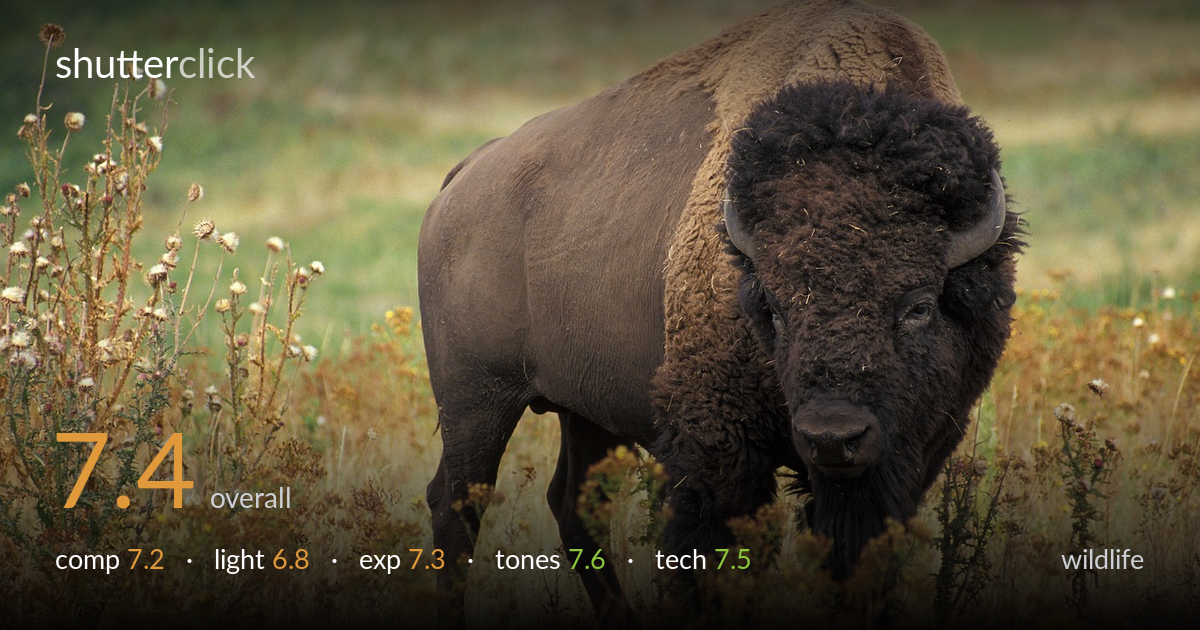
Bison facing down on the prairie
Photo by WikiImages

No EXIF metadata in this file
Technical analysis based on visual assessment only.
A commanding three-quarter portrait of a bison meeting the lens head-on, with direct eye contact that anchors the frame and an autumn prairie that situates the animal in its habitat. The dried thistle and prairie grass build a strong sense of place, and the warm palette flatters the subject. What most holds it back is the light: a flat, overcast quality that softens the modelling of the massive shoulder hump and shoulders. The animal sits slightly high and right, leaving heavy foreground grass that, while atmospheric, crowds the lower face. A cleaner light direction and a touch more breathing room would elevate it.
The bison fills the right two-thirds while the soft green hillside and dried thistle on the left provide context and balance — a workable environmental wildlife frame. The head turned toward the camera carries the eye, and the diagonal of the body leads back into the scene. The placement is slightly high in the frame, and the foreground grass crowds the lower jaw and beard, partially obscuring the face. A touch more space below the chin and a marginally lower angle would give the head cleaner separation from the busy understory.
Soft, diffused overcast light keeps detail across the dark fur and avoids blown highlights on the pale hump, which is a genuine advantage with a subject this tonally extreme. The trade-off is flatness: the modelling on the shoulder hump and the depth of the woolly cape read shallow, and the face lacks a catchlight in the eye, costing some life and connection. Low side light or a break of late-afternoon sun would have raked across the fur, revealing texture and giving the form three-dimensional presence.
Exposure is handled well for a difficult subject — the near-black head and cape retain detail in the fur and horns without crushing, while the lighter hump and the surrounding grasses hold highlight information. The midtones of the prairie sit comfortably, and there is no obvious clipping. The dark face edges toward the lower end of the histogram but stays readable. A slight lift of the shadow region in the cape would recover a little more texture in the densest fur without flattening the overall contrast that gives the animal weight.
The warm autumn palette is the image's strongest asset — golden dried grasses, russet thistle, and the muted green hillside create a cohesive, seasonal mood that complements the bison's brown coat. White balance reads natural and slightly warm, suiting the subject. Contrast is moderate and appropriate to the soft light, with pleasant tonal gradation across the hump. The greens behind are a touch muddy where they meet the grass, but the overall harmony is convincing. Saturation is restrained and believable rather than pushed.
Focus lands accurately on the head and eye, which is the essential plane for wildlife, and the fur detail across the face and horns is crisply rendered. Depth of field is judged well: the subject is sharp front to back while the background hillside falls into a soft wash that separates the animal from the scene. No motion blur is evident, suggesting a shutter speed sufficient for the static pose. Noise is well controlled and the file looks clean. The main technical compromise is the foreground vegetation crossing in front of the lower face — shooting from a slightly lower or shifted position would have let the grass fall away from the jaw rather than tangling with it. A longer focal length or a step to one side would also have thinned the busy understory immediately around the head, giving the face the clean separation the rest of the frame nearly achieves.
What would elevate it
Tags
Shot something like this?
Expert photo critique, on demand — scored across six categories, EXIF-aware. Start with 3 free critiques, no credit card.
critique my photo — free