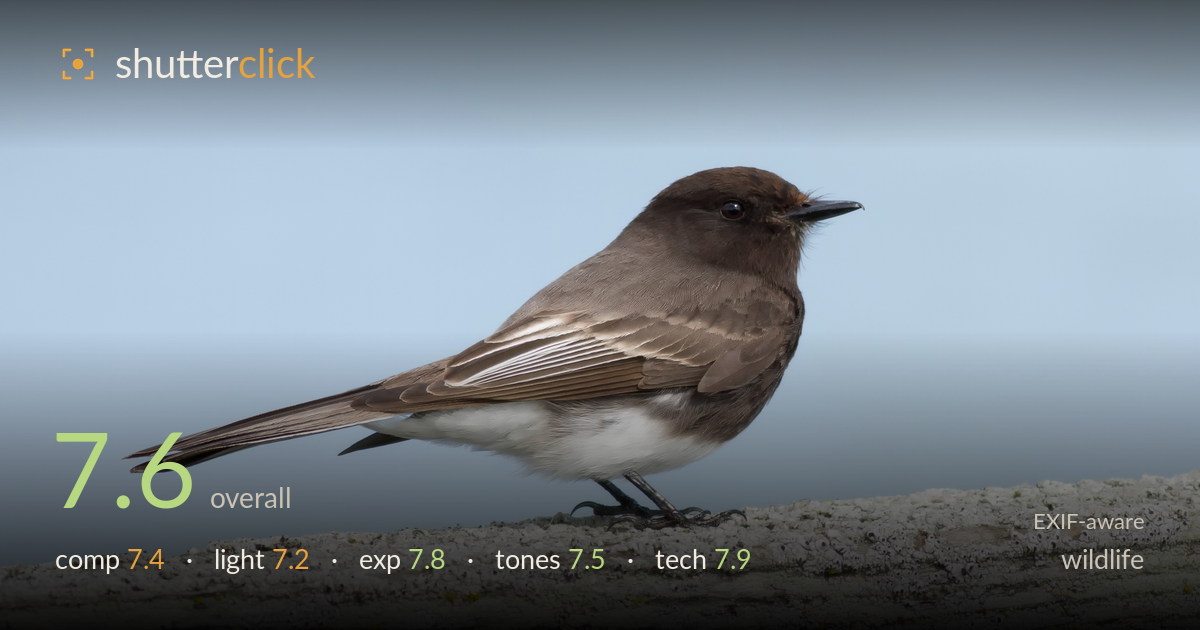
Black phoebe on a lichened perch
Photo by Frank Schulenburg

| Focal length | 560 mm |
| Aperture | f / 8.0 |
| Shutter | 1/200 s |
| ISO | ISO 100 |
| Exp. comp. | 0.0 EV |
| Shot at | 10:52 · Mar 1, 2014 |
A clean, well-executed profile of a black phoebe with a tack-sharp eye and excellent feather detail — the core requirements of a strong bird portrait are met. The lichen-covered perch adds textural interest and grounds the bird in a natural setting. What holds the frame back most is the flat, slightly overcast light, which leaves the dark plumage lacking dimensional modeling, and a composition that places the bird high with the perch dominating the lower third. The soft, even light keeps the whites tame and shadows open, but a touch more directionality would lift this from documentary-clean to memorable.
The side-on profile is textbook clean and the bird reads clearly against the sky. Placement in the upper-left with the beak facing into open space gives the gaze room, which works. The diagonal perch adds a pleasing line, but it occupies a large share of the lower frame and competes for attention. The bird sits fairly high, leaving generous empty sky above while the perch crowds the base. A slightly lower framing that balanced sky and perch more evenly, or a bit more breathing room ahead of the beak, would tighten the arrangement.
The light is soft and diffuse, likely an overcast or hazy sky, which evenly illuminates the bird and avoids harsh shadow or blown highlights on the white belly. That safety comes at a cost: the dark brown plumage stays flat and lacks the directional modeling that would separate feather groups and give the form dimension. The catchlight in the eye is present but small. A lower, raking side light near golden hour would carve out texture in the dark upperparts and add warmth to an otherwise cool, even scene.
Exposure is well judged for a tricky subject — the white belly retains detail without clipping, and the dark brown upperparts hold feather structure rather than blocking up into black. The eye and beak are properly rendered. The sky sits as a clean, bright backdrop without pulling the bird into underexposure. ISO 100 keeps everything clean. If anything the overall rendering is slightly flat, but that stems from the light rather than the exposure decision, which appears deliberate and accurate across a demanding tonal range.
The palette is restrained and natural: cool blue-grey sky, warm browns in the plumage, and the pale mottled lichen of the perch. White balance is neutral and believable. Contrast is on the gentle side, matching the soft light, which keeps the browns readable but a little muted. The whites of the belly are clean without a colour cast. A modest contrast lift and slight clarity boost on the plumage would give the feathers more separation and punch without disturbing the honest, natural colour rendering.
The 400mm f/5.6L with a 1.4x extender at 560mm and f/8 is a sensible combination that delivers the reach and sharpness this small subject needs. Focus lands precisely on the eye, and feather detail from the crown through the wing coverts is crisp — the extender hasn't visibly degraded resolution here. f/8 is a smart choice, giving enough depth of field to keep the whole bird sharp while throwing the sky into clean nothingness. ISO 100 yields a noise-free file. The one genuine concern is the 1/200s shutter: for a perched, still bird on a solid support at this focal length it worked, but 1/200 at 560mm is right at the edge of what handholding or a still subject can forgive. Any head twitch or camera shake would have softened the frame, so this was a slightly risky margin. A faster shutter, traded against the low ISO headroom available, would have been the safer call for such a long effective focal length.
What would elevate it
Tags
Shot something like this?
Expert photo critique, on demand — scored across six categories, EXIF-aware. Start with 3 free critiques, no credit card.
critique my photo — free