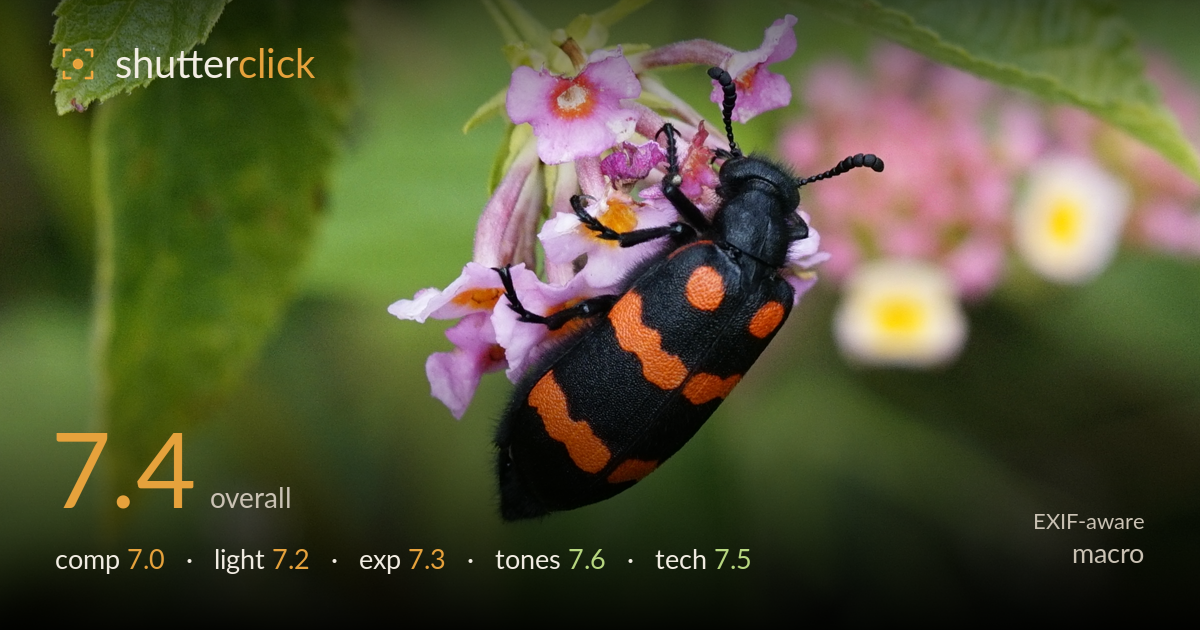
Blister beetle on pink lantana
Photo by Vengolis

| Focal length | 150 mm |
| Aperture | f / 6.3 |
| Shutter | 1/250 s |
| ISO | ISO 400 |
| Exp. comp. | 0.0 EV |
| Shot at | 14:57 · Sep 11, 2016 |
A striking subject rendered with strong colour and clean separation. The blister beetle's black-and-orange pattern reads unmistakably against the pink lantana, and the diagonal orientation carries the eye down the frame. The blurred lantana blooms at right add welcome context and a secondary colour echo. What most holds it back is focus placement: the sharpest plane sits on the elytra mid-body while the head, antennae, and eye — the natural anchor in insect macro — fall slightly soft. Framing is a touch loose on the left, and the light is even but flat, muting texture on the shell.
The diagonal descent of the beetle down the flower cluster gives the frame good energy, and placing the subject just right of centre works against the softer lantana blooms on the right. The overhanging leaves at top add a natural frame. However, the left third carries a large expanse of undifferentiated green that adds little, and the beetle's head crowds toward the flowers rather than sitting in cleaner space. A tighter horizontal crop from the left would concentrate attention and improve balance.
The light is soft, diffuse, and even — likely overcast or shaded — which avoids blown highlights on the glossy black shell and keeps the orange saturated. That evenness is safe but flat: the elytra reads as a solid mass without the raking highlight that would define its domed, sculptural form. A hint of directional light or a small reflector would carve out the shell's curvature and give the pitted texture more presence. Highlights on the flowers are controlled and pleasant.
Exposure is well judged for a difficult subject — a glossy black body against bright pink and green. The blacks retain shape without crushing into an empty void, and the orange markings hold their detail rather than clipping. The pink flowers sit comfortably below the highlight ceiling. Only the brightest white lantana at right edges toward the top of the range, but nothing distracting. The overall midtone placement is deliberate and confident, with no accidental underexposure.
Colour is the strongest element here. The orange-on-black against pink and green forms a lively complementary interplay, and white balance looks accurate — the greens read natural without a yellow or cyan cast. Saturation is punchy but stops short of garish, and the pink lantana holds subtle gradation. The black shell shows a faint sheen that keeps it from going dead. Contrast is well controlled across the frame, letting both the vivid subject and the muted background coexist without either overpowering.
The 150mm f/2.8 macro is well suited to this working distance, and f/6.3 is a reasonable compromise for depth of field on an insect of this size — though the trade-off shows. The plane of sharpness sits squarely on the mid-body elytra, where the pitted texture and orange markings are crisp, but the head, eye, and antennae drift soft. In insect macro the eye and head are the natural focal anchor, so nudging focus forward would strengthen the shot considerably. At this magnification, stopping down another stop or two to f/9–f/11 would extend the plane to cover both head and shell, at the cost of a slightly faster ISO or slower shutter. 1/250s at ISO 400 froze the stationary subject cleanly with no visible motion blur, and noise is a non-issue at this ISO. A focus-stacked pair would resolve the depth limitation entirely if the subject cooperates.
What would elevate it
Tags
Shot something like this?
Expert photo critique, on demand — scored across six categories, EXIF-aware. Start with 3 free critiques, no credit card.
critique my photo — free