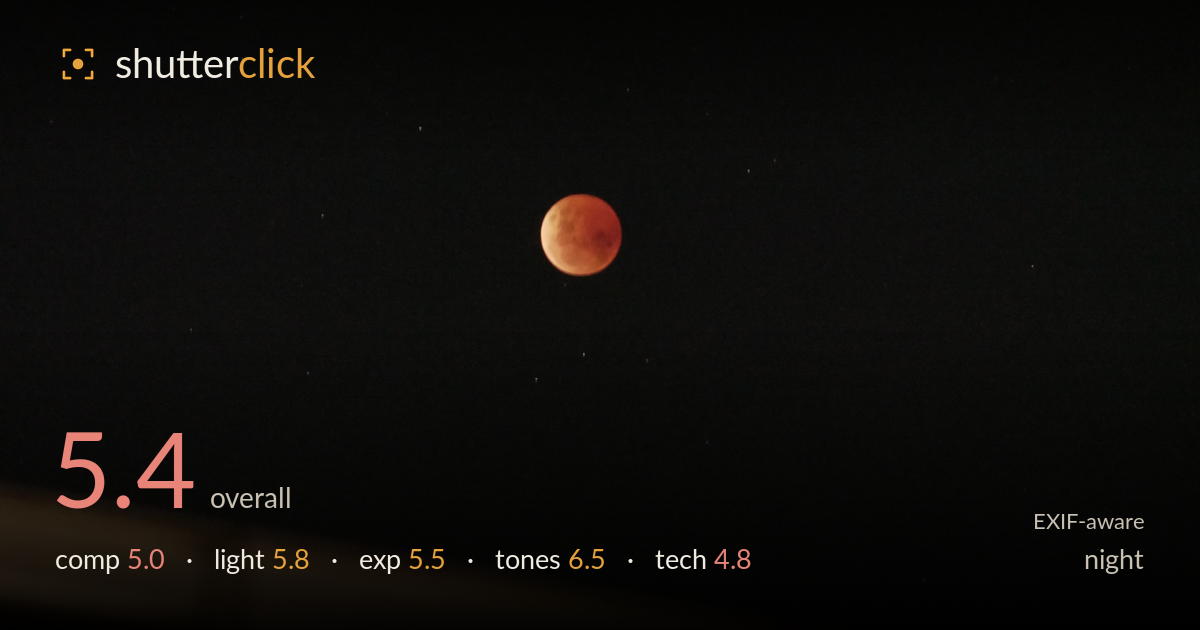
Blood moon over a guardrail

| Focal length | 0 mm |
| Aperture | f / 0.0 |
| Shutter | 1/2 s |
| ISO | ISO 6400 |
| Exp. comp. | 0.0 EV |
| Shot at | 20:27 · Nov 8, 2022 |
A lunar eclipse captured with genuine colour in the moon's copper-red disc, but the framing and softness hold the image back. The moon sits close to centre in a vast expanse of black sky, and the out-of-focus guardrail intruding along the bottom adds distraction rather than useful foreground. The moon itself is soft, lacking the crisp lunar detail this subject rewards. The blood-moon tone is the standout, and a few faint stars register. With a sharper focus, more reach, and a deliberate compositional relationship between moon and horizon, this has real potential.
The moon floats just above centre in an ocean of empty black, and the negative space isn't working hard enough to justify itself — the disc is small and the frame feels underfilled. The blurred guardrail slicing across the bottom is an ambiguous element: too soft to read as intentional foreground, too prominent to ignore. A composition either committing to the moon large and isolated, or building a real earth-sky relationship with a sharp foreground element, would carry far more intent than this in-between placement.
Light here is entirely the subject's own — the eclipsed moon glowing its characteristic reddish-brown as it passes through Earth's shadow. That colour is the payoff of the event and it registers clearly. The surrounding sky is genuinely dark, which is appropriate and keeps the moon isolated. There's little to shape beyond the moon itself, and the faint stars add modest atmosphere. Timing to catch totality's colour was the right call, and it delivered the one thing this frame is really about.
The 1/2s exposure at ISO 6400 brightened the dim eclipsed moon enough to hold its colour, a reasonable trade given how little light a blood moon emits. But at that shutter the moon's own motion softens its edges, and the surface detail is muddy rather than crisp. The sky is deep black with no clipping, and the moon avoids blowing out. A shorter exposure with a wider aperture or slightly higher gain might have frozen more detail while keeping the tone.
The strongest element. The moon's coppery red-orange gradient — deeper at the shadowed edge, warmer toward the still-lit rim — is rendered convincingly and reads as a genuine eclipse rather than an over-processed effect. The surrounding black is clean and neutral, giving the warm disc room to sing. Contrast between subject and sky is stark and effective. The only tonal note is the slightly greyed, low-contrast guardrail at the base, which lacks the tonal depth the rest of the frame carries.
The EXIF is incomplete — 0mm and f/0.0 suggest a manual or adapted lens the body couldn't report, common with astro rigs. What's clear is a 1/2s exposure at ISO 6400. For a handheld or lightly supported shot of the moon this is a difficult combination: half a second is long enough that the moon's apparent motion, plus any tripod or mirror vibration, blurs the fine crater detail this subject depends on. The moon reads soft, and the eye can't land on sharp structure. The high ISO keeps noise present in the sky, though the deep black hides most of it. For lunar work, more focal length to fill the frame and a much shorter shutter — even at the cost of pushing ISO further or opening up — would freeze the disc. Solid support and a remote or timer release are essential at these speeds. The colour was captured well; the sharpness is what needs the most attention.
What would elevate it
Tags
Shot something like this?
Expert photo critique, on demand — scored across six categories, EXIF-aware. Start with 3 free critiques, no credit card.
critique my photo — free