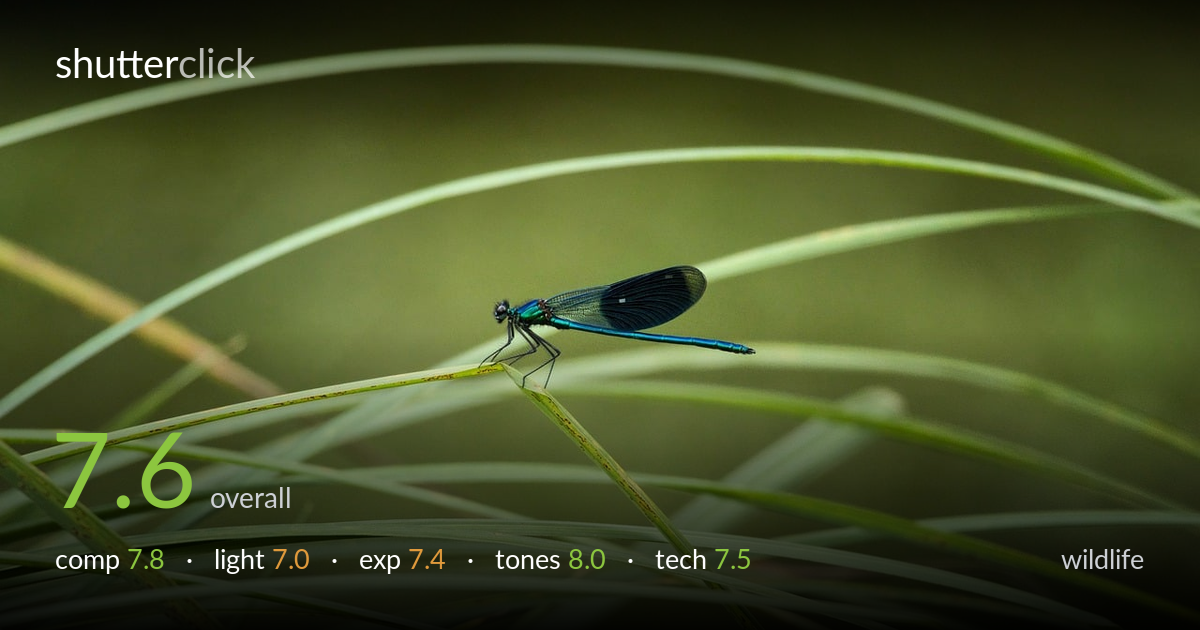
Blue damselfly on arcing grass
Photo by wvrede

No EXIF metadata in this file
Technical analysis based on visual assessment only.
A banded demoiselle rendered with strong colour and a genuinely elegant supporting structure — the arcing grass blades sweep through the frame and lead the eye toward the subject. The iridescent blue-green body pops cleanly against the muted green field. What most holds it back is the focal plane: the head and thorax sit slightly softer than the abdomen, and the wing tip and eye lack the bite a tack-sharp wildlife frame demands. The subject sits a touch low and central. Light is flat, doing little to model the metallic sheen. A sharper eye and more directional light would elevate this from pleasing to striking.
The sweeping arcs of grass are the strongest element here, framing the damselfly and carrying the eye in from the edges with real grace. The insect sits roughly along a thirds line horizontally, which works, though it reads slightly low and the perch blade runs almost flat across the lower middle. The dense tangle of grass in the bottom third competes a little for attention. The clean, dark upper-left negative space balances the busier foreground well and gives the subject room to breathe.
The light is soft and even, characteristic of overcast or shaded conditions, which avoids blown highlights on the iridescent body but also flattens it. A damselfly's appeal lies in its metallic sheen, and that sheen only ignites under directional light raking across the wings and abdomen. Here the colour reads more as flat pigment than living iridescence. The diffuse light does keep the green background smooth and free of distracting hotspots, and shadow detail in the grass tangle holds well.
Exposure is well controlled across a tricky tonal range. The dark wings retain detail without crushing to black, and the bright green grasses avoid clipping despite their luminance. The midtones of the background sit at a pleasing, slightly moody level that keeps the subject forward. The blue abdomen holds its saturation without blowing out. If anything, opening up a fraction would lift detail in the darker thorax and head region, where the body shadow merges a little too readily into the dim eye and legs.
The colour relationship is the photo's quiet strength — the cool metallic blue-green of the damselfly set against a deep, desaturated forest-green field creates a harmonious, almost monochromatic palette with one vivid accent. White balance reads accurate and natural. The background's tonal gradient, from near-black upper left to lighter lower right, adds depth. Contrast is judged well, neither muddy nor harsh. The iridescent body shows good colour separation across blue, teal and bronze, the most engaging tonal note in an otherwise restrained frame.
Depth of field is shallow and largely well placed, but the critical plane has landed on the abdomen rather than the head and eye. In wildlife and macro work the eye must be the sharpest point, and here it sits marginally soft while the bright blue tail tip carries the crispest detail. The wing venation resolves nicely where it crosses the focal plane, suggesting a capable lens and steady handling. Noise is well controlled and the background blur is smooth and creamy, free of distracting bokeh artifacts. The shutter clearly froze the subject, no motion blur is evident. Stopping down a stop would have pulled the entire insect — head to tail — into acceptable focus given how parallel the body sits to the sensor, a worthwhile trade against the already pleasing background separation. Focusing precisely on the eye, or focus-stacking two frames, would resolve the single most limiting issue. Overall execution is competent and clean.
What would elevate it
Tags
Shot something like this?
Expert photo critique, on demand — scored across six categories, EXIF-aware. Start with 3 free critiques, no credit card.
critique my photo — free